Startups often face the “experience paradox”. They need seasoned developers but suffer from severe budget constraints. In 2026, most founders will have to find creative solutions to overcome this paradox. So, where do you find mobile app developers to realize your idea without breaking the bank?
As a software development company, MindK often has to hire mobile app developers for US clients. Important nuances range from understanding the key qualities of a great developer to navigating the local employment laws and taking care of IP ownership, double taxation, and confidentiality. They also include onboarding new team members, managing the project and risks, communicating across time zones, code review and testing protocols, setting the right KPIs and tracking performance, retaining key talent, as well as integrating AI into the delivery process without compromising quality and security.
All of this seems overwhelming, so let’s break it into bite-sized steps. We’ll guide you through battle-tested and lesser-known strategies to help you build a mobile app development team that delivers reliably and quickly.
Table of contents:
- What does a mobile dev team look like in the age of AI?
- Where to find mobile app developers?
- How much does it cost to hire an app developer?
- How to hire mobile app developers
- How to evaluate vendors (if you’re not a software engineer)
- #1 Search for potential partners
- #2 Check each company’s portfolio
- #3 Read customer reviews
- #4 Contact the company’s representatives
- #5 Demand a transparent delivery plan
- #6 Assess their quality & release safety system
- #7 Inquire into their App Store readiness workflows
- #8 Investigate the security baseline
- #9 Cut through the hype around AI-enabled delivery
- How to navigate the legal aspects of international hiring?
What does a mobile dev team look like in the age of AI?
A small team can now do more than ever before (as long as it has the right experience and the right controls). For most MVP apps, where the goal is to validate the direction quickly, the setup we recommend in 2026 is a “two-core-role” team:
1. One senior engineer (Solution Architect) as the primary builder. They are responsible for:
- Architecture decisions (what to build now vs later)
- Implementation (features, integrations, edge cases)
- Technical risk management (security basics, performance budgets, stability)
- Keeping the codebase structured, so the product can scale later without a rewrite.
A Solution architect uses AI to accelerate scaffolding and repetitive implementation, debugging assistance (faster root-cause exploration), documentation drafts (decisions, architecture notes), test scaffolding and checklists (with human review).
2. A part-time Proxy Product Owner who’s responsible for:
- Turning business goals into clear backlog items and acceptance criteria.
- Controlling scope to prevent feature creep.
- Documenting decisions and trade-offs so nothing is lost in meetings,
- Ensuring the team is always working on the highest-impact slice next
- Maintaining stakeholder alignment with short, regular updates.
A Proxy PA uses AI to turn raw notes into structured requirements and acceptance criteria, summarize decisions and open questions, draft user flows and edge-case lists for review, as well as prepare stakeholder-ready weekly summaries.
All other roles on the project (design, DevOps, QA) are fractional. They can be brought in at the right moment without putting 10+ people on payroll before the product even proves itself.
- Product Designer establishes key flows, visual direction, and reusable UI patterns early on.
The Solution Architect can implement UI quickly with AI help, but a designer is still valuable for usability, clarity, accessibility, and consistency. Later in development, a designer may refine high-traffic screens and UX friction points based on real user feedback.
The trick is timing: bring design in early enough to avoid rework, then use it surgically.
- DevOps and release support
You don’t need a full-time DevOps person for many MVPs, but you do need reliable builds, versioning, and environments, basic monitoring/crash reporting, and a repeatable release process.
- Quality Assurance
This fractional role might be needed to design a lightweight test strategy and release checklist up front. They implement targeted regression testing on key flows before releases, ROI-driven test automation, and device/OS sanity checks for your target market.
Many of these tasks can be accelerated with AI, but “what actually blocks a release” should remain a human decision.
An AI-enabled team works using the time-tested Scrum approach with two-week iterations and regular demos. Decisions are documented quickly, so there’s no ambiguity later. AI accelerates the “paperwork” and repetition while humans approve scope and acceptance criteria, architecture decisions, critical business logic, and release readiness.
Quality is enforced by gates that include basic automated checks (linting/build/test where relevant), manual verification of critical flows, release checklist (permissions, analytics events, error handling, edge cases), and a staged rollout/hotfix plan.
Store-readiness isn’t an afterthought. A small team can still get stuck if app-store requirements or disclosures are mishandled. The lean approach works when store submission prep is treated as part of delivery, not a last-minute scramble.
| AI accelerates | Humans are responsible for |
| Turning meeting notes into structured summaries, decisions, and action items | Confirming what was decided, resolving ambiguities, and ensuring stakeholder alignment and sign-off. |
| Drafting epics, user stories, and acceptance criteria from product goals. | Defining scope boundaries, prioritizing work, and approving acceptance criteria before the build starts. |
| Rapid synthesis of market and competitor research into briefs. | Validating relevance and correctness, deciding what changes the roadmap, and documenting assumptions |
| Producing initial user flows, edge-case lists, and validation checklists. | Choosing the MVP slice, confirming critical paths, and ensuring edge cases align with business risk. |
| Generating scaffolding code, repetitive UI wiring, and boilerplate integrations. | Owning architecture, reviewing generated code, ensuring maintainability, and preventing long-term technical debt. |
| Drafting API contracts, data models, and integration outlines. | Deciding domain boundaries, validating security/privacy implications, and ensuring compatibility with existing systems. |
| Suggesting implementations for common patterns (auth flows, caching, error handling). | Making final design choices, verifying correctness in the app context, and enforcing consistency across the codebase. |
| Assisting in debugging by proposing hypotheses and likely root causes. | Reproducing issues, validating root cause, implementing fixes safely, and preventing regressions. |
| Drafting unit tests and proposing test scenarios from requirements. | Defining what must be tested, deciding what blocks a release, and ensuring coverage matches user and business risk. |
| Generating documentation drafts (architecture notes, setup steps, release notes). | Ensuring docs are accurate, keeping them aligned with reality, and deciding what needs to be communicated to stakeholders. |
| Creating release checklists and suggesting rollout steps. | Owning release readiness, performing final verification, and deciding rollout strategy and rollback criteria. |
| Automating routine project artifacts (status summaries, changelogs, backlog grooming suggestions). | Owning delivery commitments, communicating trade-offs, and keeping scope changes explicit and agreed. |
| Assisting with CI/CD configuration drafts and environment setup steps. | Approving pipeline design, enforcing quality gates, protecting secrets, and ensuring reproducible builds. |
| Proposing non-functional requirement wording (performance, reliability, security). | Setting targets that match the business, validating feasibility, and ensuring they are enforced during delivery. |
| Identifying potential privacy/store-compliance impacts from feature descriptions and SDK usage. | Making final compliance decisions, ensuring disclosures are accurate, and managing store submission readiness end-to-end. |
Where to find mobile app developers?
There are many ways to find the right experts for your project. Each has its pros and cons.
Freelancer platforms and marketplaces
Examples: Upwork, Freelancer.com, Guru.com, Toptal, Lemon.io, Fiverr, PeoplePerHour.
Freelancers are a good option for part-time jobs and founders with limited budgets. After posting your offer on sites like Upwork, you will receive bids from freelancers. Review each proposal carefully and select the candidate that best fits your requirements and budget. Checking their portfolio, client feedback, and ratings will help you make the right decision.
Finding freelance app developers is easy. On the flip side, how can you be sure of hiring a reliable, qualified specialist? The quality of work and ethics varies greatly among freelancers. There are many cases of people juggling too many clients or disappearing in the middle of a project.
This is where platforms like Lemon.io and Toptal come to the rescue. They claim to provide a list of pre-vetted candidates with proven qualifications. Such platforms use AI tools and HR managers to check technical skills and evaluate developer experience.
However, vetting platforms aren’t always transparent about the skills or the hiring speed. Likewise, they can’t guarantee a successful project completion. So, research any platform or freelancer before committing to work.
Pros:
✔️ Cost-effectiveness. Hiring freelancers is cheaper compared to in-house developers. Vetting and bidding platforms typically charge a flat fee or a % of the freelancer’s earnings. Some have subscriptions for businesses that frequently hire mobile application developers.
✔️ Global talent pool. Connecting with developers worldwide increases the chance of finding the right expertise, especially for niche skills.
✔️ Flexibility and speed. Hiring freelancers is quick and almost effortless. Pick a candidate and get started. If something goes wrong and you are not satisfied with the services provided, you can hire another developer just as fast.
✔️ Pre-vetted engineers. You can never be 100% sure of the app developer’s skills. However, freelance platforms claim to have a rigorous vetting process to reduce the risk.
Cons:
❌ Varied quality of work. A large pool of freelancers is both a blessing and a curse. Skill levels vary significantly so it’s important to carefully vet freelance developers.
❌Less control. Many of our clients complained of freelancers who juggle multiple projects and rush to deliver results. You have to make sure freelancers prioritize your project and can meet the deadlines.
❌ Unreliability. When working with freelance specialists, you risk being left alone with an unfinished project. While not all freelancers are untrustworthy, it’s wise to choose reputable platforms and start small.
❌ Confidentiality issues. In addition to communication barriers, hiring freelancers is the most risky option when it comes to IP rights and keeping secrets. So, remember to do all the paperwork.
Job boards to hire mobile app developers in-house
Examples: Indeed, Glassdoor, AngelList, Dice.com, Stack Overflow Jobs, Levels.fyi.
Most companies that hire full-time employees post job openings on platforms like Indeed or Glassdoor. This provides a number of benefits. It’s easier to manage and communicate if the entire mobile development team works in one office. Even with remote employees, founders feel in control over the team and the results they produce.
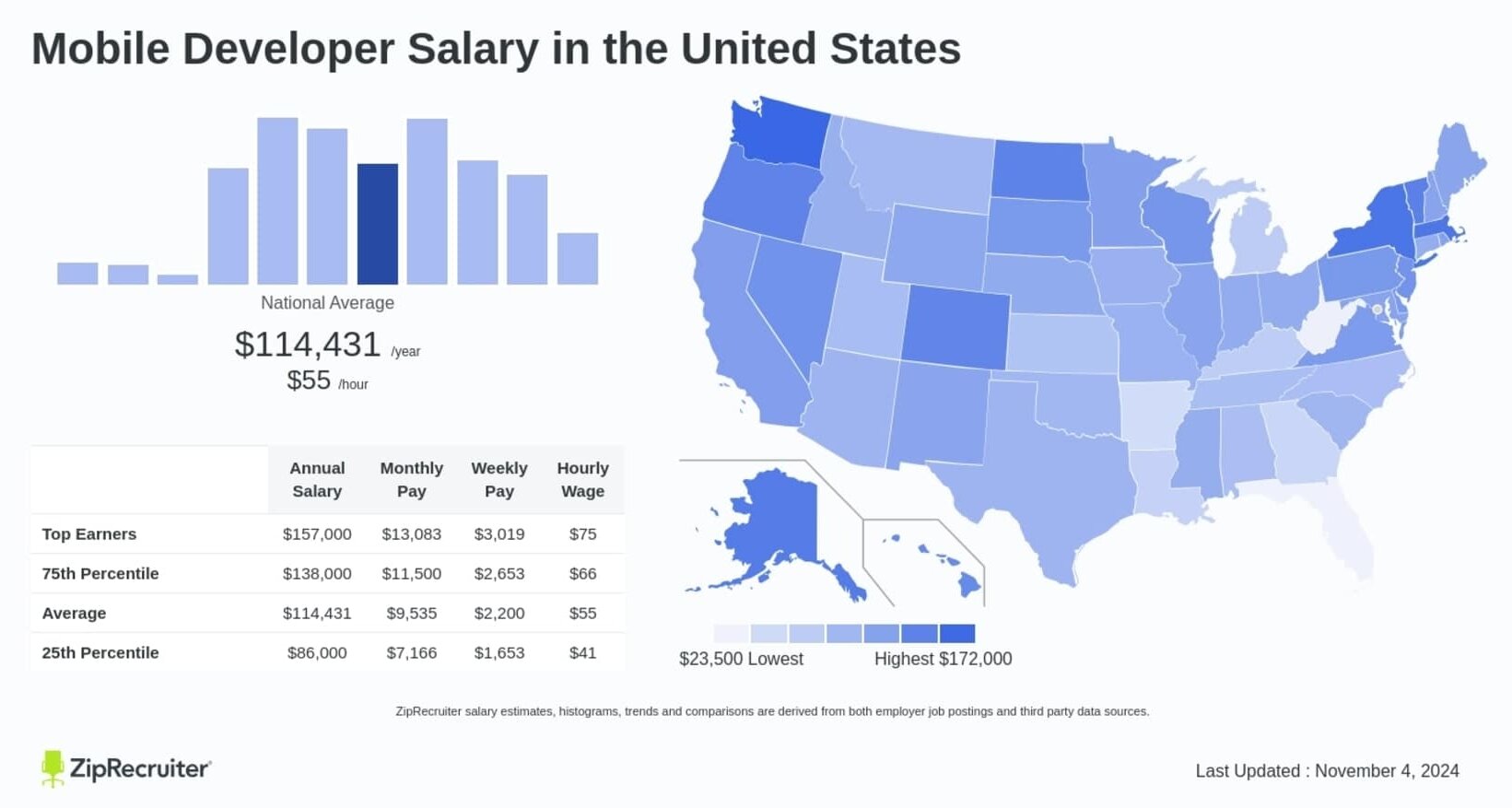
Going for in-house developers isn’t cheap, however. According to ZipRecruiter, the average mobile app developer salary in San Francisco is $134,819 a year vs $67,500 for Prague. Apart from paying a salary, you must also factor in the cost of insurance, paid vacations, dental plans, sick leave, free coffee, gym, and other benefits.
Pros:
✔️ No cultural barriers. When searching for in-house employees, you are more likely to find someone who shares your startup’s values and attitudes. This might prevent misunderstandings and communication issues.
✔️ Seamless team collaboration. When everyone’s in one office, you’re likely to have better productivity and team relationships (except for the rare cases of office drama).
✔️ More control. You directly manage recruitment, interviews, and selection. With a mobile development team under one roof, it’s easier to monitor progress and resolve issues.
Cons:
❌ High salaries. The average mobile developer in the US earns $114,431 a year, which may be too expensive for some companies. We’ll talk more about salaries below.
❌ Additional expenses. Besides salary, factor in other expenses like taxes, employee benefits, office rent, and utility bills. Those perks can account for 25% to 40% of the employee’s salary. And don’t forget about hidden recruitment and training costs.
❌ Time-consuming. Few startup founders enjoy going through dozens of interviews after sifting through hundreds of CVs. Even with a well-built recruiting process, the average time-to-hire in the US is 52 days. This is much higher than hiring freelancers or outsourcing mobile app development.
❌ Talent retention difficulties. The average tenure for a mobile developer in the USA is less than a year. Therefore, startups need to be serious about retaining the key in-house staff.
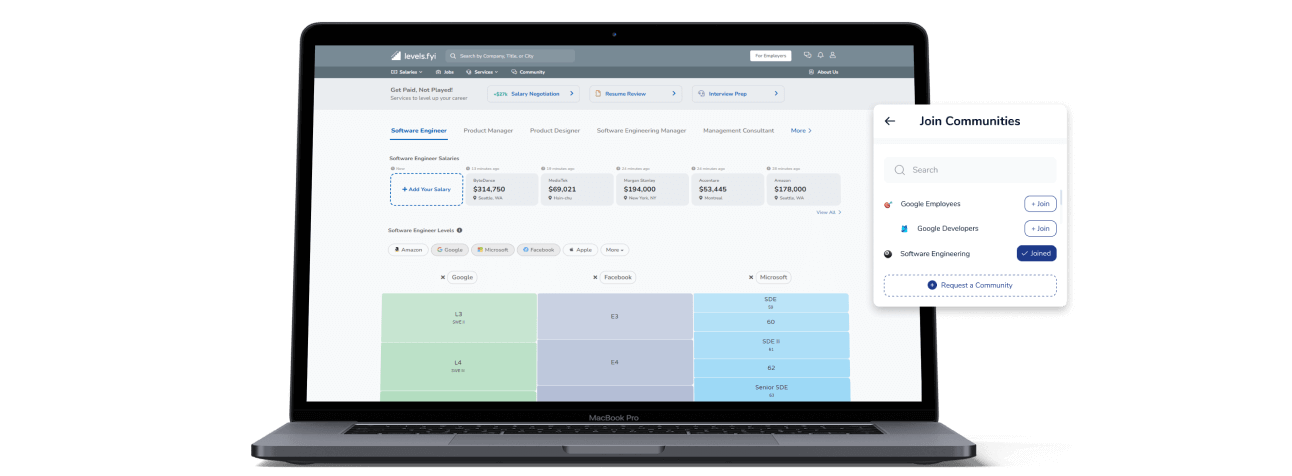
Levels.fyi, a job search platform and community apps on iOS and Android, developed by MindK [case study]
Mobile app development outsourcing companies
A single engineer will never have the same level of experience as a mobile app development company with dozens of successful products in their portfolio. Such agencies usually have all the resources you need to realize your ideas.
Unlike most outsourcing firms, MindK doesn’t look for engineers on the local market at the client’s request. All our app developers available for hire have been working with us for at least 3 years, gaining a stellar reputation on multiple projects. We’re confident of their skills and encourage clients to run additional tech interviews and test assignments.
Another advantage is that you get access to all other specialists you might need on a mobile project – Product Managers, UI/UX Designers, DevOps engineers, QA Specialists, AI/ML engineers, and even web developers. A highly specialized professional may temporarily join a project to solve a challenge much quicker than a generalist.
Mobile development companies offer various engagement models to meet client needs and requirements. Here’s a brief overview.
| Team augmentation | Project outsourcing |
|
|
|
|
|
|
|
|
Pros:
✔️ Development expertise. With dozens of successful projects in various niches, mobile development companies have the experience to tackle complex challenges. This experience helps to secure the success of your product.
✔️ Long-term partnership. Any mobile development outsourcing company worth its salt is serious about reputation. It treats each project with a sense of personal responsibility. Bound by legal agreements, the team will continue the work to ensure a smooth operation after the release.
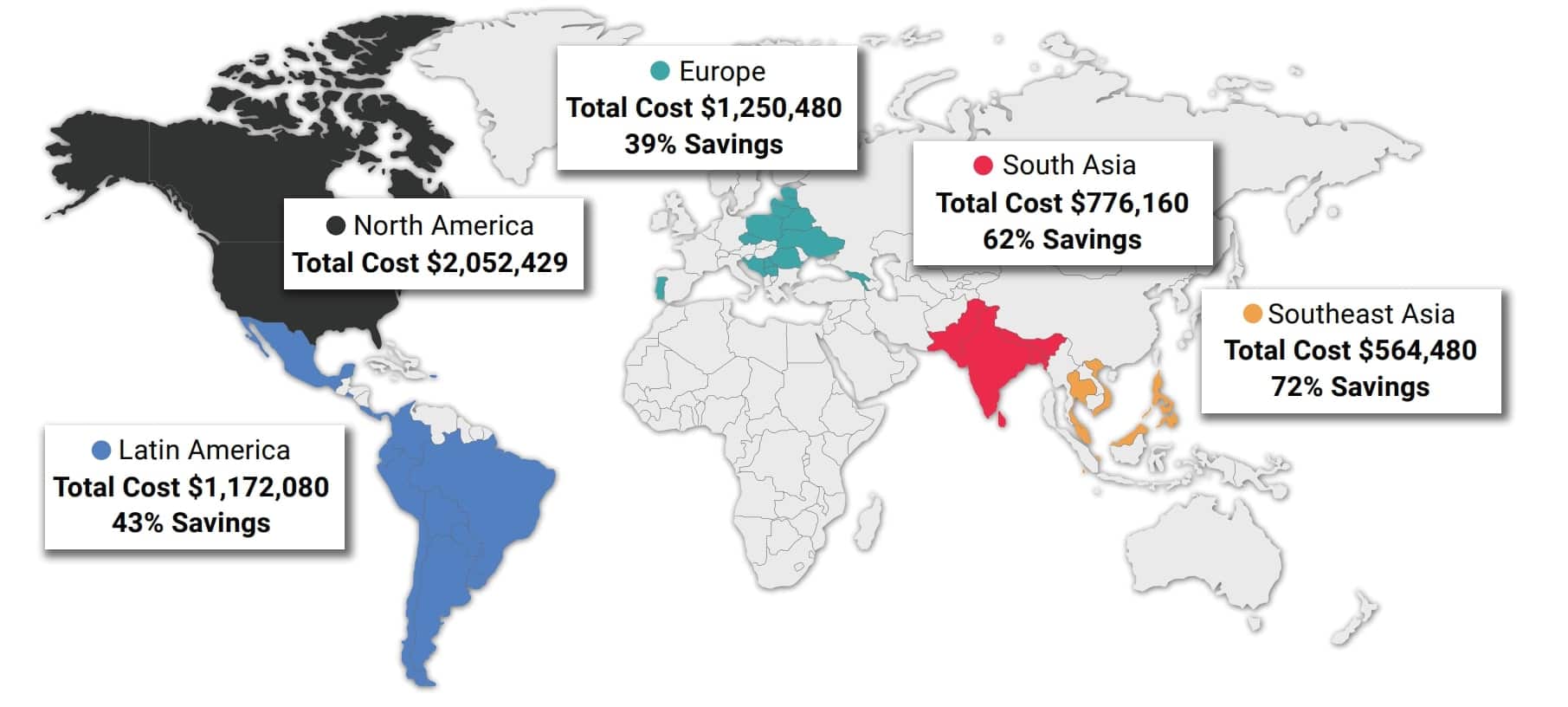
✔️ Cost-savings. Outsourcing companies provide local talent at a lower cost. You can often avoid overheads, hiring, and onboarding costs, paying only for the work that is done. After a project estimate is completed, you’ll understand exactly how much you need to invest in the project.
✔️ Scalable, comprehensive services. At companies like MindK, you can hire a mobile application development team that covers all the project tasks. They range from preparing the system requirements to App Store publishing and support. You can also scale your team up or down with ease.
Cons:
❌ Less control over a team. Many companies filter communication through project managers rather than directly with mobile developers. They might also give you less say in selecting individual team members.
❌ Different time zones. Working across time zones can be a challenge. When the time difference is significant, it may be hard to schedule meetings convenient for everyone.
❌ Cultural barriers. If you work with mobile app developers from overseas, you might face challenges such as language barriers. This may lead to misunderstandings and poor quality.
We’ve detailed how to mitigate these disadvantages in the guide to the top 8 risks in outsourcing software development.

Agency directories and B2B review platforms
Examples: Clutch, DesignRush, GoodFirms, The Manifest, TechReviewer.
Nothing beats a recommendation from a long-time friend or a trusty partner. More than half of all hires come from internal referrals. But what if you don’t have a person you can trust in the industry? B2B directories like Clutch can help you hire a mobile app development company with search and filtering, as well as independently verified reviews and company ratings.
Pros:
✔️Experienced teams. This approach shares most pros and cons with the previous one as long as you do the research, clearly communicate your goals, and sign legally-binding contracts.
✔️Project management. Agencies handle coordination, reducing your managerial burden. Most also have a solid Quality Assurance process in place.
✔️Scalable resources. Working with a mobile development company allows you to adjust team size and expertise as project demands change.
Cons:
❌Less direct control. A client typically has limited influence over individual team members.
❌Potential misalignment. Agencies use a huge variety of methodologies and engagement models which requires thorough research to fit your needs.
❌ Risk of dependency. Ongoing support may tie you to a company. This is one of the risks you can mitigate by specifying knowledge transfer in your contracts. You can also outsource mobile app development to multiple vendors to diversify risks, or have the vendor mentor your new hires.
If you only require basic functionality, a freelance developer might suffice. But if you plan to build an application with complex logic, it’s better to hire a mobile app development company like MindK to make sure you have all the necessary experts.
We use both native and modern cross-platform development frameworks like React Native. In fact, we’ve used these frameworks to build a popular mobile game and an award-winning entertainment app.
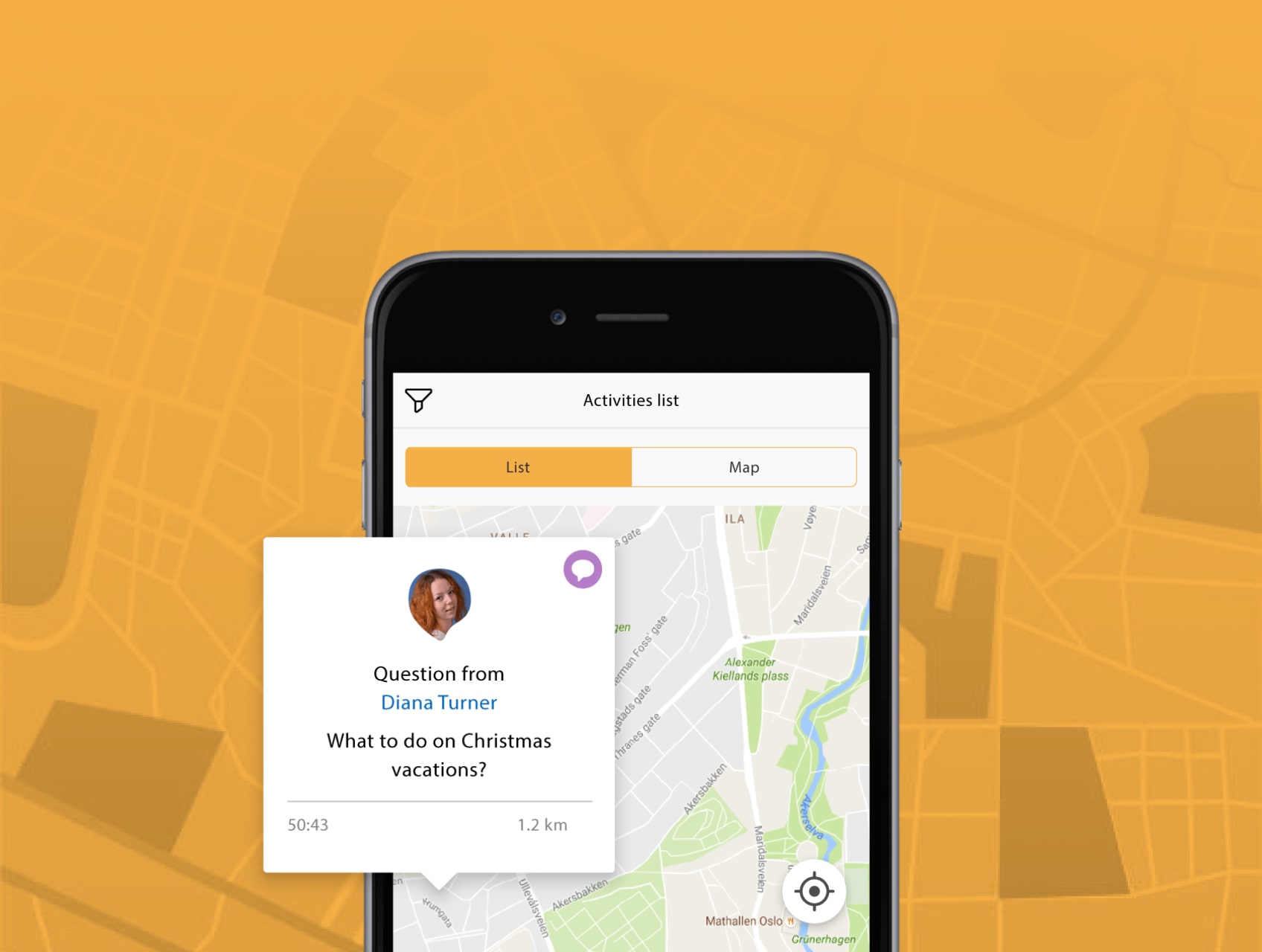
Juvo, a native iOS/Android app developed by MindK [read the case study]
How much does it cost to hire an app developer?
Developer salary is one of the main components that make up the cost of mobile app development. Here are the median annual salaries for mobile engineers around the world, according to the StackOverflow developer survey:
iOS developer salary:
- Swift (worldwide): 74,100 USD
- Swift (USA): 100,265 USD
- Objective-C (worldwide): 72,284 USD
- Objective-C (USA): 123,138 USD
Android developer salary:
- Kotlin (worldwide): 65,000 USD
- Kotlin (USA): 127,151 USD
- Java (worldwide): 61,222 USD
- Java (USA): 117,931 USD
Cross-platform developer salary:
- React Native (worldwide): 63,000 USD
- React Native (USA): 129,348 USD
- Flutter (USA): 98,514 USD
- Kotlin Multiplatform Mobile (worldwide): 65,000 USD
- Kotlin Multiplatform Mobile (USA): 127,151 USD
- Jetpack Compose Multiplatform (USA): 124,464 USD
However, developer rates are a weaker predictor of total cost than they used to be. AI is cutting time spent on routine tasks, while the remaining work increasingly demands senior judgment (architecture, risk trade-offs, release readinredictor oess). Outsourcing benchmarks also show downward pressure on hourly pricing in several regions. A practical way to budget now is by phases:
Discovery (1 to 3 weeks). This phase turns a vague idea into a testable plan. It sets the scope boundaries, prioritizes backlog, defines key flows and early technical decisions. You pay for clarity up front so you avoid expensive rework later.
MVP build (6 to 12 weeks). Instead of staffing a classic multi-role squad from day one, the MVP can often be built by one hands-on senior engineer with a part-time Proxy Product Owner. The budget driver becomes the number of meaningful product decisions and integrations, not the size of the team.
Scale (ongoing). This is where headcount usually rises, but it should rise for the right reasons: parallel workstreams, stronger QA automation, performance work, compliance hardening, and faster release cadence.
If you want a budget that survives contact with reality, ask vendors to price around these three levers: how volatile you expect scope to be, how many external integrations you need, and how frequently you want to release. Those choices drive total delivery cost more than shaving a few dollars off an hourly rate.
 Want to get a custom quote for your mobile application? Tell us more about your project, and we’ll provide you with a free estimate within 24 hours.
How to hire mobile app developers
When hiring a mobile app developer, it’s important to assess their hard and soft skills through the interview process, just as you would with any other professional.
Check hard skills
When it comes to hard skills, both theoretical knowledge and practical experience are important.
The theoretical part usually includes a variety of questions to test the mastery of programming languages, frameworks, and the latest development tools (e.g., SwiftUI, Jetpack Compose) along with the general knowledge of iOS/Android:
- Top interview questions to ask Swift and Objective-C developers.
- Best questions to ask Android and Kotlin engineers.
Technologies change all the time, according to Nika Arkatova, Lead HR at MindK. So, the most difficult thing is to find mobile app developers that are open and capable of learning new languages, frameworks, and libraries. She likes to start the interview by asking engineers about their experience:
- What exactly did they do in the past?
- How many programming languages do they know?
- Do they understand OOP, algorithms, and other fundamentals of computer science?
- Why did they decide to become a developer?
She says: “You want to hire a true geek, a person who disassembled their first PC, the person who dived into their favorite game’s engine to figure how it works. Such a candidate will explore every new technology with great interest. This interest and a flexible mind allows them to learn fast. And this is exactly what you want in a mobile developer.”
Next comes the practical evaluation. If you’re not a tech expert yourself, it’s better to ask an experienced developer to help you prepare the tests. There are many possible ways to organize a practical assessment:
- Portfolio evaluation: review previous projects, apps, and open-source contributions. Focus on code quality, design patterns used, and user experience.
- Technical discussion: dive deep into specific areas of expertise, such as memory management, concurrency, or security in mobile apps.
- Whiteboard challenges: pose algorithmic or architectural problems that require on-the-spot problem-solving.
- Code review: provide candidates with intentionally flawed code, ask them to identify and fix issues.
- Take-home assignments: provide time-sensitive tasks to assess the ability to deliver under pressure and with constraints.
At MindK, we run all candidates through a multi-stage interview and assessment process that filters out 96% of potential candidates. So drop us a line if you’ve got any questions about hiring mobile app developers.
Evaluate soft skills
Should you hire a genius developer who doesn’t gel with your team or a good developer who fits seamlessly into the company’s culture? This is one of the questions you can debate endlessly. However, there’s no doubt that soft skills play a role in project success:
- Effective communication: an engineer should be able to convey ideas clearly in English, both verbally and in writing. Active listening is just as important.
- Time management includes the ability to prioritize tasks and complete critical work without sacrificing quality.
- Mental agility helps developers quickly adapt to new technologies and acquire the necessary skills.
- Accountability and ownership are critical traits we develop in product teams. An engineer should own up to mistakes and learn from them.
Picking the right personality for the project will bring you one step closer to building a high-performing app development team.
How to evaluate mobile app development teams (if you’re not a software engineer)
Focusing on interviews isn’t always useful for non-technical decision-makers who want to hire app developers. You need a mobile development team that will reliably ship, handle app-store compliance, and keep quality stable as the product changes. Here’s how to make sure you get a reliable delivery system:
#1 Search for potential partners
We recommend shortlisting at least 5 promising companies as the right choice for your project:
- Ask for recommendations from your network and business partners. Some of the most successful projects we developed at MindK came from such recommendations.
- Use independent review aggregators like Clutch and DesignRush.
- Research online for companies with relevant expertise.
#2 Check each company’s portfolio
After you’ve picked several candidates, learn more about their experience and expertise. Check recent case studies to see how they work and the results achieved.

Melody, a Tinder-like app we built for a team of Grammy Award-winning producers [read the case study]
#3 Read customer reviews
The number of completed projects can prove the company’s experience. But it’s also useful to read client testimonials. They can show whether a mobile app development company is capable of delivering a high-quality product within time and budget. For instance, here is feedback from one of our clients.
#4 Contact the company
Start by filling out the contact form on the company’s website. Provide a few words about your project requirements, timelines, and anything considered critical to a successful partnership. The process might vary from company to company, but from MindK, expect an answer from the technical team within 24 hours.
After this, the company will schedule a brief introductory call to learn more about your project. You can usually sign a Non-Disclosure Agreement (NDA) to protect the idea before revealing any details. This is the perfect time to learn about the developer’s capabilities. Ask about their experience with similar projects, engineering approaches, and terms of service. Request relevant case studies and references.
#5 Demand a transparent delivery plan
From the very start, the vendor’s delivery plan should include assumptions and dependencies in addition to the feature lists. Reliable teams back these features up with a clear Definition of Done (what “finished” means for a feature), including testing and release readiness.
During the development phase, a reliable vendor will provide you with weekly product demos as opposed to simple status meetings. This is an opportunity to see what changed in the app and what’s ready for review. After each demo, you should also get a short written recap that sums up what shipped, what changed, what’s next, current risks, decisions needed from you. Such a transparent approach allows you to:
- Track progress without reading code.
- Know what’s blocked and why.
- See scope changes early, with options and impact.
Red flags:
- “We’ll update you in Jira” (but no consistent demo cadence).
- Progress reports that are mostly time spent, not value delivered.
- Vague answers like “we’ll handle quality later” or “we’ll do QA at the end.”
#6 Assess their quality & release safety system
A mobile development team doesn’t need to be perfect. It just needs to prove they can ship repeatedly without breaking production (which is not trivial to prove). During negotiations, ask the vendor to show a live walkthrough of their release pipeline. Ask about the checks that would block a release.
How do they ship safely? Do they use staged rollouts? What is their hotfix approach? What’s the rollback plan? How do they handle urgent defects? Ask them which delivery health metrics they track and can report on a monthly basis, such as:
- Lead time for changes
- Change failure rate
- Time to restore service (MTTR)
- Deployment frequency
You don’t need to optimize these on day one. However, if a vendor can’t explain what they are measuring (or why), it often means reliability depends on heroics.
Red flags:
- “We test manually” as the primary strategy for regression prevention.
- “We’ll stabilize after launch.”
- No clear story for hotfixing and rollbacks.
#7 Inquire into their App Store readiness workflows
Mishandling store approval is a major release blocker. Apple provides explicit App Review Guidelines with privacy expectations that can affect approval and continued availability. Google Play, meanwhile, requires completing the Data safety section and keeping it accurate. That’s why a mobile team should have a repeatable way to handle privacy disclosures and submission readiness.
When evaluating vendors, ask who owns App Store submissions and reviews preparation on their side. How do they prevent privacy disclosure mistakes when using third-party SDKs (analytics, attribution, ads, push, crash reporting)? What is their process to keep disclosures accurate as features change?
Red flags:
- “We’ll handle that when we submit.”
- Confident answers with no mention of how SDK data practices are tracked.
- No named owner for the release and submission process.
#8 Investigate the security baseline
Security discussions often get stuck between vague reassurance (“we take security seriously”) and deep technical audits. A practical middle ground is to anchor to an industry baseline and ask how they meet it. Can they show a security checklist for a typical release? Do they perform basic secure design checks early (authentication, storage, network security) and verify them before release?
OWASP MASVS (Mobile Application Security Verification Standard) is a reputable standard you may use as a reference. It’s designed specifically for mobile apps and gives you a structured way to request security coverage without being a security expert.
Red flags:
- No security baseline and no consistent verification habit.
- “Security is the client’s responsibility” (unless you explicitly agreed to that).
- Overconfidence without proof (e.g., “we’re secure by default” but no checklist, no verification approach).
#9 Cut through the hype around AI-enabled delivery
Every vendor is now “using AI.” The question is whether their AI workflows accelerate delivery without making quality and risk worse for you.
During negotiations, it’s recommended to discuss exactly where AI reduces effort: requirements, implementation, tests, documentation, release notes, and so on. What exactly stays human-owned and reviewed? What guardrails do they use to prevent sensitive data exposure? How do they measure whether AI is helping?
A reputable vendor will use AI for drafting and acceleration, but have humans approve requirements and review critical logic. They will also have quality gates still block releases and fully own the security/disclosures.
Red flags:
- “AI writes most of the code” (with no mention of review gates).
- No clear policy about what data is allowed in AI tools.
- Speed claims without measurement (especially if they can’t relate it back to quality or delivery stability).
How to navigate the legal aspects of international hiring?
Many founders hesitate to look for mobile developers abroad due to legal complexities. The process depends heavily on the hiring model you choose.
Direct employment usually requires a deeper understanding of local employment laws. Different countries may have mandatory benefits like health insurance, pensions, or paid leave, which are also important to research.
Those who want to hire a mobile app development company should take the following precautions to mitigate the risks of outsourcing:
- Draft robust contracts. Specify job duties, compensation, intellectual property rights, and confidentiality clauses among the terms and conditions:
- Protect Intellectual Property (IP). The first step is to sign a Non-Disclosure Agreement (NDA) with every new team member. You can also insure your company against IP disputes arising from international hires. Finally, make sure that all work created is legally transferred to your company.
- Ensure tax compliance. Determine if taxes need to be withheld in the employee’s country. Utilize treaties to prevent being taxed in both countries.
- Explore alternative legal structures. These include joint ventures with local firms to share responsibilities and compliance burdens. Another option is to acquire a local company to simplify employment and operational processes.
When handling EU citizen data, adhere to GDPR. If necessary, consult legal experts for advice on country-specific nuances.
Conclusion
As Steve Jobs once said, “Great things in business are never done by one person. They’re done by a team of people.”
There are many ways to find great app developers – from marketplaces for freelancers to B2B review platforms and agency directories. With all of them, it’s important to research your options, look through the case studies and references, as well as protect yourself with legally-binding contracts.
Now that you know how to hire mobile app developers, you’re halfway there. If you need a partner with proven tech skills and industry expertise, MindK fits that bill perfectly. Feel free to drop us a line to arrange a free consultation with our mobile app development team.