Outsourcing SaaS development used to be a staffing decision: fill gaps, move faster, keep costs under control. The market is now full of teams that can produce code quickly. AI-assisted workflows accelerate every stage of the lifecycle, not just implementation, and they amplify both the upside (faster iteration) and the downside (faster mistakes) without the right controls.
When evaluating partners, you need to understand how work moves from idea to production. A strong partner adds an experienced product/architecture layer, rigorous engineering processes, quality gates, and a way to prove progress beyond slide decks.
This guide provides a practical checklist for vetting a SaaS partner, the red flags that predict rework, and the specific artifacts to request in order to avoid the risks of outsourcing.
Table of contents:
- Why outsource SaaS development in 2026?
- What is the best way to outsource SaaS development?
- How to succeed with SaaS outsourcing
- #1 Shortlist potential vendors
- #2 Check vendor reviews
- #3 Learn about the vendor’s approach
- #4 Create a Request for Proposal (RFP)
- #5 Vet their technical skills
- #6 Mitigate risks proactively
- #7 Ask for a Non-Disclosure Agreement (NDA)
- #8 Sign a SaaS outsourcing contract
- #9 Stay involved with your new team
- #10 Define a vendor exit strategy and offboarding plan
Why outsource SaaS development in 2026?
Most companies no longer view outsourcing only as a way to reduce costs (70% in 2020 vs. 34% in 2025, according to Deloitte). The market for SaaS development outsourcing is now driven by several other factors.
Human-led, AI-accelerated delivery
Over the past couple of years, SaaS development companies have experimented relentlessly with LLMs, agents, and all things AI. Everyone knows these tools can code really fast. We also know that AI can create an “illusion of correctness”. Its code may look production-ready on the surface, hiding flawed business logic and critical vulnerabilities.
As a certified AWS partner, MidnK recommends the AI-DLC approach (AI-Driven Development Life Cycle) coined at Amazon and adapted for outsourced SaaS development.
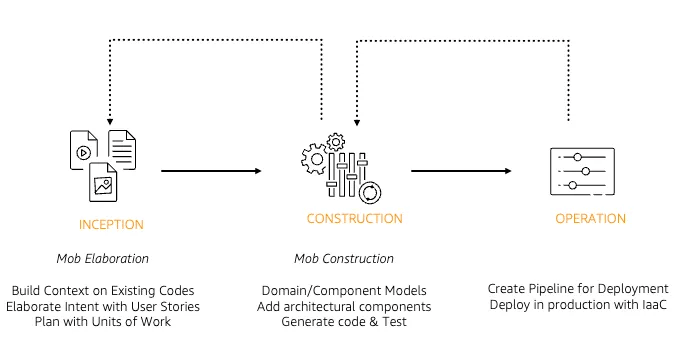
Source: Amazon
This methodology covers all stages of product development, including Inception, Construction, and Operation. It recommends AI for requirements/story refinement, architecture options, code scaffolding, test generation, doc/ADR drafts, PR summaries, automated review hints, and incident triage.
Humans are still responsible for security-sensitive code, data access, authZ logic, and infrastructure changes. Any AI mistakes must be blocked using quality gates (static analysis, SAST/DAST, dependency scanning, policy-as-code, contract tests, performance baselines).
Faster inception
This stage corresponds to the traditional discovery phase at SaaS outsourcing companies.
Artificial Intelligence | Human experts |
Takes notes during stakeholder interviews, prepares structured reports. | Proxy Product Owner and Solution Architect define functional and non-functional requirements, align them with business needs. They are responsible for data mappings, workflows, and rules. |
Research the market and synthesize thousands of sources (competitor products, industry reports, regulatory updates, best practices). | Identify trends that apply to the target segment, filter out noise to focus on what matters. Humans ensure business logic is correct and complete. |
Creates flowcharts, user journey maps, and process diagrams. Designs of UI layouts, visual variations, and interface ideas based on initial requirements, allowing the team to explore multiple directions quickly. | The designer remains fully responsible for usability, aesthetics, and accessibility. They analyze user behaviour, translate product vision into UX structure, correct layouts, adjust spacing, hierarchy, navigation, and visual flow to match brand guidelines |
An AI-driven approach cuts the setup time from 3–4 to 2.5 weeks. However, it doesn’t mean you have to build on a shoddy foundation.
With a bespoke architecture and examples of modular Terraform code, AI-generated infrastructure remains modular, secure, scalable, and cost-optimized. Generating CI/CD scripts saves about 30–40% of setup time. However, those pipelines should still include automated testing stages, environment provisioning, rollback mechanisms, and safe release mechanisms like blue-green/canary deployments.
Security checks should be embedded into the pipeline from week one. We recommend machine learning tools like Snyk Code for vulnerability detection, Amazon GuardDuty for continuous threat monitoring, AWS Macie for sensitive data discovery and classification, and Amazon Inspector for automated vulnerability assessments.
These checks ensure the rapidly generated code does not introduce serious problems that negate all the costs saved initially.
Rapid Construction with quality gates
Once discovery is complete, the SaaS development process can move into Scrum-like iterations. AI accelerates many activities, but human specialists must be responsible for decision-making, validation, prioritization, and delivery quality.
AI-generated features should match all established patterns, from DTOs to services. Our recommended approach includes connecting AI tools to the company’s Golden Repository. This allows AI to analyze pre-configured contracts, namespaces, and existing modules instead of writing code from scratch.
Human engineers enforce architecture patterns, contracts, and review standards to prevent the codebase from drifting into inconsistent fragments. Tools like Cursor actively monitor our runtime environments, parsing terminal logs and stack traces in real-time. AI uses this runtime data to detect issues and generate precise, architecture-compliant fixes.
Every new feature must be wrapped in a safety net of tests that strictly adhere to our CI/CD quality gates. This includes unit tests, integration scenarios, and necessary data mocks. QA engineers shift effort from writing tests to reviewing critical behavior and regression risks.
As a result, the Construction phase of SaaS development can be compressed to 5–10 weeks, down from 8–14 weeks.
Data-driven Operation phase
This approach, based on structured workflows with guardrails, continues throughout the Operation phase. AI tools use the context generated during the previous phases and projects to maintain the infrastructure and codebase. The client gets consistent artifacts, including tests, docs, release readiness evidence, and demos tied to sprint goals.
Deep expertise in SaaS development
It’s still rare to meet engineers with combined tech skills and business acumen; people who care about the UX just as much as they care about coding. SaaS development outsourcing companies like MindK are extremely picky when it comes to hiring SaaS developers because it leads to faster onboarding, fewer surprises, and costly architecture reversals.
- Modern architectural patterns for highly accessible and available applications. This includes microservices, serverless, edge computing, hybrid, and event-driven architectures.
- Cutting-edge front-end frameworks like React and Angular.
- Backend and API development (REST, GraphQL, gRPC, composable SaaS, event-driven microservices, legacy API integration, HL7/FHIR interoperability).
- Application security and QA best practices (TDD, zero-trust architecture, automated security testing, knowledge of privacy & compliance regulations, such as HIPAA, and GDPR)
- AI-accelerated development, data engineering, and visualization.
- Cloud computing and cost optimization (FinOps, Kubernetes, Terraform basics). AWS alone offers over 300 services for SaaS apps. Making the wrong choice can mean the difference between paying $20K and $6K a month for cloud costs.
One of the most important qualities that SaaS software development companies look for is what I call a product mindset. In fast-paced Agile and Lean environments, developers need to embrace a wide range of duties. They help teammates test the application, tweak its UX, and explain things to stakeholders.
SaaS developers must have excellent soft skills. At MindK, the entire team should be able to talk with the client and manage their own workload. Great SaaS developers are proactive and responsible workers, great communicators, and technical advisors to business stakeholders.
Future-proof decisions and defensible tradeoffs
Most SaaS projects involve high-stakes decisions, such as the tradeoffs between microservices and monolithic architecture, tenant isolation, serverless vs container-based scaling, and so on. A company specializing in SaaS development outsourcing services will typically provide a rationale for the key architectural choices, alternatives considered, and the reasons for picking the final approach.
A Capacity and Scalability Plan typically includes the vendor’s assumptions about the application’s future, a projected demand, SLO-driven sizing approach. The vendor will often model the cost per tenant/workflow/request, so you can forecast spend as usage grows. In case your product outgrows the initial choices, a SaaS outsourcing company should provide a realistic migration path to alternative solutions.
Microservices vs modular monolith
Default choice | Modular monolith first with clear module boundaries, internal APIs, and strong layering. Faster to build and easier to operate early on. |
Switch to microservices | When you have stable domain boundaries, multiple teams frequently blocking each other, or independent scaling/release needs that a modular monolith can’t easily satisfy. |
Risks and cost implications | Distributed systems complexity for data consistency, versioned APIs, latency, observability, incident surface area, and higher operational burden. |
Artifacts to request |
|
Serverless vs containers (Kubernetes/ECS)
<
Default choice | Hybrid (serverless for event-driven/irregular workloads; containers for steady, long-running services). |
Switch toward serverless | When the app has a spiky load, is event-driven, and benefits from “managed ops”. Ideal for startups that want fewer infrastructure concerns, rapid iteration, and autoscaling without managing nodes. |
Switch toward containers | When you have steady 24/7 high-volume traffic, long-running processes, and custom networking/runtime needs. Containers can be more cost-effective vs. per-invocation serverless for steady workloads at scale. |
Risks/cost implications | Serverless: vendor coupling, cold starts/limits, per-invocation costs can surprise at scale, debugging/event chains can get tricky. Containers: higher ops burden, you own more reliability/scaling/security hardening. |
Artifacts to request |
|
Vector DB vs managed search vs RAG platform components
Default choice | Start with search and lightweight semantic retrieval if your primary need is “find the right doc fast and reliably.” Add vector search when semantic matching materially improves relevance. |
Switch to vector | When you need semantic similarity over large unstructured corpora, multilingual paraphrases, fuzzy intent matching, or retrieval over embeddings at scale (and you can invest in ingestion/chunking/eval. |
Risks/cost implications | Vector retrieval introduces extra complexity. It includes ingestion pipelines, chunking strategy, embedding generation cost, index maintenance, evaluation, and “relevance drift.” Some teams overbuild with vector DBs, overlooking simpler solutions. |
Artifacts to request |
|
Flexible, scalable teams
The SaaS market is shifting rapidly. Once hired, in-house teams become fixed overhead. SaaS outsourcing allows modular team adjustments without layoffs or restructuring pains. You can scale resources up or down on short notice. This includes both in-demand tech specialists, such as Data Scientists, ML & DevOps Engineers, as well as UX/UI Designers, Product Managers, and other non-technical team members.
Faster innovation
Although there are now tons of engineers available in the USA, it still takes months to hire, onboard, and form a high-performing SaaS team.
Outsourced teams can start development within weeks, bypassing these ramp-up delays. They often consist of engineers who have worked together on multiple SaaS projects, reaching an earlier peak in performance.
Built-in risk mitigation and resilience
Loss of control, low quality, and vendor lock-in are some of the top outsourcing risks that are well-known among industry decision-makers.
However, outsourcing can also be a risk mitigation strategy if approached correctly. In-house teams often suffer from key-person risk. If a senior engineer or architect leaves, critical knowledge is lost. SaaS outsourcing companies provide team redundancy so that the know-how is preserved when individuals transition.
Reputable vendors use business continuity plans (BCP), redundant infrastructure, and 24/7 DevOps teams to handle outages or security incidents without downtime. They also have hands-on expertise with key regulations and standards, such as GDPR, HIPAA, FHIR, HL7, cms-0057-f, for the industries they specialize in, reducing the risk of legal complications.
Cost-savings
You can outsource SaaS product development that costs $100+ an hour in the US to other countries for $40+ per hour, maintaining the same quality standard. This also frees you from the cost of recruiting, education, and management, additional cash compensation, insurance, paid leave, and overheads. Startups with tighter budgets can find even cheaper vendors. However, the lower the rates, the faster quality drops.
Developer rates aren’t the only factor that determines the web development costs. Vendor size, project complexity, choice of technology, the use of AI, functional and non-functional requirements are also important.
Clients often overlook infrastructure and cloud costs. MindK once consulted a SaaS company with $210M in funding. Each month, they overpaid $14,000 for AWS services, managed databases, and testing environments.
Total Cost of Development (TCD) may also include hidden costs. Change requests, for example, are costly if you choose a fixed-price contract. Some vendors may also require 6–12 month minimum retainers, increasing costs.
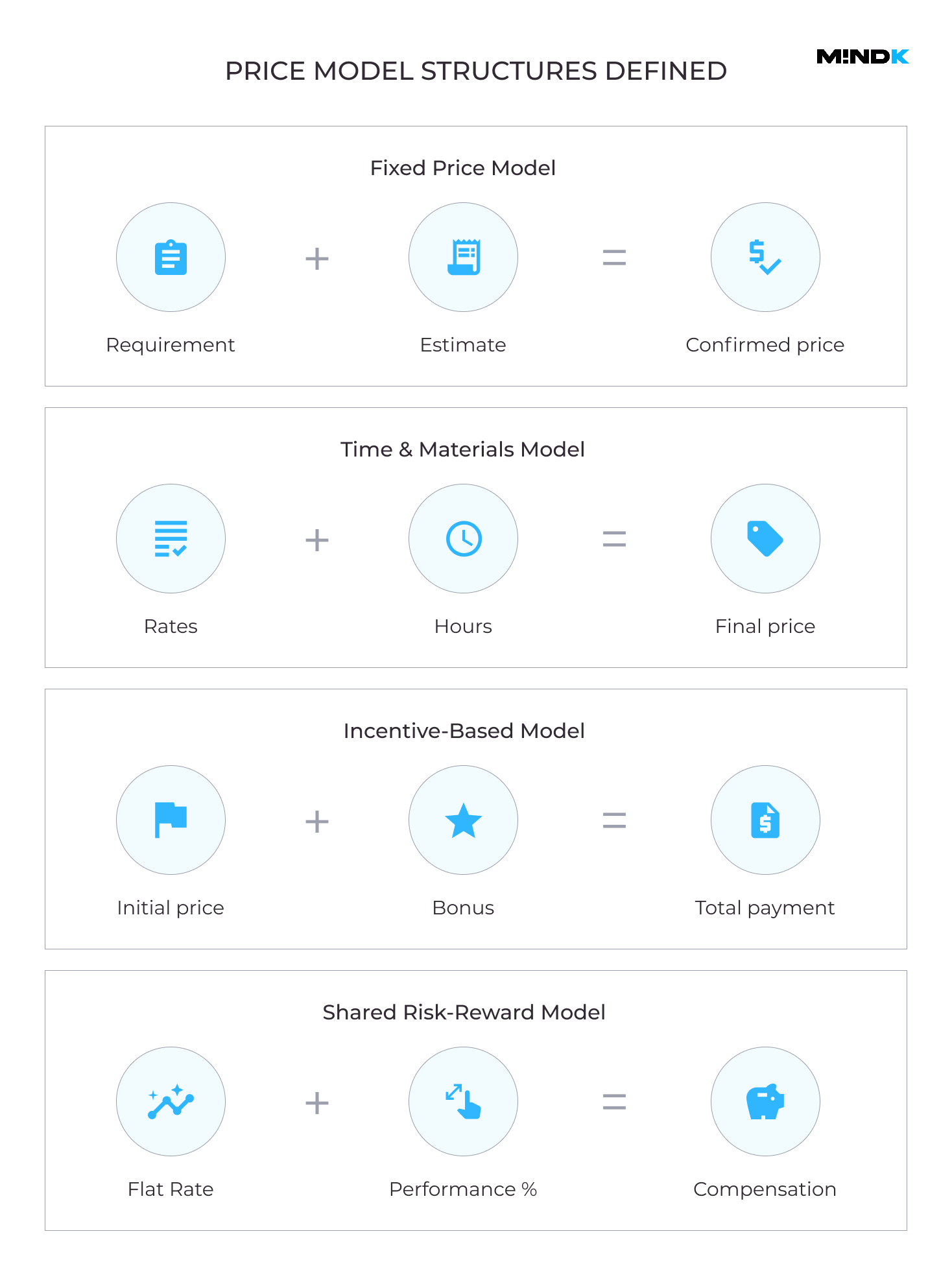
This means that the total cost depends on the vendor’s engagement (pricing) models:
- Fixed-price contracts are predictable but require a thorough discovery phase. The vendor also takes on all the risks and management duties. This results in extra contingency costs (10-30%).
- Time & Materials (T&M) requires you to pay a fixed hourly rate plus a fixed vendor fee. T&M is more flexible but requires active cost monitoring to avoid overruns.
- Incentive-based contracts require the vendor to estimate your project based on the initial requirements. You can then add specific rewards for exceeding those original performance objectives.
- Shared risk-reward contracts are a variant of the incentive-based model where partners fund the project together and share rewards for a set period.
- Dedicated Team is cost-effective for long-term projects, but requires ongoing commitment.
At MindK, we only recommend fixed-price contracts for specific, highly regulated industries. You can also use it to build trust with a new partner with a small proof of concept/MVP. After that, switch to a non-fixed-price model. They all offer the flexibility needed for large projects in dynamic markets.
| Cost factor | Typical additional costs |
| Cloud infrastructure | $500-$5K/month |
| Maintenance & bug fixes | 10-20% of initial development cost/year |
| Project management | 15-25% of total project cost |
| Legal and compliance expenses | $10K-$50K |
| Onboarding when switching vendors | $5K-$20K |
What is the best way to outsource SaaS development?
There are many types of outsourcing and even more names vendors use to describe these engagements. However, as a SaaS founder, you need to know about two basic types:
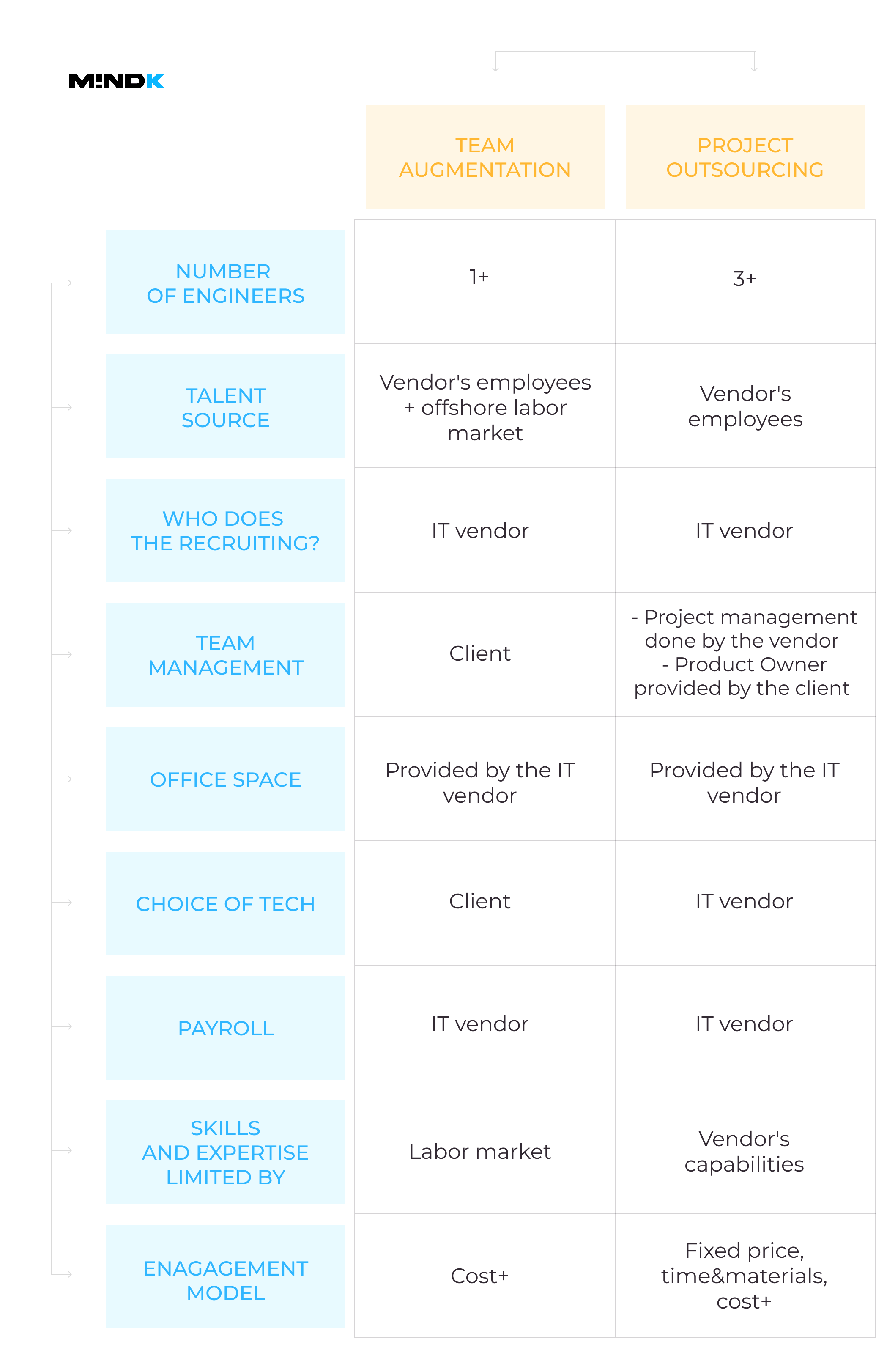
- Staff augmentation (outstaffing, dedicated team).
- Project-based outsourcing (also known as managed services).
IT staff augmentation
This traditional model focuses on filling specific team roles with outsourced specialists. They adopt your company’s culture, tools, and engineering approaches. You provide the daily tasks and manage the engineers while they work as a remote extension of the team.
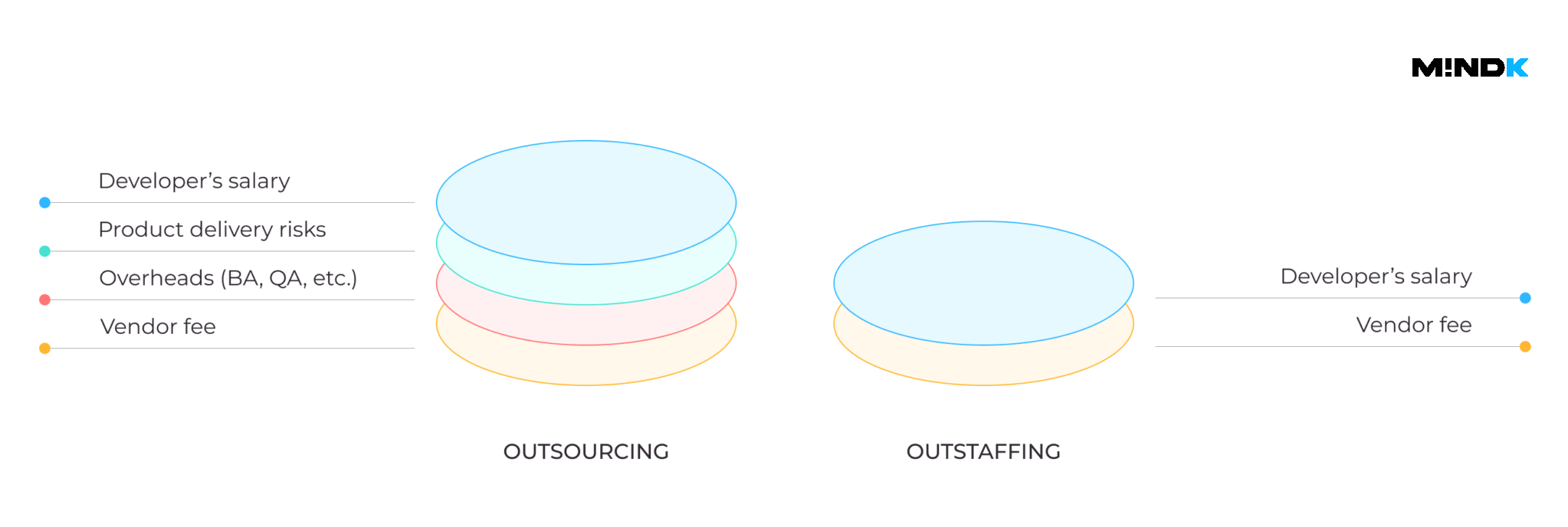
Pricing in staff augmentation is incredibly transparent—you pay the developer’s hourly rate plus a small vendor’s fee.
Some firms act as recruiters that identify suitable specialists in the global market. Other SaaS outsourcing companies offer pre-vetted specialists who have worked together for many years.
Benefits:
- Retain 100% control over the project. Hand-pick all the candidates, have as many interview rounds as needed, and oversee daily activities.
- Quick scale-up, swapping specialists, expanding the team, or canceling services on short notice.
- Save money. The payment model includes no additional fees.
Drawbacks:
- Requires tech expertise to interview candidates, check test assignments, and manage their tasks.
- More responsibilities for the client. You’ll have to onboard and manage developers, budgets, scope, and project timelines.
- Requires well-established development processes to succeed with SaaS product development.
Perfect-fit when you:
- Need to rapidly scale up your team while building your SaaS product.
- Want to save money as a series A/B startup.
- Have a project with an unusual tech stack.
- Want to avoid putting all your eggs in one basket. Diversify risks by working with multiple SaaS outsourcing companies.
Outcome-based outsourcing
This model focused on delivering a successful SaaS product as a cross-functional team.
According to the latest Deloitte stats, 67% of companies prioritize outcome-based services vs. 29% for staff augmentation. They also report 17% higher satisfaction and plan to increase investment in SaaS outsourcing services.
In outcome-based models, the vendor takes on more responsibilities, including Product Management, Business/System Analysis, UX/UI design, DevOps, QA, and outsourced SaaS development.
On Agile projects, the client typically acts as a Product Owner. The outsourced team helps them analyze user needs, monitor competitors, single out key MVP priorities to prevent scope creep, collect feedback, and build new features to reach long-term objectives.
Benefits:
- Less stress, more results. SaaS development company projects provide all the necessary specialists to complete your project. There’s no necessity to micromanage the team, you are free to focus on your core business.
- Minimal engineering leadership required from the client side. The vendor provides technical Project Management and other critical skills.
- Clear goals, outcomes, and success conditions defined in the contract. It also specifies the duties and responsibilities of all parties, along with deadlines, budget, and scope.
Drawbacks:
- Less flexible. Drastic changes to the project and team composition typically require an advanced warning and might result in additional fees.
- More expensive. The vendor takes on more risks and responsibilities like Project Management and QA.
- Can’t hand-pick all the team members. The vendor usually selects an optimal team for your task based on your requirements.
Perfect-fit when you:
- Don’t have an internal IT department or lack technical expertise.
- Have an internal team but lack the resources to build additional modules or products.
- Want to focus on successful product outcomes, rather than team micromanagement.
How to succeed with SaaS outsourcing
Your SaaS product development partner must have the required technical skills, experience, and domain knowledge to build a complex product. They should also use proven methodologies, have good soft skills, and a culture that matches your business.
Here are the 10 crucial steps to select a reliable SaaS outsourcing vendor and succeed with your product objectives.
#1 Shortlist potential vendors
The first step to choosing a trustworthy partner is learning as much as you can about outsourcing.
Study the market, consider the risks, understand the SaaS development process. I worked with companies that failed several attempts to outsource SaaS product development. My other client tried to do all the development in-house before hiring MindK to migrate to a multi-tenant SaaS. One thing is clear—the more you know about the market, the lower the chance of regretting your choice.
Defining project goals is equally important. Not everyone can write complete requirements, specifications, or a product roadmap. However, a high-level product vision is essential.
At this stage, the goal is to shortlist five or more high-potential vendors based on their tech stack, industry expertise, case studies, project types and sizes.
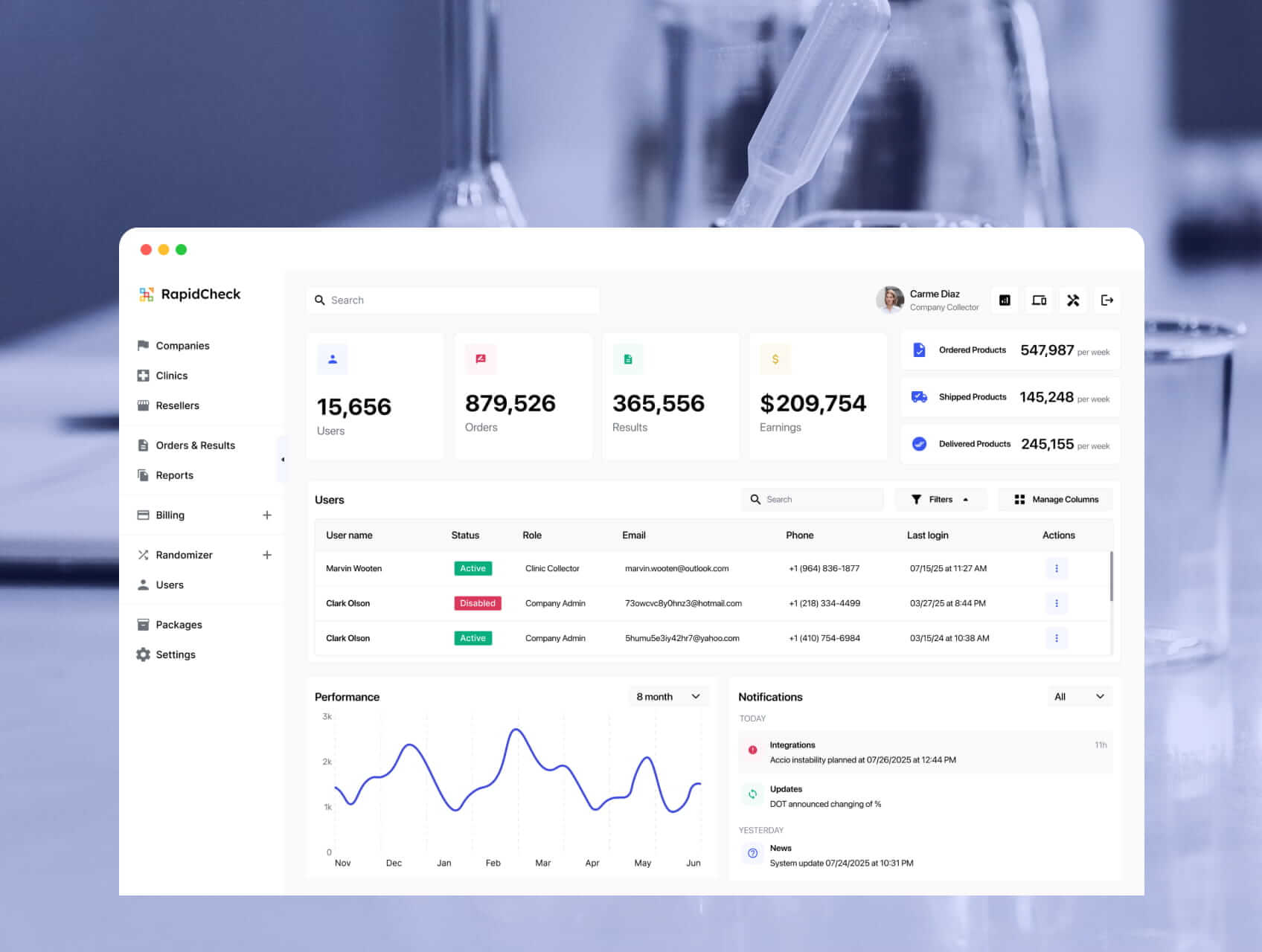
An analytics dashboard in the medical application we migrated to a multi-tenant SaaS [request case study]
#2 Check vendor reviews
You may request relevant case studies and reviews from vendors directly or look at independent listings like Clutch.co, GoodFirms, DesignRush, or G2. Clutch.co, in particular, only lists reviews written by the platform’s employees based on customer interviews and research.
While the reviews themselves can be faked, you can Google the person who gave the testimonial and contact them via LinkedIn or email. As a rule, people eagerly share any negative experiences they’ve had with outsourcing vendors.
#3 Learn about the vendor’s approach
Now that you have a list of potential vendors, it’s time to fill out the contact form. In most cases, this will provide a meeting with a pre-sale or a tech specialist (if you’re a technical founder). During the call, try to learn as much as you can about the company.
Watch out for these red flags:
- 🚩 Slow response times, vague answers, and (especially) over-promising.
- 🚩 Lack of transparency in team structure, task ownership, or development progress.
- 🚩 Poor visibility into task tracking, sprint progress, or development velocity.
- 🚩 Over-reliance on proprietary tech (vendor lock-in risk).
- 🚩 No documented coding standards.
- 🚩 Hesitation or refusal to provide a sample code review.
- 🚩 “We use AI everywhere,” but no written AI usage policy. No prompt injection/untrusted input plans for LLM features.
- 🚩 No clear plan for handling scope creep or changing requirements.
- 🚩 Cheap rates with lots of unpriced add-ons (environments, QA, DevOps, security scans, on-call, incident support).
- 🚩 Ambiguous IP ownership or reuse clauses without clear boundaries.
An intro call is a good time to learn about the vendor’s approach to communication. Offshore SaaS developers may use the so-called ‘golden hours’ when one team has just started working and the other has yet to leave the office. Besides weekly progress reports and stakeholder demos, MindK recommends inviting clients to daily stand-up meetings and retrospectives with the entire team.
These calls are usually short, and there are many questions to ask. Don’t be afraid to mail some of those questions you didn’t have time to discuss during the first meeting.
#4 Create a Request for Proposal (RFP)
An RFP is a document that outlines your requirements for an outsourcing vendor and your project. It can take different forms. The most common variant includes the following:
- Project description & goals.
- Information about your company.
- Project requirements.
- Ballpark timeframes
- Your budget range, and so on.
You can use an RFP to ask vendors questions that interest your company and compare the answers to shortlist the best candidate.
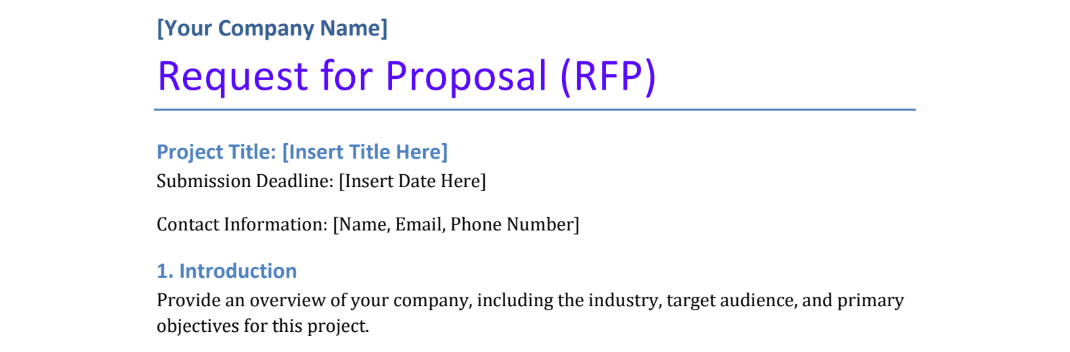
Download a customizable RFI / RFP template for SaaS development
#5 Vet their technical skills
A) Evaluate SaaS experience
Not all firms specialize in SaaS architectures. You need a vendor that understands multi-tenancy, cloud scalability, API-driven development, security compliance (GDPR, SOC 2), and SaaS monetization models. Domain-specific expertise is essential if your SaaS operates in regulated fields like FinTech, HealthTech, or EdTech.
- Check their case studies for detailed success stories, tech stacks, and measurable business impact.
- Cross-check LinkedIn & GitHub. Do their engineers contribute to SaaS-related open-source projects or technology blogs?
- Request direct contacts from past clients to discuss their experience working with the vendor.
B) Assess technical competency and code quality
A vendor may claim expertise, but how do you know their code is scalable, maintainable, and secure?
- Conduct a technical interview with your CTO or senior developer to quiz them on architecture, performance, and security best practices.
- Request a sample code review. Have your tech expert evaluate a sample from a real-world SaaS project repo.
- Start with a paid trial project. A small proof of concept will reveal their coding standards, communication, and problem-solving skills.
C) Validate their AI maturity
AI can reduce productivity or increase errors if used poorly. In addition to requesting a code review and process walkthrough, ask for AI-specific proof points:
- Request the company’s AI usage policies for coding assistants and agents. What data is allowed in prompts (e.g., no secrets, no customer data by default)? How are exceptions handled?
- Ask whether they store prompts, for how long, and whether these prompts are used to improve models.
- Do they have a documented “safe prompting” standard? A reputable SaaS outsourcing company would never paste credentials, tokens, private keys, or regulated data (PHI/PII) unless explicitly approved and covered by the data policy.
- Inquire about the safeguards against prompt injection and untrusted inputs: separation of instructions/data, least privilege tool access, output validation, and monitoring.
- How do they quantify impact on quality: lead time/cycle time changes, escaped defects, rework rate, incident rate/MTTR, security findings, and so on?
- Finally, require a statement that AI-generated code is treated the same as human code for security review and vulnerability testing.\
D) Ask for a Quality Control system
- Request the SaaS vendor to walk you through their QC system, including quality gates in CI/CD (automated unit/integration tests, linting/static analysis, dependency and secret scanning, and build-break rules).
- What release safety controls do they employ? These might range from canary/gradual rollout to monitoring-based rollback triggers and explicit SLO/error-budget thinking for risky changes.
- Require a simple dashboard of DORA-style outcomes. Ask for evidence artifacts, such as a sample pipeline screenshot, a test report, a recent post-incident review template, or a short “Definition of Done” with security and performance checks.
#6 Mitigate risks proactively
Loss of control over product and codebase, unforeseen expenses, communication barriers, low quality, and security gaps are all serious threats. My article on the risks of outsourcing provides detailed ways to mitigate or avoid them entirely. Here’s its short summary.
| Risk | Mitigation |
| Loss of control | Retain ownership of product decisions, source code, and roadmap. |
| Security & compliance issues | Require NDAs, access controls, audits, and compliance certifications. |
| Poor code quality | Enforce coding standards, automated testing, and peer reviews. |
| Misalignment with your goals | Use Agile methodologies, KPIs, and frequent check-ins |
| Vendor lock-in | Demand IP ownership, open-source technologies, and documentation. |
| Budget overruns | Define clear contracts, monitor costs, and set contingency budgets. |
| Cultural & time zone barriers | Ensure strong English proficiency, collaboration tools, and overlapping work hours. |
| Scaling issues | Choose vendors with scalable teams and flexible contracts. |
#7 Ask for a Non-Disclosure Agreement (NDA)
This legal contract can protect your intellectual property (IP) and rights to the SaaS product. MindK recommends signing an NDA even before revealing the first details about your future product. You can also include a non-compete clause that will prohibit the vendor from working with your competitors and developing similar solutions for a set period.
#8 Sign a SaaS outsourcing contract
In addition to securing your IP rights, the contract should set clear acceptance criteria—project deliverables, major milestones, and their definition of done. A SaaS outsourcing contract should also include a budget and timeline estimate for your project (its accuracy will depend on the exact type of contract).
#9 Stay involved with your new team
To achieve the best results, treat the outsourced developers as a part of your team. Get to know them as people. Communicate regularly and early to solve any challenges before they turn into problems.
Whatever your choice, it’s not recommended to build your SaaS app in one go. Starting with a relatively small MVP is an opportunity to gather early feedback and raise funds. We opted for MVP development when partnering with Bridge, a Silicon Valley startup building a custom SaaS application for tech recruiting.
Any product is based on assumptions about technology, people, and markets. It’s often impossible to validate them until you give users an actual product. With Bridge, it turned out that users needed quite a different solution to what we were initially building. Fortunately, the founders had a working MVP that allowed them to attract funding from multiple investors.
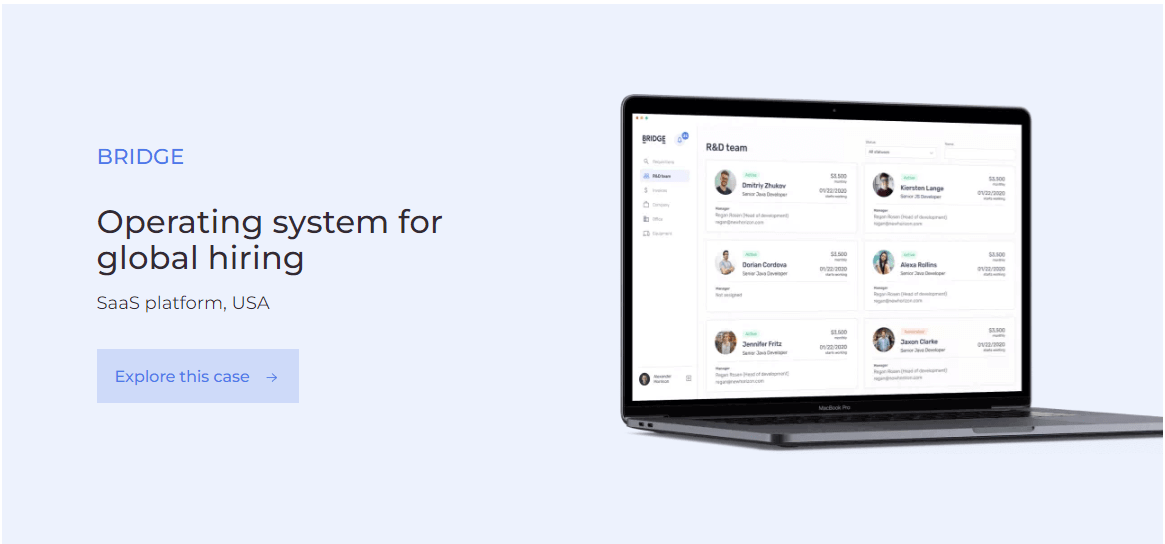
Bridge – an operating system for global hiring [read the case study]
My main lesson for SaaS founders is to stay involved during the whole project (but have a plan in case things go south).
#10 Define a vendor exit strategy and offboarding plan
At some point, you might decide to switch vendors or move development in-house. Without careful planning, this can lead to major disruptions. A good way to prevent this is to include an exit strategy clause in your contract.
Such a clause typically includes handover timelines, required documentation, and knowledge transfer obligations. Require the vendor to document and securely hand over API keys, database schemas, and architecture details. Store all IP and credentials in the company-owned repositories to prevent worst-case scenarios.
How to ensure quality and value in custom SaaS development outsourcing | ||
Best practices | Key tools | |
Expectations | Document KPIs, coding standards, and security policies upfront. | Confluence, Notion |
Project management | Use Agile sprints and bi-weekly progress reviews. | Jira, ClickUp, Trello |
Transparency | Require weekly progress reports and real-time updates. | Slack, Zoom, Google Docs |
Ownership | Ensure you own all source code and cloud accounts. | AWS IAM, GitHub |
Code quality | Enforce peer reviews, CI/CD, and automated testing. | GitHub Actions, SonarQube, Jest |
Monitoring | Track app performance, error rates, and API latency. | New Relic, Datadog |
Exit strategy | Require knowledge transfer & full documentation. | Notion, Google Drive |
Conclusion
Outsourcing SaaS development has evolved from a purely cost-saving measure into a calculated strategy to achieve well-defined objectives. The steps outlined in this article will allow you to mitigate the risks and select a partner with the necessary expertise to succeed in this highly competitive market.
Do you have any questions? MindK has been building SaaS projects for a decade now. We’re experts in both horizontal and vertical SaaS for industries like Healthcare, Education, and Recruiting. Don’t hesitate to drop me a line to arrange a free consultation on custom SaaS development outsourcing.