




Robotic Process Automation
for Medical Billing
Save up to 70% of staff time across the whole revenue cycle and benefit from near real-time adjudication. MindK makes RPA for medical billing more efficient with ready-to-use AI agents for medical billing. You get an equivalent of a fully-custom RCM solution with a 4-5x shorter time-to-value.
Trusted by







Agentic AI is the natural evolution of medical billing RPA
Traditional RPA
Runs predictable actions in a fixed sequence. Best for narrow, repetitive tasks with structured inputs, such as logging into a portal, copying claim status, or moving data between fields. It becomes fragile when workflows branch, screens change, payer rules vary, documents are incomplete, or exceptions require interpretation.
01Agentic automation
Works towards the goal using context, tools, rules, memory, and escalation logic. Fits messy RCM work such as verification of benefits, prior authorization follow-up, payer portal navigation, claim preparation, and denial prevention. Sensitive or uncertain cases remain in human control.
02MindK agents can augment the RCM tools you already use. They also make it possible to replace expensive SaaS sprawls with a focused platform, tailored to the way you actually work.
Fill the gaps in your medical billing automation
Most RCM teams already use digital tools. The problem is that digital tools still leave people doing too much of the work.
Verify coverage before the visit
Traditional RPA healthcare services struggle when coverage details are incomplete, payer responses vary, data is missing, or the next step depends on plan-specific logic. Agents can query systems, normalize responses, flag conflicts, and route edge cases before the visit becomes a denial risk. The result is 50% to 70% touchless completion for eligibility checks with full visibility for the staff.
Make benefit checks granular
VoB often requires deductibles, coinsurance, visit limits, auth requirements, plan exclusions, and payer-specific nuance. Reduce benefit-review time by up to half with AI agents that gather benefit details across portals, calls, documents, and EMRs. You get a structured, reviewable coverage picture for claims, authorizations, and patient estimates.
Keep prior auth moving when workflows branch
Prior authorization work often breaks away from a clean script. Some documents may be missing, payer rules differ, portals throw exceptions, or follow-up moves to fax and phone. Shorten auth cycles by at least 1/2 with RCM agents that prepare packets, gather required materials, track status, and capture payer responses. Ambiguous cases are escalated with the necessary context.
Prepare cleaner claims before submission
Many claim problems start upstream. Incomplete documentation, mismatched codes, missing authorization, weak coverage visibility, or payer-specific rules are often missed before submission. Agentic automation can connect signed notes, eligibility results, benefit details, coding logic, payer requirements, and clearinghouse workflows to increase first-pass claim acceptance by 10%–20%.
Automate payer follow-up across portals and calls
Payer follow-up is scattered across portals, IVRs, representatives, faxes, email threads, and internal queues, which makes scripted automation fragile. Our agents combine multiple communication modes to log and escalate cases whenever a portal changes or a payer gives only a partial answer, saving ~17 minutes per transaction.
Prevent denials earlier in the workflow
Reduce preventable front-end denials by up to a quarter. We move denial prevention upstream by watching for missing coverage details, authorization gaps, documentation risks, payer-specific claim issues, and unresolved exceptions while the case can still be fixed.

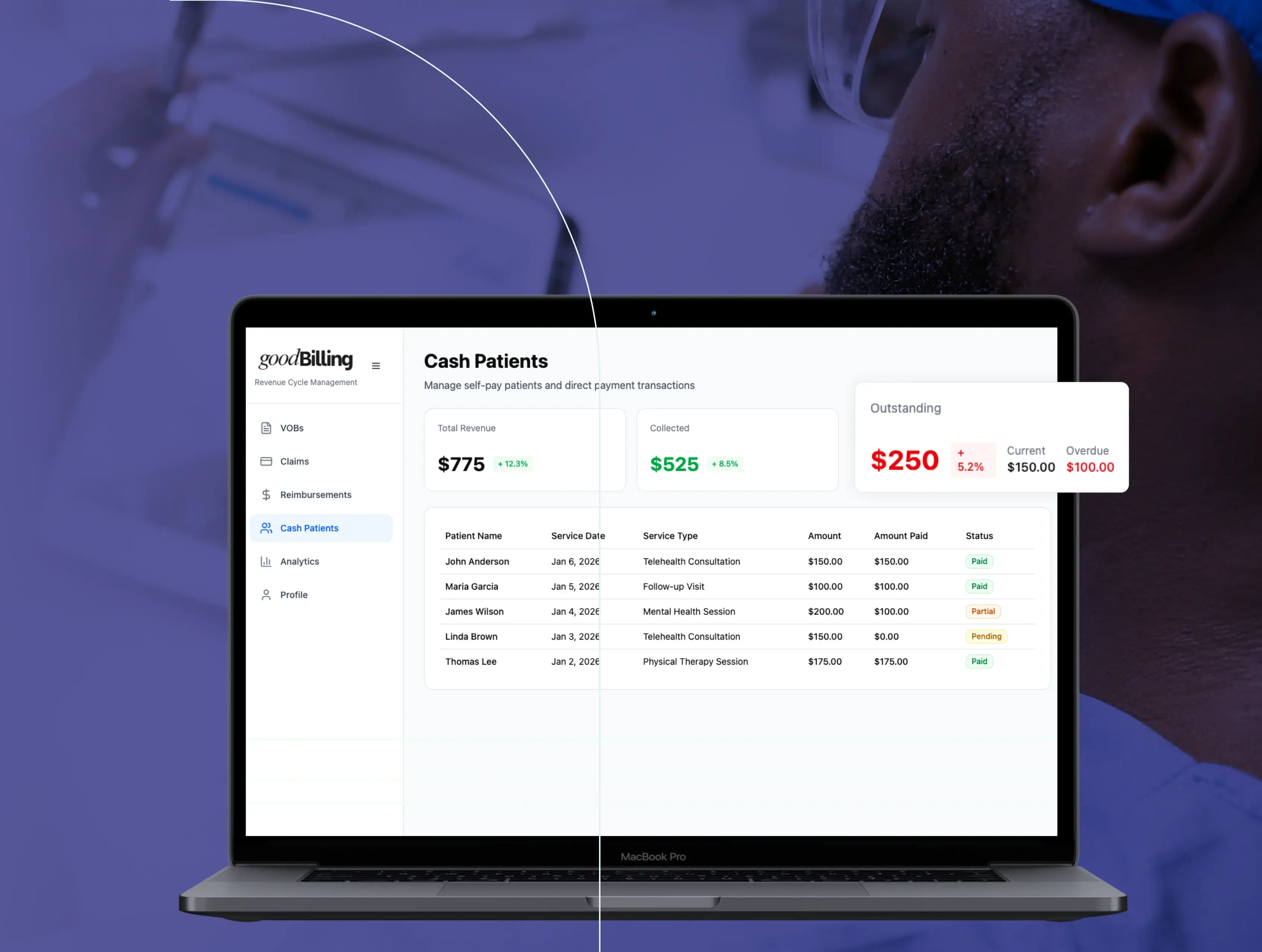
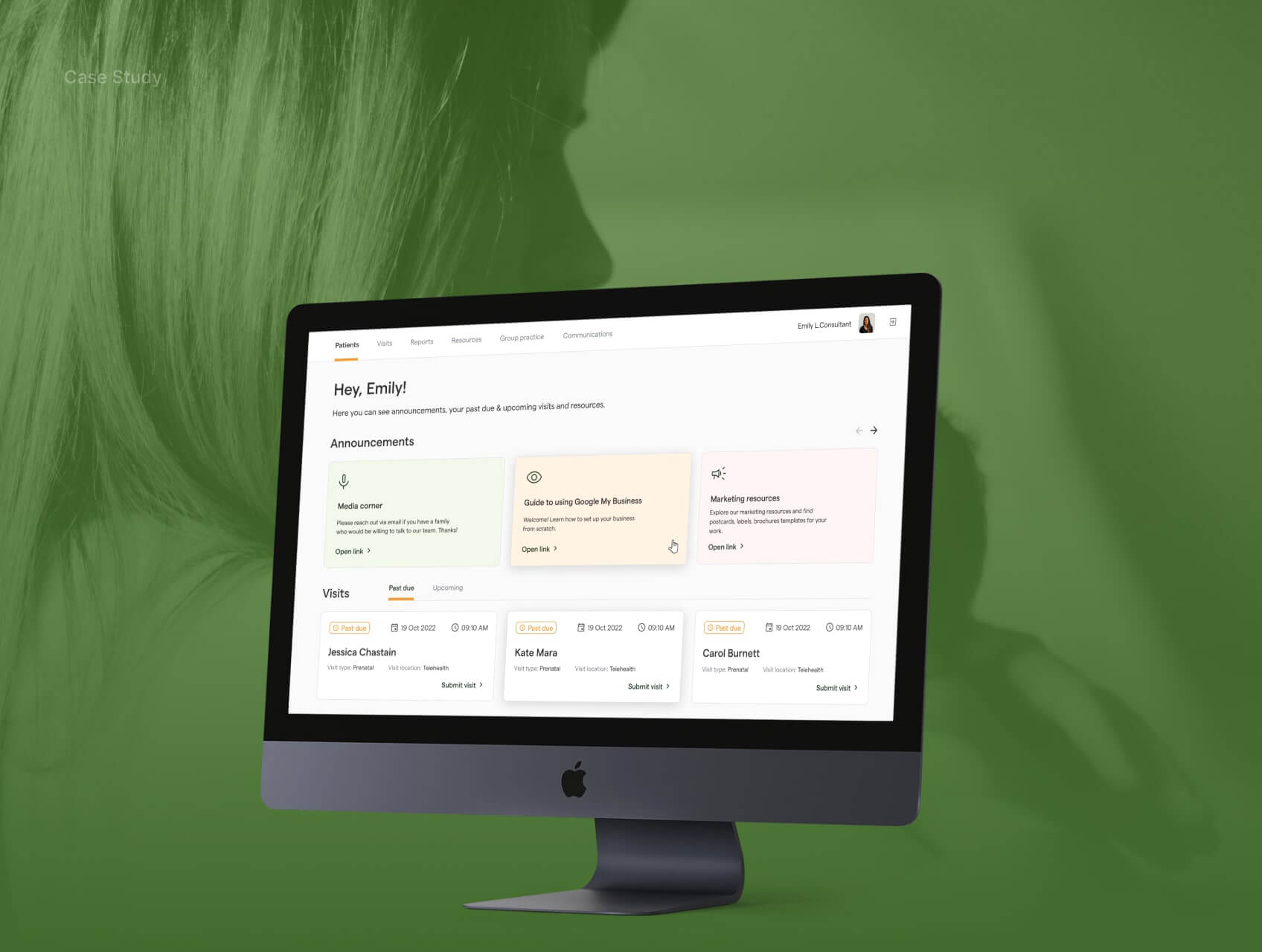
RCM automation options we provide for different teams
Not sure where to start?
Business analysis
Workflow mapping
Data readiness review
Integration constraints
PHI exposure
Risk ranking

Decrease time-to-value by up to 80% with ready-to-use AI agents and building blocks
Patient intake
Captures insurance, conditions, risk factors, referral context, and intake details before they become downstream billing gaps.
Eligibility
Queries payer systems, normalizes results, and flags missing or conflicting data.
Verification of benefits
Handles full benefit breakdowns, including self-funded plans and payer-specific gaps.
Prior authorization
Prepares forms, gathers documentation, and follows up through portal, fax, phone, or API.
Claim generation
Aligns signed clinical notes, coverage data, CPT and ICD logic, and payer rules.
Payer portal navigation
Navigates portals, extracts fields, submits requests, checks status, and captures responses.
Voice and IVR automation
Calls payers, moves through phone trees, and captures structured answers.
Patient billing & engagement
Explains estimates, balances, documents, and next steps with escalation rules for sensitive cases.
PHI Anonymization
Strips PHI from the data that goes into external AI services and restores the missing data in the user interface.
Healthcare data normalization
Unifies EHR, payer, document, and billing data into structured formats that downstream agents can use reliably.

How We Implement RPA for Your Billing Operations
Workflow discovery
Timeline: 1 to 2 weeks
MindK maps the current billing operation across front-end, mid-cycle, and back-end stages. The team identifies which parts can be handled with ready-made agents, classic RPA, APIs, or custom logic. The goal is to choose the right automation for each workflow instead of forcing every process into the same box.
Data, integration, compliance planning
Timeline: 1 to 3 weeks, overlaps with discovery
We assess the systems and data that AI depends on. This includes your EHR, EMR, clearinghouse, payer portals, scheduling, patient communication, documents, faxes, and internal reporting.
Implementation
Timeline: 3 to 16+ weeks
This step may range from integration of ready-made AI agents to fully custom engineering. The work runs iteratively. Agents are configured around the target workflow while engineers connect systems, test edge cases, harden the production layer, and adjust rules based on payer behavior and operational constraints.
Pilot launch and testing
Timeline: 1 week
MindK tests the system against real billing scenarios, payer variability, missing data, portal changes, PHI rules, edge cases, and human override paths. The first automation path launches in production with measured outcomes and clear staff ownership.
Optimization and support
Timeline: Ongoing
After launch, MindK tracks automation performance against the baseline and expands from the first workflow into adjacent RCM work.

HIPAA-Compliant RPA Implementation
PHI exposure mapping
Separation of sensitive and non-sensitive processing
Audit trails built into every workflow
Human control over uncertain cases
Hardened infrastructure around RPA and agents
What
our
clients
say
-

Allison Erickson
Director of Product, The Lactation Network
USA Such quality work in such efficient timing
«I have nothing but great things to say about our partnership with MindK and the solid work they have done and continue to do for the growth of our company. Our rapport is strong which is a reflection of their professionalism, hard work, and great outputs.»
-

Jason Lutton
CEO, International Surrogacy Center
Impressed with their ability to understand our industry
«MindK reduced the time a surrogate takes to complete an online application, increased the number of completed applications, and streamlined our intake process, resulting in fewer staff man hours needed to complete the backend processes for finalizing an applicant.»
-

Al Hariri
Co-Founder, Vitagene
USA Results-oriented and
outcome-driven«I can tell you confidently that they are different from your regular agency that just wants to charge as much money for their work as they can get away with. MindK is completely results-oriented and outcome-driven.»




Why Healthcare Organizations Choose MindK for RPA Implementation
Ready-to-use agents
Reduce development effort and help move from assessment to live automation up to 80% faster with ready-made AI agents and reusable components.
Keep your systems
MindK can automate on top of your EHR, clearinghouse, payer portals, and patient tools, reducing staff touches without a full replacement project.
Built-in healthcare controls
PHI handling, audit logs, review queues, escalation logic, and human override paths are designed into billing workflows from the start.
First-hand RCM experience
MindK has released its own products that deal with RCM workflows, provider variations, EMR integrations, and compliance requirements.
Automate beyond medical billing
Healthcare Automation Services
HIPAA compliance and security consulting
EHR and clearinghouse integration
Healthcare data engineering
Cloud and DevOps implementation
Healthcare EDI consulting
Our Healthcare Tech Insights


Ready to Eliminate Billing Errors and Accelerate Revenue?
Let us know about your challenges and we'll contact you within 24 hours to
schedule a free consultation with the MindK team.
FAQ
- Can this work with our current EHR and clearinghouse?
Yes. MindK can build agentic middleware on top of your current EHR, clearinghouse, payer portals, scheduling tools, and patient communication channels. During discovery, we assess integration options, data access, PHI exposure, and workflow constraints before defining the first release.
- How reliable are AI agents in payer workflows?
Reliability comes from boundaries, rules, monitoring, and human control. MindK designs agents around specific tasks, structured outputs, payer-specific logic, confidence thresholds, and exception routing to augment robotic process automation for healthcare companies. Sensitive or uncertain cases are escalated to staff with the context needed for review.
- What happens when a payer portal changes?
The automation layer should detect failures, log what changed, route affected cases to a review queue, and support updates to the portal workflow. For high-volume portals, MindK can combine monitoring, fallback paths, and human-in-the-loop handling so work does not disappear when a screen or field changes.
- How is PHI protected?
MindK maps PHI exposure before automation starts, separates sensitive and non-sensitive processing where appropriate, uses access controls and encryption, and builds audit trails into the workflow. Where AI is involved, sensitive workflows can use hosted models, limited data, masking, or anonymization depending on the use case and compliance requirements.
- Where do humans stay in control?
Humans stay in control of judgment-heavy and sensitive cases: ambiguous coverage, missing documentation, unusual payer behavior, denial responses, patient-facing financial decisions, and any workflow where confidence is below the required threshold.
- Can this replace outsourced RCM?
It can support that path when the economics and operating model make sense. Some provider organizations use automation to bring more RCM control in-house. Others use it to improve oversight, reduce manual volume, or make outsourced relationships more transparent. The right path depends on volume, systems, payer mix, staffing, and reimbursement goals.
- Can we start with eligibility, VoB, or prior auth only?
Yes. Robotic process automation for healthcare companies often starts with one workflow where volume is high, rules are clear enough to automate, and outcomes can be measured. Eligibility, verification of benefits, prior authorization, payer follow-up, and claim preparation are common first-release candidates.
- What happens after launch?
After launch, MindK monitors performance, reviews exceptions, improves agent behavior, updates payer-specific workflows, and expands automation into adjacent RCM areas. The goal is continuous improvement without losing control, auditability, or rollback paths.