




Healthcare AI solution
development
We use pre-built AI agents and deep HealthTech expertise to reinvent the core workflows behind care delivery, clinical operations, and revenue performance.
Trusted by




End-to-end healthcare AI development services

Accelerate your time-to-value by 3-4x with our ready-to-use AI agents and building blocks
Patient acquisition & marketing
Lower cost per acquired patient and produce effective campaigns without paying an agency retainer.
Chat automation
Resolve routine patient questions 24/7, taking response time from hours to seconds.
Fax, SMS, and email automation
Convert inbound faxes and messages into structured records, so no one re-keys a document again.
Automated patient intake
Make sure patients arrive with complete records, cutting intake time by ~50% and killing the incomplete-form rework.
Eligibility verification
Catch coverage gaps pre-visit, removing the ~25% of denials that trace back to eligibility errors.
Verification of benefits
Give patients an accurate cost estimate up front without time-consuming manual checks.
Prior authorization
Reclaim ~13 hours a week staff spend per physician on PA paperwork and shorten approval turnaround.
Coding & charge capture
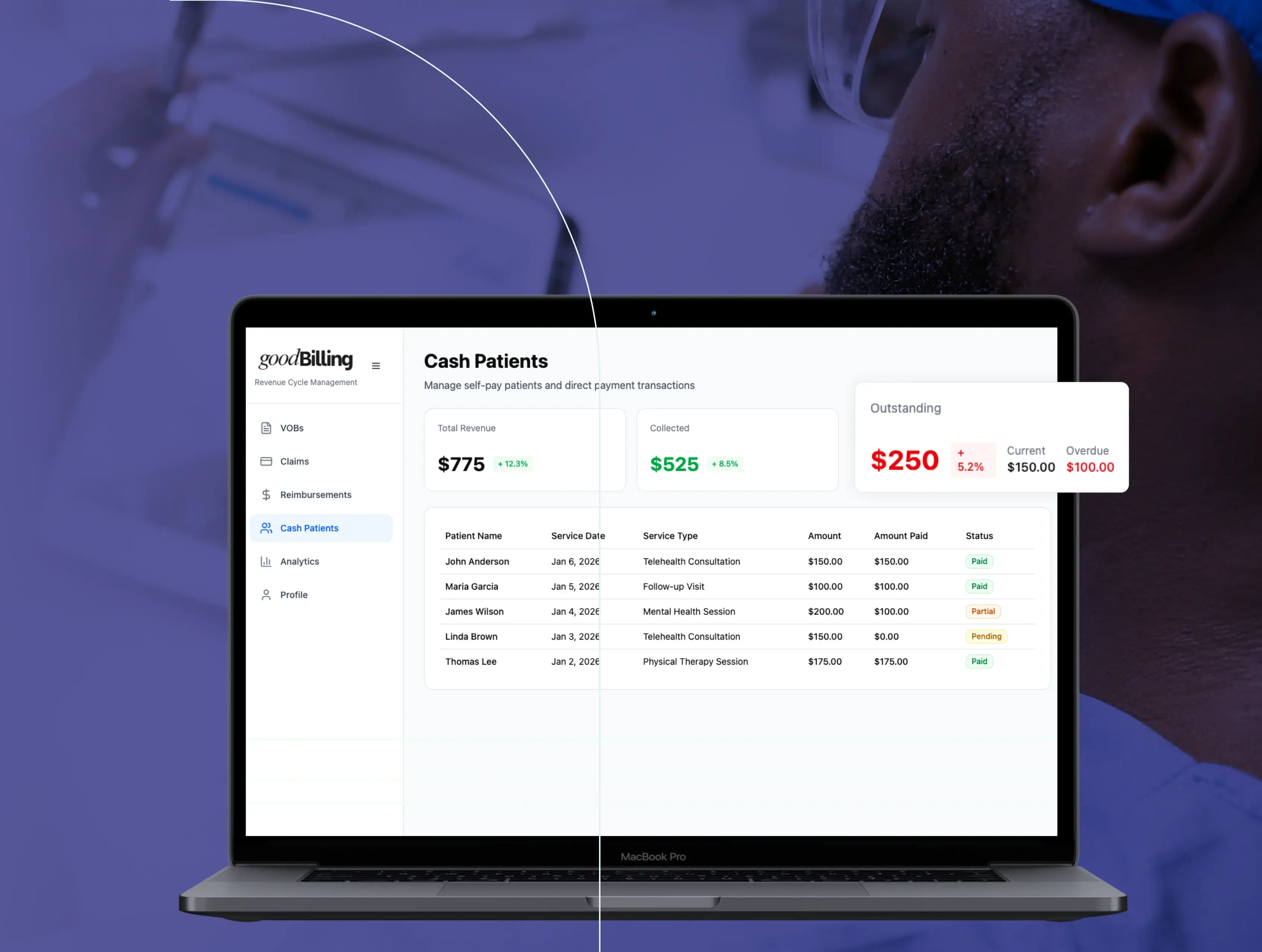
Recover 1–3% of revenue that leaks through missed and undercoded charges with agentic claim automation.
Claim submission
Push first-pass acceptance above 95%, so cash lands on the first cycle.
Claim status & AR follow-up
Work every open claim automatically, pulling days in AR down without adding billers.
Healthcare data normalization
Map any payer or EHR format into one model, taking new integrations from months to weeks.
PHI anonymization
Make your data safe for AI automation and analytics without the fear of HIPAA exposure.
Report / CV evaluation
Turn any document type (lab results, CVs, intake forms, payer correspondence) into structured data scored against relevant criteria.
Patient engagement
Cut no-shows by ~30% and keep patients on their care plan between visits.
Trend identification & analysis
Surfaces the outliers worth acting on and rank them by urgency, tuned to whatever data your product holds.
Interactive Q&A for training
Promote your online courses and offline events using an interactive chat bot that answers questions based on the course content.
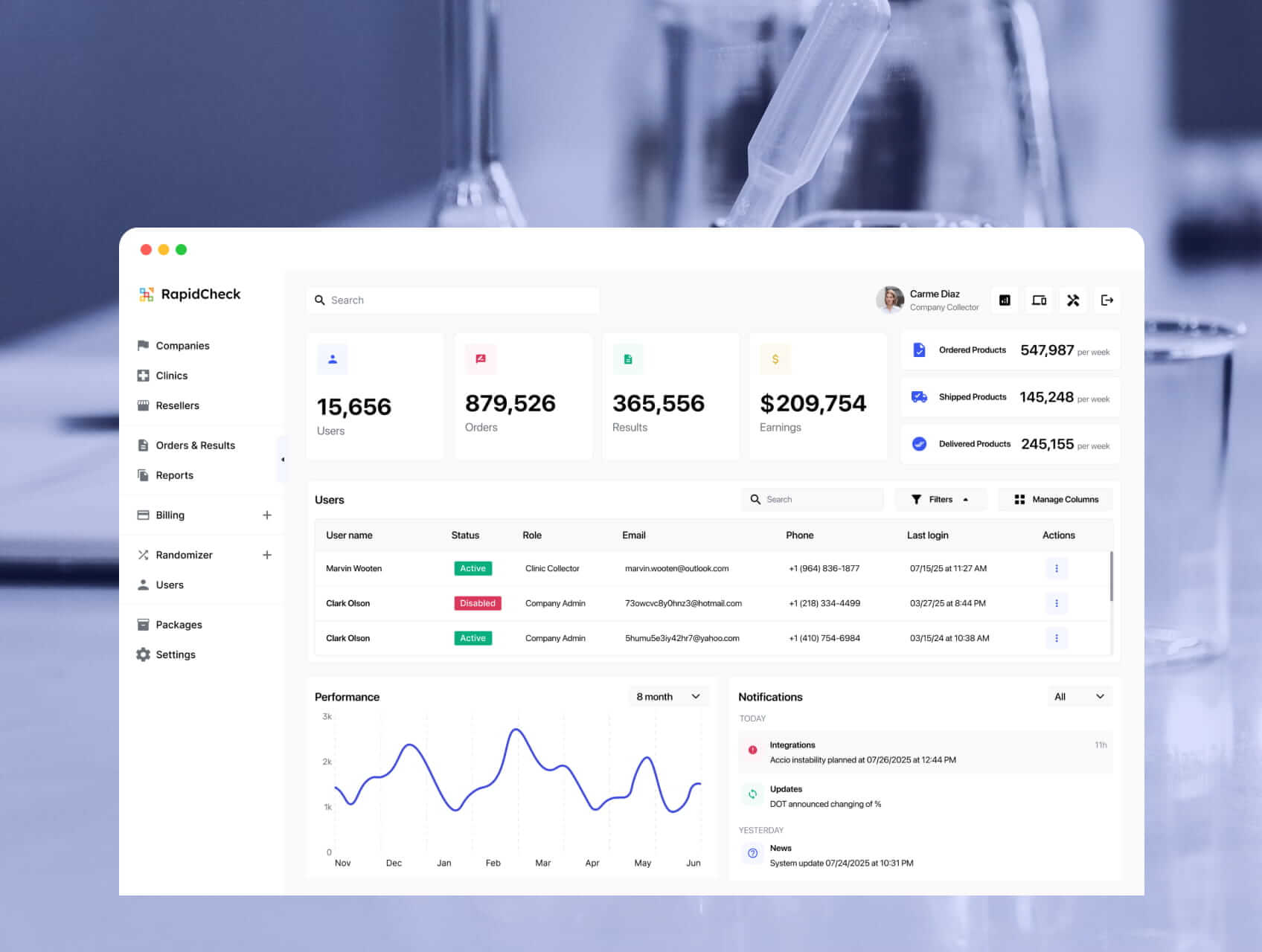


How we build healthcare AI that delivers results
Production-grade AI architecture
HIPAA, FDA, and EU AI Act-ready healthcare AI
AI solutions across every healthcare domain
Agentic RCM with near real-time adjudication
Patient access and care navigation
Clinical workflow and provider productivity
Healthcare data, analytics, and intelligence
Remote patient monitoring and home-based care
Pharmacy and medication management
Population health and preventive care
Secure AI enablement for healthcare products
Accelerate your time-to-value by 3-4x

Our healthcare AI development process
AI strategy & readiness assessment
Duration: 1 to 2 weeks
We start by validating the use case and the real workflow around it. This includes stakeholder interviews, workflow mapping, assessment of risk and data readiness, regulatory classification, and PHI exposure analysis.
What you get: data readiness findings, MVP boundaries, PHI exposure and risk assessment, success criteria.
Planning and data preparation
Duration: 2 to 4 weeks
Get a future-proof architecture before buildout. The team thinks through the integration strategy, model approach, infrastructure, security controls, evaluation, and testing plan. They also review data provenance and dataset quality.
What you get: architecture and integration plan, model & data strategy, compliance control plan, evaluation strategy.
AI solution engineering
Duration: 6 to 16 weeks
The team implements healthcare AI using an iterative Scrum methodology. This may involve building the frontend, backend, AI agents, data pipelines, APIs, EHR/EMR integrations, payer workflows, admin tools, review queues, and override paths.
What you get: working AI, connected data pipelines & APIs, integrations, admin tools, audit-ready user actions and logs.
Validation, hardening, clinical review
Duration: 2 to 6 weeks
Before launch, MindK runs comprehensive checks. These include UAT scenarios, security & performance testing, AI behavior evaluation, red-team prompts, bias and subgroup checks, clinical safety review, usability testing, and release readiness review.
What you get: AI behavior tested against known risks, release readiness findings, security and performance validation, clinical review feedback.
AI solution maintenance
Duration: Ongoing
The final part of our AI healthcare solutions development services involves maintaining CI/CD, observability, incident workflows, and analytics. We also support monitoring, versioning, change control, retraining, and rollback for the AI model. You get detailed documentation to facilitate long-term ownership.
What you get: monitoring for outputs, errors, and drift. Incident, rollback, change-control workflows, iteration roadmap based on live usage
Why healthcare AI projects fail: treating the symptoms
Promising ideas may fall apart in production, whether you try to integrate AI into existing processes or build the entire product around LLMs and agents. These systems must handle messy healthcare data, EHR workflows, payer rules, PHIs, and clinical risk. And above all, they require a solid foundation of data & business strategy.
Data silos across EHRs, devices, registries, claims, and internal systems
To be useful, AI needs a connected context. A model cannot support clinical or billing workflows when the data lives in disconnected systems (or exists only on paper). MindK starts with workflow mapping, then connects the right systems through data pipelines, APIs, FHIR or HL7 flows, and integration logic.
Underestimating the real-world variability of data
Production systems deal with malformed records, duplicate data, missing fields, edge cases, latency limits, permissions, and uptime expectations. We plan for that variability from the start. Data readiness checks, normalization rules, test cases, fallback logic, and monitoring help teams find weak points before they reach users.
Generic models without specialty knowledge
Healthcare language is dense in meaning and workflow-specific. Clinical shorthand, payer rules, documentation habits, and specialty workflows need to be accounted for early. For some products, we retrieve knowledge from approved sources. For others, MindK uses task-specific prompts, fine-tuning, structured outputs, rules, or domain-specific logic.
Hallucinations and low-trust output
Clinical and administrative teams need answers they can trust, trace, and challenge. Our healthcare AI software development company implements source references, confidence thresholds, review queues, and clear override paths to make sure you can trust the AI output.
Inability to override autonomous AI output
Healthcare AI becomes risky when users have no practical way to stop it, correct it, or escalate a case. Clinicians and ops need a control layer to trust AI agents. At MindK, this layer includes review queues, approval steps, escalation logic, human overrides, exception handling, and audit-ready records.
Weak AI governance and compliance
Healthcare AI can touch PHI, regulatory expectations, internal policies, and patient-facing decisions. Without strong governance, the system becomes harder to trust after launch. We build this governance into your operating model, from PHI-aware data flows to robust audit trails and clear post-launch ownership.
What
our
clients
say
-

Allison Erickson
Director of Product, The Lactation Network
USA Such quality work in such efficient timing
«I have nothing but great things to say about our partnership with MindK and the solid work they have done and continue to do for the growth of our company. Our rapport is strong which is a reflection of their professionalism, hard work, and great outputs.»
-

Al Hariri
Co-Founder, Vitagene
USA Results-oriented and
outcome-driven«I can tell you confidently that they are different from your regular agency that just wants to charge as much money for their work as they can get away with. MindK is completely results-oriented and outcome-driven.»
-

Jason Lutton
CEO, International Surrogacy Center
Impressed with their ability to understand our industry
«MindK reduced the time a surrogate takes to complete an online application, increased the number of completed applications, and streamlined our intake process, resulting in fewer staff man hours needed to complete the backend processes for finalizing an applicant.»




Why healthcare organizations choose MindK for AI development
Healthcare-first, not AI-first
MindK builds its own healthcare products. We understand clinical and RCM workflows, regulatory, and patient safety requirements.
Responsible AI by design
AI needs to be ethical and accurate. Explainability, human-in-the-loop, bias testing, and audit trails are non-negotiable.
FHIR-native, integration-ready
We build AI that speaks healthcare data standards natively. This makes it easy to connect with existing systems.
Full lifecycle partnership
MindK focuses on strategy and business outcomes before you invest in our engineering, MLOps, compliance, or post-launch optimization.
Our approach



FAQ
-
Is AI safe to use in clinical decision-making?
Only when the use case, risk level, human oversight, validation process, and regulatory path are defined before launch. Clinical AI should support safe workflows with clear review, escalation, and override logic.
-
How long does it take to go from idea to production healthcare AI?
It depends on workflow complexity, data access, integrations, compliance needs, and MVP scope.
-
Can your AI integrate with our existing EHR?
Yes. Our healthcare AI development company supports EHR, EMR, FHIR, HL7, payer, CRM, scheduling, RCM, and data platform integrations.
-
What is a PoC for healthcare AI and how is it priced?
An AI proof of concept (PoC) is a scoped validation of model behavior, data readiness, workflow fit, integration constraints, and production risk before a full build. Pricing depends on the use case, data access, integration depth, evaluation needs, and MVP scope.
-
How do you handle errors in clinical AI outputs?
We design for grounding, confidence thresholds, review queues, clinician override, audit logs, monitoring, and escalation paths. Sensitive outputs should be traceable and reviewable.
-
What data do you need to build custom AI healthcare software?
Typical inputs include workflow samples, system access details, data schemas, approved datasets, policies, user roles, edge cases, and success criteria.
-
How do you measure healthcare AI ROI?
The ROI of custom AI solutions for healthcare can be measured through operational time saved, reduced manual work, throughput, error reduction, claim quality, user adoption, response time, and workflow completion rates.
-
What happens after launch?
Once the AI is live, we support monitoring, documentation, model evaluation, retraining planning, security review, feature iteration, integration maintenance, and ongoing product improvement.
DOWNLOAD THE COPY
Fill in the form to get your copy. It's 100% free
