



Agentic engineering for smarter product shipping
We build real-world custom products at a fraction of yesterday's cost and time by orchestrating AI agents and LLMs across every stage of the delivery process. Senior engineers own the thinking
Get a delivery estimatefaster time-to-value
lower total cost of ownership
lines of unreviewed code

AI is rewriting the economics of software
We don't resist this shift. Because what AI cannot replace is the part we sell – the art, science, and expertise of engineering.
What you get when senior engineers run Agentic AI and Gen AI through SDLC
Someone who thinks about your business, not just your code
We look at your users, unit economics, where your market is heading, and its challenges. Our approach combines senior expertise, AI-assisted workflows, and commercial consulting to help businesses build systems that last.
Product judgment
Engineering decisions made with a commercial context
Roadmaps that anticipate change
Software in weeks. Not because we cut corners
Prototypes ship in days. For new products, our AI-accelerated software development company replaces 15-person delivery teams with 3-5 AI-assisted seniors. You see production code in the first sprint.
Idea to live software in 6-12 weeks
Up to 8x faster prototyping
Release cycles measured in days
A bill that finally makes sense
Engineering cost drops by up to 60%. Maintenance runs itself. You’re paying for experts who make decisions, not for people who attend meetings about decisions.
Fixed-scope sprints
Up to 75% lower TCO
Maintenance budget cut by 50-60%
High-quality software you actually own and control
Architecture you can read. No agents we won’t show you, no pipelines we won’t hand over. When your AI-accelerated development company leaves, the system keeps running.
90%+ test coverage
Automated test generation
Zero vendor lock-in, zero black box

Agentic development workflow with AI pods
The standard flow our AI engineering company provides for cross-functional units. In rapid sprints, it shrinks to a Product Owner and a couple of AI engineers running every stage with AI.
faster
Product defining
faster
Requirements
faster
Design
faster
Code
faster
Tests
faster
Deployment
Proxy product owner
Solution architect
UX/UI designer
Product engineers
DevOps
Product mgt Agent
Discovery timelines reduced to ~2 weeks.
Requirements Agent
Backlog that's ready before the planning meeting starts.
Design Agent
Five prototypes by Friday, not one by next month.
Coding Agent
Boilerplate disappears. Logic is the only thing left to write.
QA Agent
Tests written alongside the code, not after release.
DevOps Agent
Infrastructure that exists before anyone asks for it.
What agents do
Automation and execution
Code, tests, and infrastructure generation
Analysis, monitoring, and optimization
Documentation and workflow acceleration
Repetitive engineering tasks
What humans own
Security and compliance
Quality and release decisions
Architecture and business logic
Risk management and governance
Strategy and final accountability
Ways to work with us
Rapid zero-to-one validation sprint
For founders who need a working product in the market, fast
A lean team of senior engineers. A full agent stack. Your product is on the market in 6-12 weeks.
Agent-paired product development
For established businesses and B2B product teams
Proxy PO, Architect, Designer, Product Engineers. Each role is paired with its own agent stack.
Compressed legacy modernization
For organizations burdened by low-performing apps
AI agents read your codebase, map the architecture, and run the migration in stages. Senior architects own the risk and rollback.
Ready to rebuild the economics of your software?
A 30-minute conversation tells us both whether our AI software development company is a fit.

We stay at the wheel when vibe coders hand the keys to AI
Staged workflow shows what's under the hood at every step
Vibe coding produces code that compiles and passes tests, yet remains the wrong product. Our AI-assisted software development services break delivery into defined stages, with human sign-off at each stage. Senior engineers define what the system should be before LLM generates a line.
Humans own the thinking. LLMs generate. Agents automate
Senior engineers own scope, architecture, trade-offs, and risk. Claude, Cursor generates code, tests, and docs against patterns we set. Agents run continuously: code review, runtime debugging, self-healing tests, security scanning, and monitoring.
A unified specification, followed by engineers, LLMs, and agents alike
We created a Golden Repository, a single source of truth every AI engineering services project starts from: pre-written contracts, architectural patterns, proven modules, testing standards, and quality gates. Senior AI engineers reference it. LLMs generate against it. Agents validate against it.
Max Churylov
CTO at MindK
Methodology is worth more than code now
It's a strange and good moment to be an engineer. The code writes itself. What's left is the part I've always wanted to do. You design the system, draw the boundaries, and decide what 'good' means. With AI methodology is now worth more than code. That feels right.
Frequently asked questions
- Which AI tools and models do you use in your engineering workflow?
We run a defined stack across the delivery lifecycle. For code generation, debugging, and documentation, our engineers work with Cursor and Claude Code connected to our Golden Repository, so generated code matches our established contracts and patterns. For testing, we use Testsigma. On infrastructure and operations, we apply Snyk Code and AWS services. The principle behind the stack – LLMs and agents generate and automate, while senior engineers own architecture, business logic, and every release decision.
- Can your AI pods integrate with our existing dev team?
Yes. This is one of our standard engagement models, which we call AI-native team embedding. A senior AI-native pod plugs into your existing process, while your team retains ownership of the product logic. It’s designed for teams that want to bring AI-accelerated delivery into their own workflow.
- Do you offer AI strategy consulting before committing to a build?
Our approach combines senior engineering expertise with commercial consulting, so strategic thinking is built into how we work. Before delivery, our business analyst maps your business processes, analyzes your market and competitors, and defines what success looks like. The starting point for a potential engagement is a 30-minute conversation to determine whether we’re a fit on both sides.
- Can you modernize a legacy codebase, or do you only build new products?
We do both. Compressed legacy modernization is a dedicated engagement model for organizations carrying low-performing applications that slow the business down. AI agents read your codebase, map the architecture, and run the migration in stages, while senior architects own the risk and rollback decisions.
- How do you ensure compliance and security?
Security is built in our delivery framework. We integrate AI-driven security tooling, Snyk Code for vulnerability detection and remediation suggestions, alongside AWS GuardDuty, Macie, and Inspector, to scan code, configurations, and infrastructure, and to enforce hardening policies such as encryption at rest, firewall rules, and least-privilege access. This supports compliance efforts against standards like HIPAA and SOC 2. Equally important is the division of responsibility: security and compliance, quality and release decisions, risk management, and governance are owned by humans, not delegated to AI. Agents run continuous security scanning and monitoring, but accountability stays with senior engineers.
- Can you replace a SaaS tool we're currently licensing with a custom-built alternative?
Yes, this is a specific solution we offer for companies paying license fees for a tool that’s only a partial fit. AI accelerates the build of your custom replacement, and automated maintenance keeps it running without requiring an in-house operations team.
- What industries do you have the most project experience in?
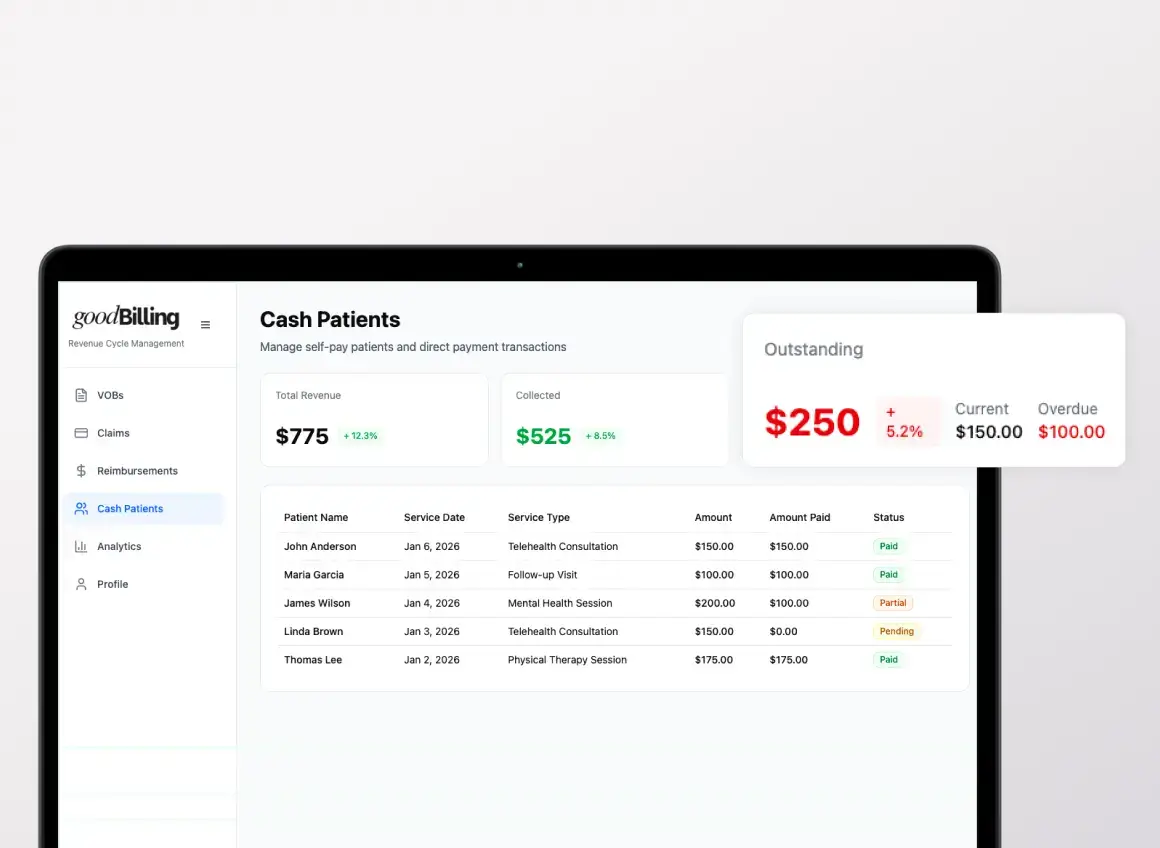
The strongest expertise is in healthcare technology. We have experience in building and scaling a revenue cycle management (RCM) platform roughly five times more cost-effectively using production-ready building blocks and AI-accelerated engineering.
DOWNLOAD THE COPY
Fill in the form to get your copy. It's 100% free
