



Healthcare AI
consulting services
Create AI that survives contact with the real world. Our healthcare AI consulting company assesses data foundations, models ROI and build-v-buy tradeoffs, handles compliance/security risks, as well as adapts legacy systems for agent-to-agent interoperability.
Assess your AI readinessTrusted by





Our healthcare AI consulting services

Build 3-4x faster with our ready-to-use AI agents and agentic blocks
Patient intake & scheduling
Patients complete intake on their own time, and your front desk stops re-keying demographics into the EMR by hand.
Verification of benefits
Learn what a visit will collect before you deliver the care, so the financial conversation happens before the service instead of after the bill.
Eligibility checks
Coverage gets re-verified on a schedule. That catches the plan change that would otherwise turn into a denial nobody saw coming.
Prior authorization
The approval clock starts the day the order is written, so scheduling stops waiting on a fax queue and patients stop waiting on scheduling.
Claim automation
Claims go out clean the first time. That frees your AR team to work exceptions instead of the whole batch.
IVR & voice call automation
The agent handles phone workflows that would otherwise require billing staff to place calls manually.
Chat automation
Automate structured portal interactions, answer payer questions, collect benefit information, determine when the verification is complete, and return a structured result to the downstream RCM workflows.
Healthcare data normalization
the same patient, payer, and procedure get reconciled across systems that each spell them differently.
Payer communication
Every exchange keeps a status trail, so nobody re-asks a question that was answered last week.
Portal navigation
Collect statuses and work with payer portals that offer no API.
Fax/SMS/email automation
Legacy channels healthcare still runs on join the same workflow as everything else.
Specialty coding
Coding agent follows the rules of your specialty, where generic coders quietly lose money.
Patient financial engagement
Patients understand what they owe and why, accelerating payments.
PHI anonymization
Work with public LLMs without PHI crossing your compliance boundary.
Payer-specific claim optimization
Each claim is formatted to the rules of the payer receiving it.
Human-in-the-loop review
Decisions a model shouldn't make alone reach a named reviewer, with the audit trail to prove it.

Our healthcare AI consulting process
Discovery and scoping
Our healthcare AI consultants map the business problem, the current process, and the data behind it. Then we define what success would have to measure. Early conversations with your decision-makers establish budget constraints and ROI expectations while they can still shape the plan.
What you get: high-level roadmap with objectives and known risks.
AI readiness assessment
We audit data quality and lineage, and map the integration surface across your systems and any external registries. We review the compliance and regulatory scope and score candidate use cases against implementation risk.
What you get: prioritized use-case list, target architecture, regulatory scoping, roadmap with cost ranges.
Compliance planning
MindK signs a Business Associate Agreement (BAA), then defines the data handling, access controls, and privacy safeguards needed. To find potential vulnerabilities, our team runs a risk assessment of your existing infrastructure.
What you get: risk assessment matrix, formal compliance framework.
Proof of concept (PoC)
We build a small-scale working system against the highest-value low-risk use case. That validates the data pipeline, the model approach, and the integration path at the same time.
What you get: working PoC, evaluation report against the actual acceptance criteria, ROI analysis.
Handoff to build
The PoC results define the full scope, budget, and timeline. From here, the work moves to delivery, either with your team using our architecture and governance framework or with ours.
What you get: full scope definition, implementation plan, and updated estimates.
Choose your engagement option
Fixed-price advisory
Time-and-materials

Our tech stack
-
 Python
 - Flask
- OpenAI
- Anthropic Claude
-
 Google Gemini
 - Meta Llama
-
 Mistral
 -
 Medplum
 - AWS HealthLake
-
 Azure Health Data Services
 -
 Mirth Connect
 - Amazon Bedrock
- Amazon SageMaker
- Azure Machine Learning
- Google Vertex AI
- LangGraph
- LangChain
-
 Microsoft Agent Framework
 - pgvector
-
 Pinecone
 -
 Weaviate
 -
 Qdrant
 - OpenSearch
- LiteLLM
- Portkey
-
 Helicone
 -
 MLflow
 - Hugging Face Transformers
- PyTorch
- scikit-learn
- AWS Comprehend Medical
- Amazon Textract
- Unstructured.io
-
 Deepgram
 -
 ElevenLabs
 - Twilio Voice
- Snowflake
- Databricks
- BigQuery
- Apache Airflow
- Apache Kafka
-
 Vanta
Vanta -
 Drata
Drata - Microsoft Presidio














MindK's AI governance framework
Model inventory and ownership
Data boundaries and PHI handling
Evaluation and acceptance criteria
Human oversight and escalation
Monitoring, drift, and retraining
Audit trail and regulatory reporting
Complimentary services for healthcare companies

Why companies choose
our AI healthcare consultants
What
our
clients
say
-
Alexander Radchenko
CEO, Radenia AG,
SwitzerlandTransparency and focus
on business value«I've been working with multiple IT services providers for more than two decades and what sets MindK team apart is transparency, focus on business value and quality of the services provided.»
-

Al Hariri
Co-Founder, Vitagene
USA Results-oriented and
outcome-driven«I can tell you confidently that they are different from your regular agency that just wants to charge as much money for their work as they can get away with. MindK is completely results-oriented and outcome-driven.»
-

Jason Lutton
CEO, International Surrogacy Center
Impressed with their ability to understand our industry
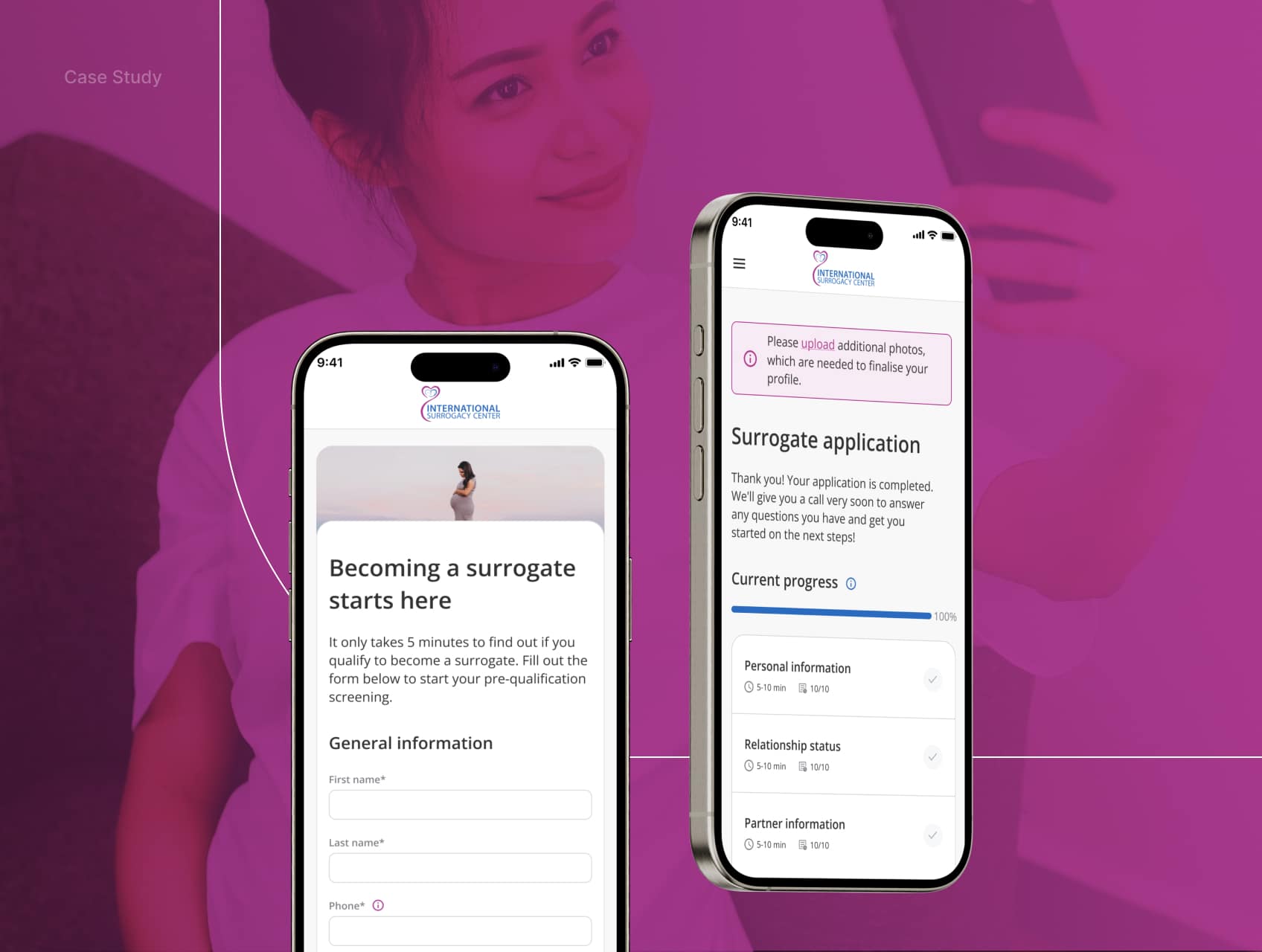
«MindK reduced the time a surrogate takes to complete an online application, increased the number of completed applications, and streamlined our intake process, resulting in fewer staff man hours needed to complete the backend processes for finalizing an applicant.»
-

Allison Erickson
Director of Product, The Lactation Network
USA Such quality work in such efficient timing
«I have nothing but great things to say about our partnership with MindK and the solid work they have done and continue to do for the growth of our company. Our rapport is strong which is a reflection of their professionalism, hard work, and great outputs.»
-

Zaheer Mohiuddin
Co-Founder, Levels.fyi
USA This isn't your typical outsourcing shop
«The quality of work and the interactions with the team felt akin to anyone that I've worked within the Bay Area in technology. MindK's expertise is for real and the bar is high. This isn't your typical outsourcing shop, MindK has top-notch engineers and PMs.»




Contact our healthcare AI consultanting company
Let us know about your challenges
and we'll arrange a free non-binding strategy session within 24 hours..
Our insights

FAQ
- How do you scope FDA, HIPAA, ONC, and state AI law?
Five separate regimes can touch medical AI solutions. Which ones apply depends on what the software does. We establish the position during the readiness assessment, before architecture decisions make it expensive to change.
HIPAA governs privacy, and says nothing about device classification. HIPAA sets the rules for how PHI is stored, transmitted, and shared, including through any model vendor in your subprocessor chain. Whether your software is a regulated medical device is a separate question under a separate law.
FDA does not regulate administrative and operational AI. Revenue cycle automation, eligibility and benefit verification, prior authorization workflow, patient access and scheduling, documentation support, and data normalization sit outside device regulation. This covers the majority of our healthcare AI work and the areas where our production experience runs deepest.
FDA treatment of clinical decision support turns on the Cures Act criteria. The 21st Century Cures Act set out the criteria that decide whether CDS software is a regulated device. Software that shows a clinician the basis for its recommendation, in a form the clinician can independently review, may fall outside device regulation. Software that issues a directive output, drives time-critical decisions, or offers no practical way to review the reasoning generally does not. We scope CDS against those criteria during the assessment and design toward the intended side of the line deliberately.
FDA regulates diagnostic imaging AI as a device. AI that detects or characterizes findings in medical images is a regulated device in the United States. It requires a clearance pathway, a clinical validation plan, and, for models that change after clearance, a Predetermined Change Control Plan.
ONC requires transparency for predictive AI inside certified health IT. Predictive decision support shipping inside or alongside ONC-certified health IT carries disclosure obligations for the source attributes behind the algorithm. We design for that disclosure at the outset, because producing the documentation as you build costs less than reconstructing it later.
State law sets the limits on AI in utilization review and claims. For revenue cycle and patient access work, state statutes bind tighter than federal law does. The recurring pattern across recent legislation: AI may process and approve authorization requests, and it cannot deny or delay care on medical necessity grounds without human review. Several states additionally require decisions to rest on the individual patient’s clinical history and mandate periodic accuracy audits. At least one 2026 law restricts providers from submitting AI-generated claims without review by a billing professional.
- How do you protect sensitive patient data and ensure HIPAA compliance?
MindK follows the compliance-by-design approach. It includes security and compliance considerations from the earliest stages of AI development.
The basic requirement is end-to-end encryption for all data in transit and at rest. Our engineers add role-based access control (RBAC) and audit logging to track data usage. We also run regular penetration testing to identify hidden vulnerabilities. For more information, check our guide on HIPAA compliance for startups.
- How do you handle regulatory changes over time, especially the FDA and CMS guidelines?
Artificial intelligence consultants at MindK follow a continuous compliance strategy. Constant monitoring of policy updates is one of its parts. We also use technical solutions like modular architecture to quickly update AI models and documentation to reflect new requirements.
- What are the cost and ROI considerations for AI implementation services?
Our AI healthcare consulting firm starts with a feasibility study to estimate costs and forecast potential returns. By measuring KPIs such as turnaround times and errors, we can project ROI and provide a data-driven rationale for budgeting.
- Can we phase the project to manage costs and demonstrate success?
Yes. Artificial intelligence consulting starts with a small pilot—such as automating a single workflow (e.g., claims processing). Based on pilot results, we refine the AI model and gradually expand its scope. This approach spreads out investment, minimizes risk, and provides measurable outcomes at each step.
- Will we need significant upgrades to integrate AI with our existing EHR?
You can typically integrate AI modules via middleware or standardized APIs (HL7/FHIR). No major upgrades are needed if your current EHR or billing software supports interoperability standards. However, smaller updates might be recommended to improve software performance or data flow.
- What are the core technical requirements (new infrastructure, cloud services, hardware) needed to implement AI?
Typical requirements for implementation of AI in healthcare include secure cloud environments (Azure, AWS) with HIPAA configurations. Larger projects also require GPU/TPU clusters for intensive training workloads. Moreover, an API or middleware layer is required to establish secure data exchange between AI and existing systems.