
Your billers still spend hours on payer hold time. A phone claim status inquiry takes 25 minutes of staff time on average, the longest administrative task in the 2024 CAQH Index (2023 data, the latest edition with public per-task figures). AI voice agents for healthcare RCM (revenue cycle management) take those calls off the team: they dial the payer, get through the payer IVR, wait on hold, ask the right questions, and write structured answers back to the EHR.
Most healthcare voice AI was built to book appointments and take inbound calls, not to get a straight answer from a payer rep. We compared 15 vendors on what matters in revenue-cycle calls: RCM stage, call direction, EHR write-back, BAA/HIPAA coverage, pricing, and limits.
Why payer calls are the hardest phone work in RCM
A scheduling call follows a script that the practice controls. Every payer runs its own IVR tree and changes it without notice, asks for a different mix of NPI, Tax ID, member ID, and claim number, and handles hold and transfers its own way. A single benefits verification call can take up to an hour for a human caller, and verification of benefits alone can require 15-60 minutes of manual work per case. Then the rep answers in free text, with carve-outs and self-funded plan exceptions that no eligibility response spells out. A voice calling AI agent for healthcare that works here needs payer-specific call logic, validation of what it heard, and an exception queue with warm transfer to staff.
Quick Pick: find your match in 30 seconds
| If you need… | → Best fit | Why |
|---|---|---|
| Payer calls inside your own RCM stack and fully tailored to your workflow | MindK, SuperDial | Exception handling, audit trails, pre-built payer agent tailored to your stack, live in about 4 weeks |
| One vendor for patient and payer calls | Prosper AI | 80+ EHR/PM integrations |
| Front-desk calls in a specialty practice | Flexbone | Eligibility across 25+ payer portals |
| Inbound billing calls at an Epic health system | Hyro, PolyAI | Epic integrations |
| Your own agent, built in-house | Telnyx, Retell AI, Vapi | Per-minute voice infrastructure |
| Pharma hub benefits verification | Infinitus | Built around specialty-drug access |
Best AI voice agents for healthcare RCM in 2026, mapped by revenue-cycle stage
The revenue cycle is typically divided into three stages. Front-end RCM covers the processes before care is delivered, including patient registration, insurance eligibility and benefits verification, prior authorization, and cost estimation. Mid-cycle RCM focuses on documenting and translating care into billable claims through clinical documentation, medical coding, charge capture, and claim preparation. Back-end RCM starts once a claim is submitted and includes payment posting, claim status follow-up, denial management, and appeals.
We then grouped vendors based on the types of payer calls they handle and the RCM stages their solutions cover. Profiles use the same core fields, so you can compare top AI voice agents for healthcare claims calls line by line.
Group A: payer-facing RCM agents
These agents call payers for eligibility verification, benefits verification, prior authorization, and claim status. For basic active-coverage checks, an X12 270/271 transaction through your clearinghouse is faster and cheaper; voice is the fallback for what the 271 leaves out, such as procedure-level benefits and self-funded plans.
Need a full RCM platform rather than one agent? See Group E below ↓
MindK: pre-built AI payer call agent, tailored to your RCM stack
MindK ships a pre-built AI payer call agent and configures it to each client’s payers, IVR paths, questions, and data model. About 80% of the agent is ready on day one.
| Best for | Specialty practices, billing companies, and healthtech products that need payer calls inside their own RCM workflow |
| RCM stage | All |
| Call direction | Payer-facing |
| Key RCM workflows | Benefits verification, eligibility, prior authorization, claim status, denial management |
| EHR/PM integrations | Your EHR, RCM, or billing system; prior work with Epic, Oracle Health (Cerner), Veradigm, NextGen. Write-back: yes |
| BAA | Yes, signed before any PHI is shared |
| Pricing | Custom; MindK estimates 40–50% below a comparable custom build |
| Limits | Not self-serve: discovery and configuration come first. 20 insurers are pre-configured; others need IVR mapping |
| KPI it moves | Cost per resolved call; staff time (15-60 minutes saved per VoB case) |
Where MindK excels
First, the agent was built for payer calls, not adapted from a scheduling bot. Twelve specialized components handle payer-aware scheduling, IVR navigation, keypad input, hold handling, rep detection, and field validation. Second, every call ends in one of 13 outcome classes, so a failed call returns a reason and a next step, such as “invalid member ID: correct and retry.” Third, the agent lives inside your own RCM workflow and goes live in about 4 weeks.
Case study: GoodBilling. MindK built the agent for its own RCM platform, where portal agents and the voice agent retrieve benefits that EDI can’t. Result: 300 clinics onboarded, 68K payer conversations automated a month, $1M+ in monthly RCM savings. → Full case study
Infinitus: payer calls for pharma and specialty pharmacy
Infinitus has automated payer calls longer than most vendors here. Its agents call payers and PBMs for benefits, prior auth, and claims data.
| Best for | Pharma hubs, specialty pharmacies, and ASCs verifying specialty-drug benefits at volume |
| RCM stage | Front-end, mid-cycle |
| Call direction | Payer-facing (payers and PBMs) |
| Key RCM workflows | Benefits verification, prior authorization, appeals, claim status |
| EHR/PM integrations | SIS Complete EMR for ASCs; structured outputs otherwise. Write-back: limited public detail |
| BAA | HIPAA; SOC 2 Type II |
| Pricing | Custom enterprise |
| Limits | Built for specialty-drug access, not provider billing. Calls can run over an hour, so turnaround tracks payer hold time |
| KPI it moves | Benefits-verification turnaround, time to therapy |
Where Infinitus excels
Depth on specialty-drug benefits: the company says one call can return 200+ data points.
When to choose Infinitus vs MindK
Choose Infinitus for hub or specialty pharmacy verification. Choose MindK for payer calls inside your own provider-side RCM platform.
SuperDial: auditable payer calls for RCM companies
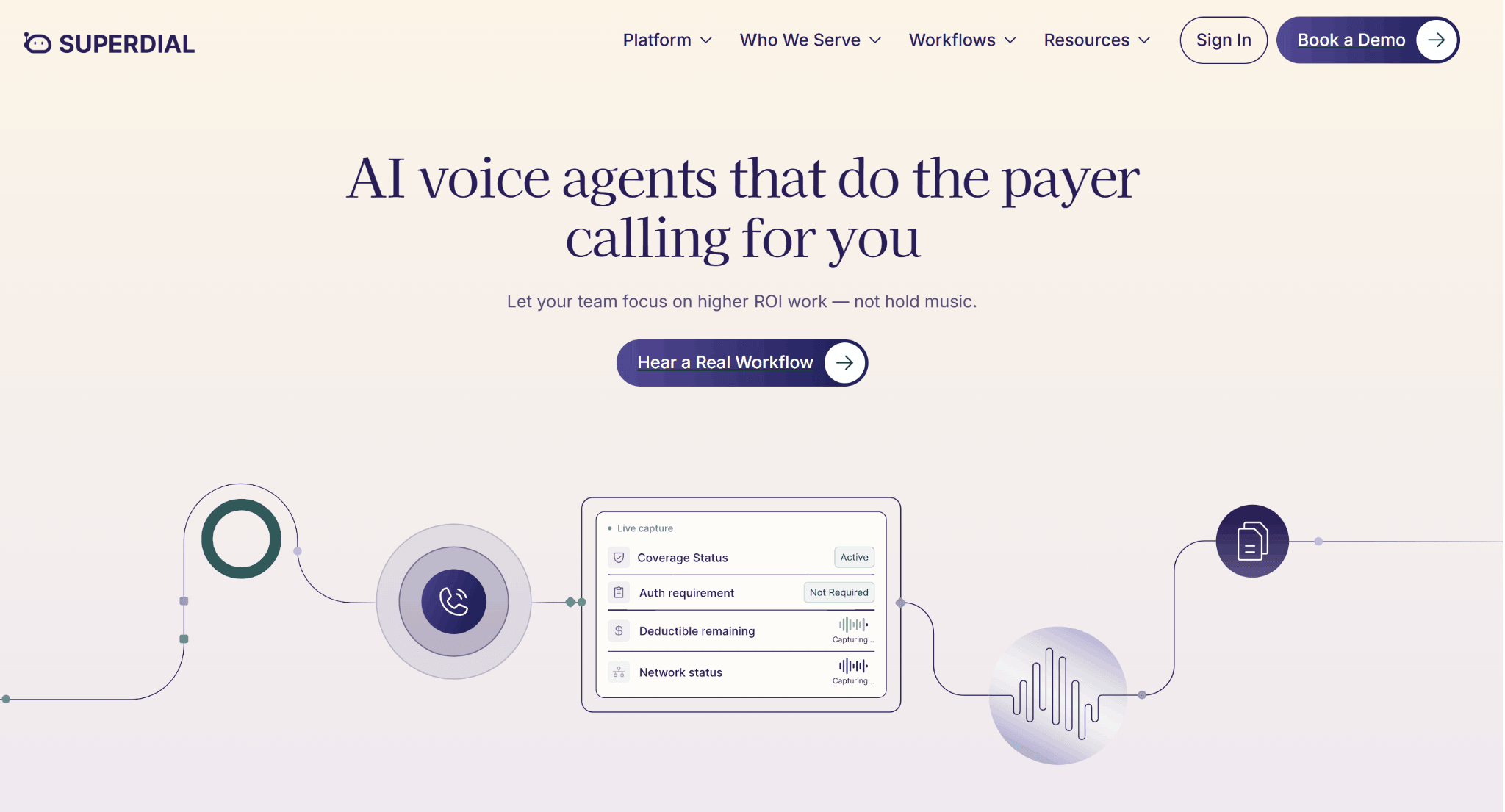
SuperDial starts from the premise that many payer answers still exist only on the phone. Its agents get through IVRs and transfers and return results with timestamps and confidence scores.
| Best for | RCM companies and provider groups with high payer-call volume |
| RCM stage | Front-end, mid-cycle |
| Call direction | Payer-facing |
| Key RCM workflows | Benefits verification, prior authorization, claim status, credentialing |
| EHR/PM integrations | EHR/PM fields, API, webhooks, CSV/PDF. Write-back: yes |
| BAA | Yes; HIPAA, SOC 2 Type II |
| Pricing | Not published |
| Limits | No patient calls. Field mapping is set up per system |
| KPI it moves | Days in A/R, cost to collect |
| Verified on | Sep 30, 2026 |
Where SuperDial excels
Exception handling: calls it can’t resolve reach staff with what was tried, what was captured, and what is missing.
When to choose SuperDial
Choose it when you bill for many clients and need an audit trail fed into your own platform.
VoiceCare AI: long, multi-transfer payer calls
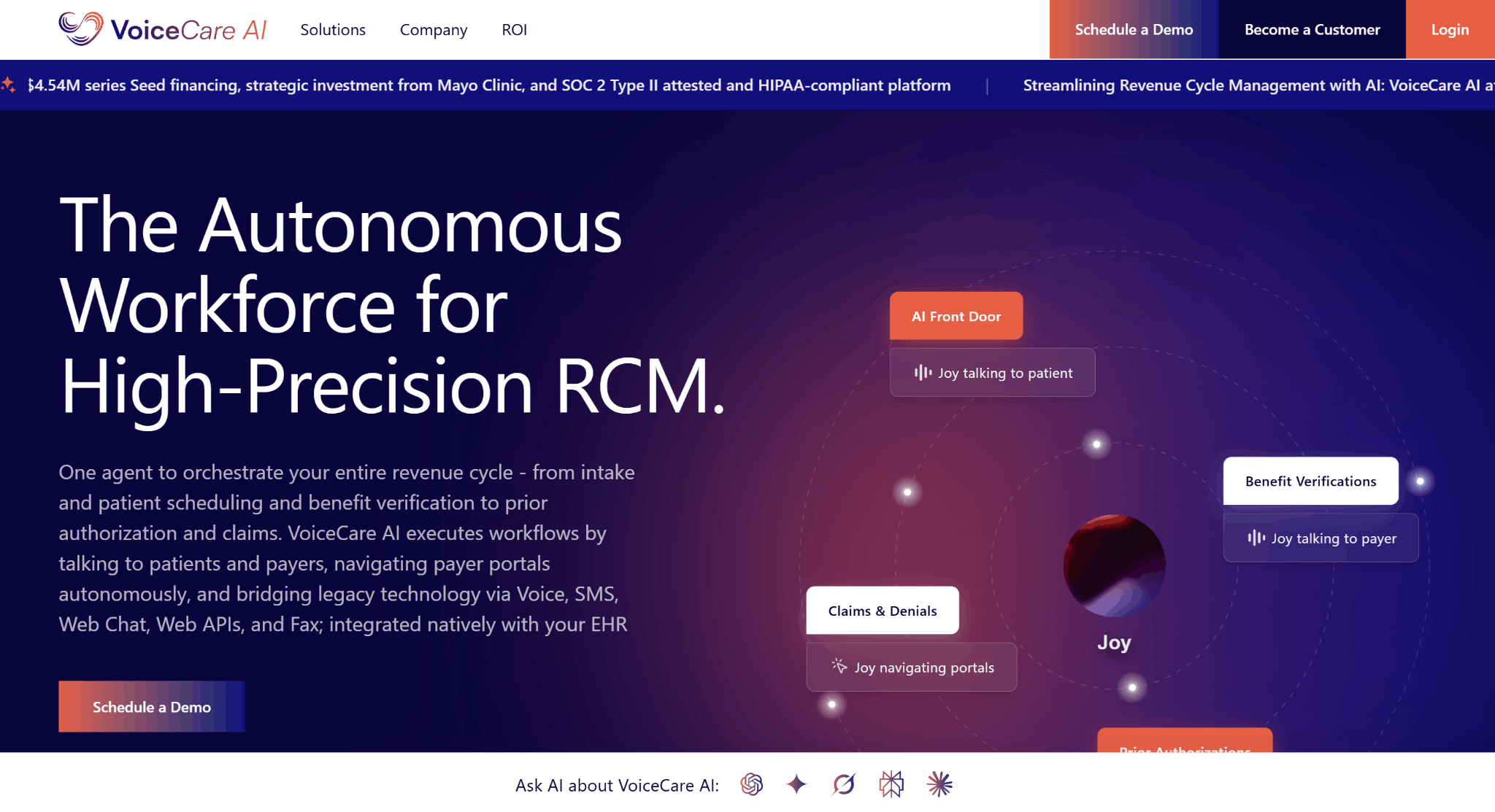
VoiceCare AI’s agent, Joy, automates provider-to-payer calls. Mayo Clinic piloted it and invested in the company’s $4.54M seed round.
| Best for | Health systems whose payer calls run long and pass through several transfers |
| RCM stage | All |
| Call direction | Payer-facing |
| Key RCM workflows | Benefits verification, prior authorization, claim follow-up, A/R collections |
| EHR/PM integrations | Native EHR integration (vendor-stated); specific systems not listed |
| BAA | HIPAA; SOC 2 Type II |
| Pricing | Custom |
| Limits | Seed-stage company with few public references. EHR list not published |
| KPI it moves | Days in A/R, staff hours on hold |
| Verified on | Sep 30, 2026 |
Where VoiceCare AI excels
Endurance: the CEO says Joy can hold a line for more than two hours.
When to choose VoiceCare AI
Choose it when your payer calls are long and an academic medical center reference matters.
Claimity: payer calls inside an AI billing suite
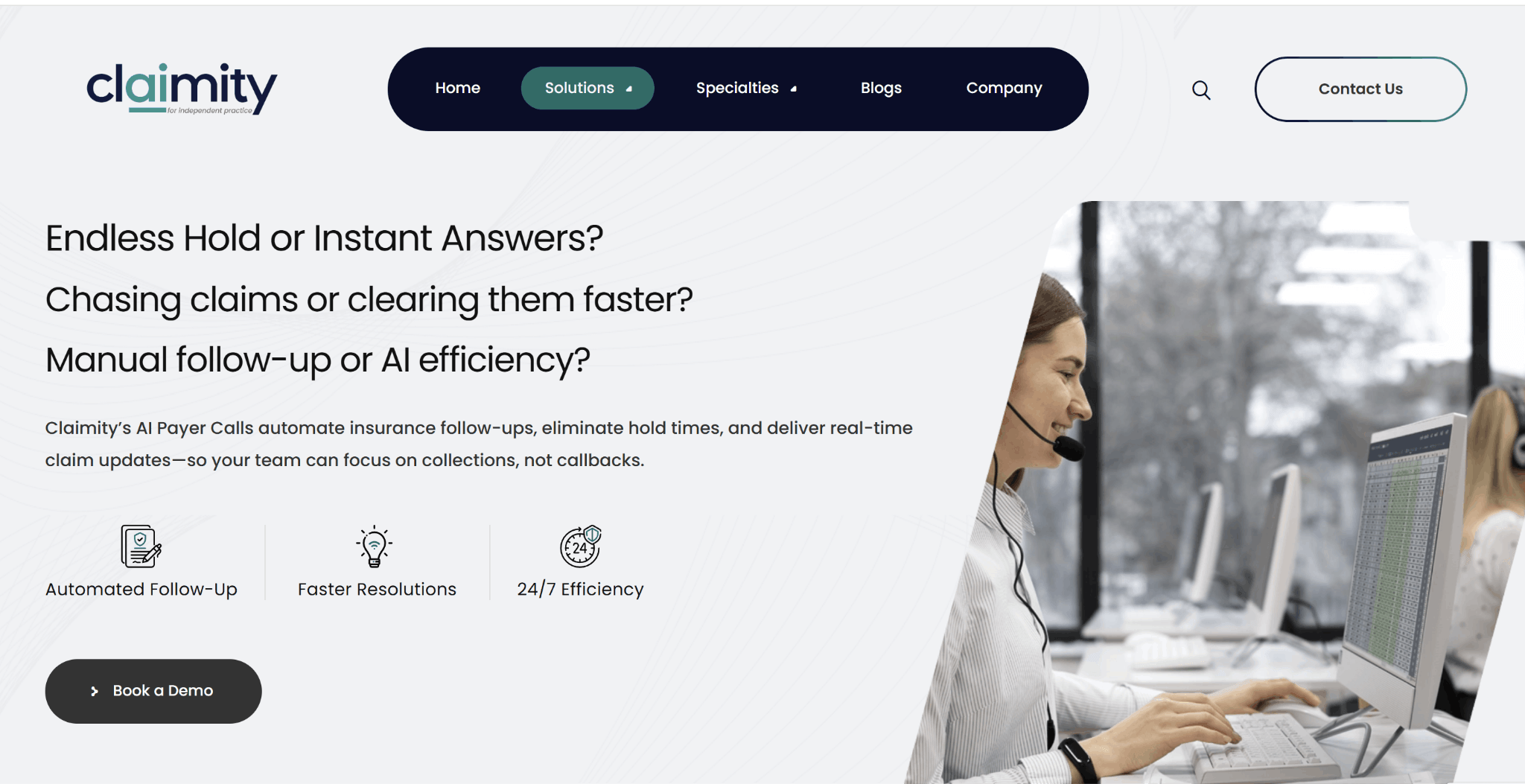
Claimity sells an AI-first billing suite. Its AI Payer Calls module checks claim status in batches and flags only the claims that need a person.
| Best for | Practices and billing companies that bill on Claimity |
| RCM stage | Mid-cycle, back-end |
| Call direction | Payer-facing |
| Key RCM workflows | Claim status, benefits verification, denial follow-up |
| EHR/PM integrations | Claimity’s own EHR/PM worklists and denial queue. Third-party write-back not documented |
| BAA | Not stated on the product page |
| Pricing | Quote |
| Limits | Value depends on using Claimity’s suite. BAA terms must be requested |
| KPI it moves | Days in A/R (Claimity says A/R staff spend 25–40% of their time on payer follow-up) |
| Verified on | Sep 30, 2026 |
Where Claimity excels
Call results land straight in the claim worklist with a suggested next step.
When to choose Claimity vs MindK
Choose Claimity if you already bill on it. Choose MindK for payer calls inside a different RCM system.
Neon Health: AI workers for patient access
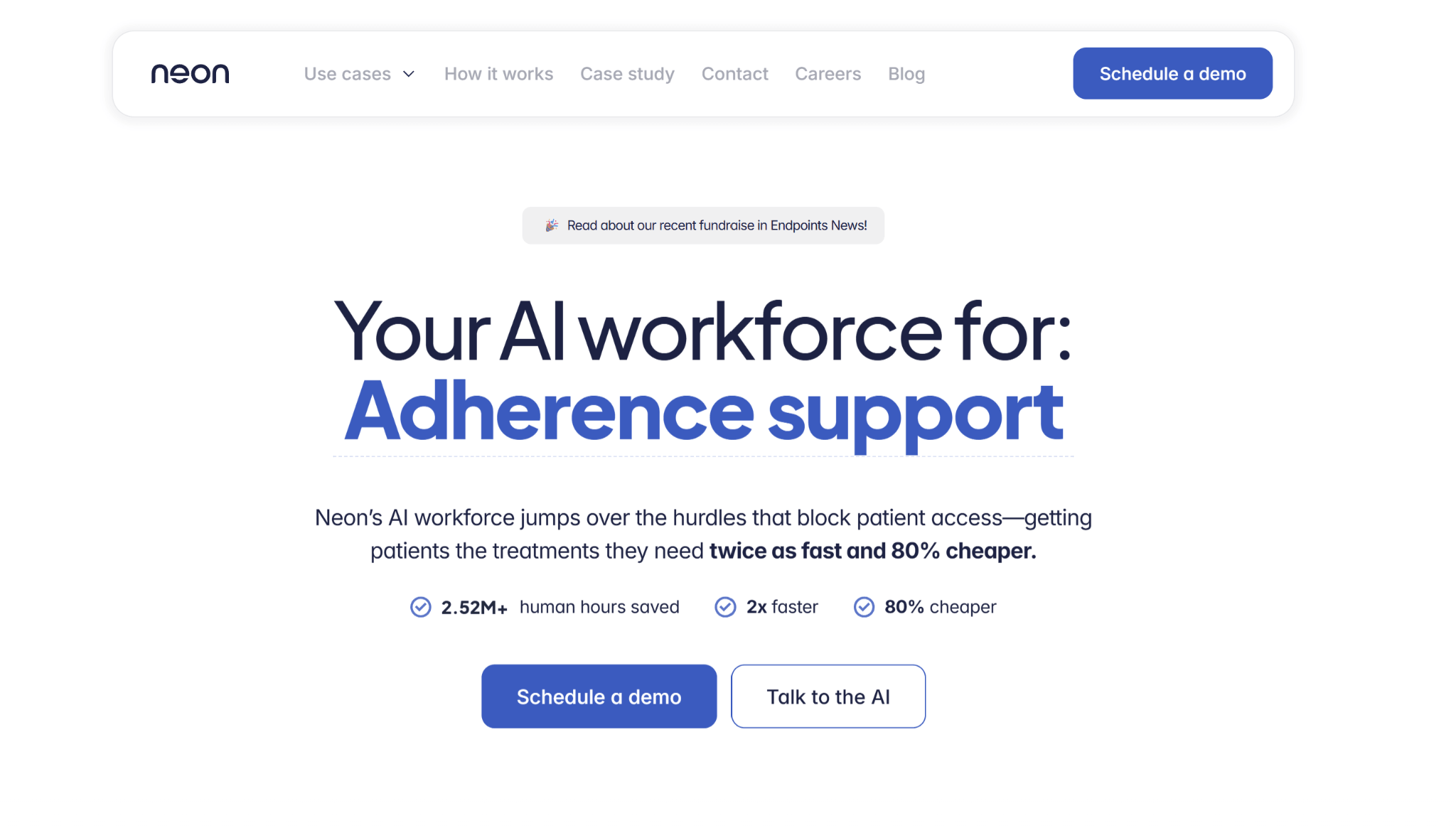
Neon Health builds AI workers from modular parts: phone and IVR automation, portal navigation, a rules engine, and human-in-the-loop review.
| Best for | Hub service providers and pharma manufacturers |
| RCM stage | Front-end |
| Call direction | Payers, providers, patients |
| Key RCM workflows | Benefits verification, prior authorization, appeals, copay assistance |
| EHR/PM integrations | CRM and case management systems. Provider EHR write-back not documented |
| BAA | HIPAA; public trust center |
| Pricing | Quote |
| Limits | Not built for provider billing or claim status |
| KPI it moves | Labor cost per case (vendor case study: 70% lower at a pharma hub) |
| Verified on | Sep 30, 2026 |
Where Neon Health excels
One AI worker covers payer, provider, and patient calls for the same case.
When to choose Neon Health
Choose it when time to therapy is your main metric.
Droidal: voice agents inside a full RCM suite
Droidal sells 20+ AI agents across the revenue cycle by subscription, with voice agents for payer and patient calls.
| Best for | Clinics and billing teams that want voice plus claims and denials bots |
| RCM stage | All |
| Call direction | Both |
| Key RCM workflows | Eligibility verification, prior authorization, claim status, payment reminders |
| EHR/PM integrations | Epic, Cerner, NextGen, athenahealth (vendor blog). Write-back details not published |
| BAA | HIPAA |
| Pricing | Subscription |
| Limits | Integration details sit mostly on the vendor blog; test write-back in a pilot |
| KPI it moves | Manual call handling (Droidal says up to 70% less) |
| Verified on | Sep 30, 2026 |
Where Droidal excels
One vendor covers the call and the back-office task after it.
When to choose Droidal
Choose it for calls and back-office bots under one subscription.
Group B: patient and payer calls on one platform
These vendors started with front-desk calls and added payer work, live or through portals and APIs.
Prosper AI: one vendor for both sides of the phone
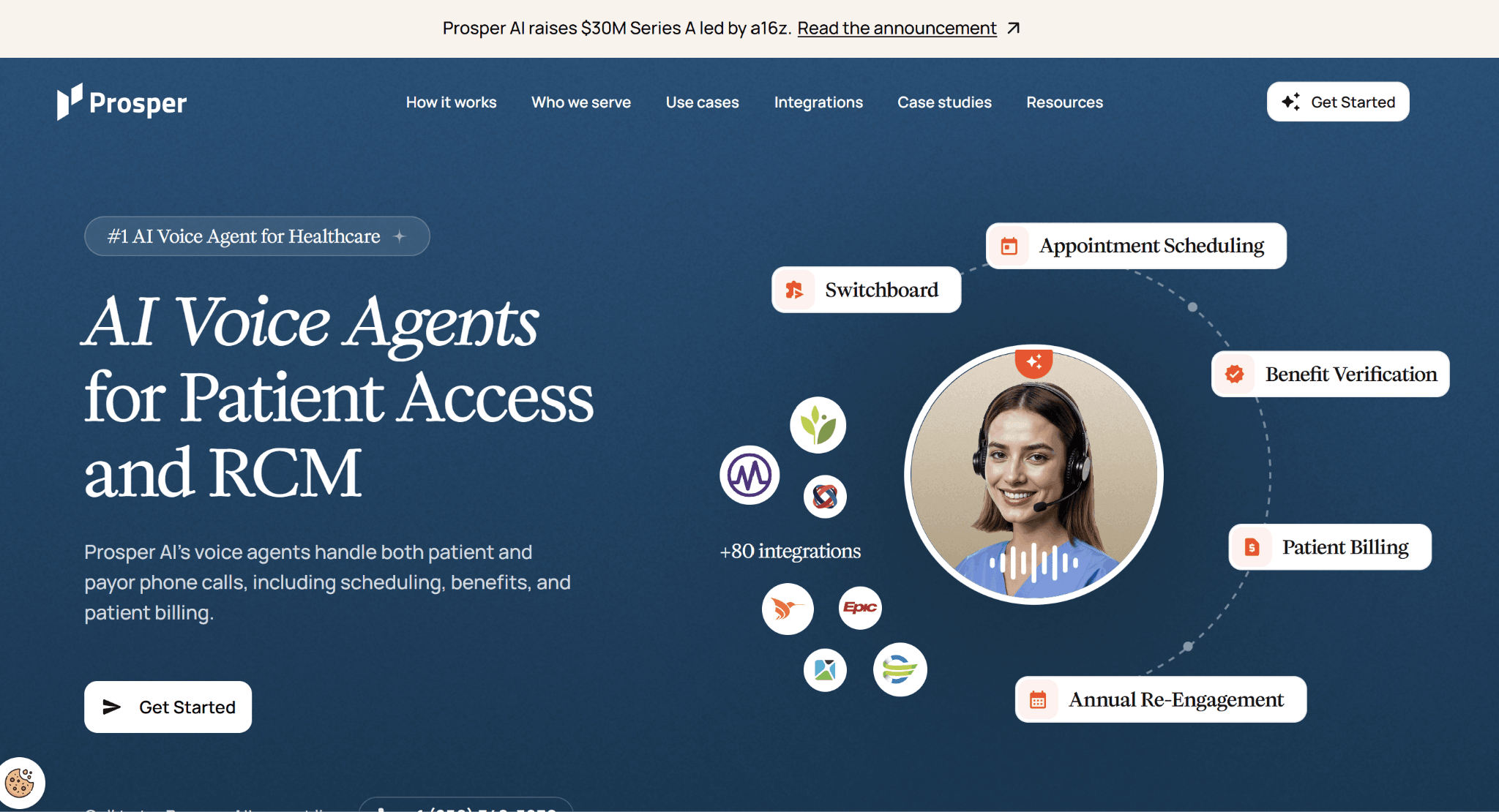
Prosper AI checks eligibility by API first and calls the payer only for the gaps. It partners with athenahealth and raised a $30M Series A led by a16z.
| Best for | Health systems and specialty groups that want one vendor for patient and payer calls |
| RCM stage | All |
| Call direction | Both |
| Key RCM workflows | Scheduling, eligibility and benefits, prior authorization, claim status, patient collections |
| EHR/PM integrations | 80+ EHR, PM, and clearinghouse integrations incl. Epic, athenahealth. Write-back: yes (vendor-stated) |
| BAA | HIPAA |
| Pricing | Custom |
| Limits | Pricing not public. Ask which payers it calls live |
| KPI it moves | Containment rate, verification turnaround (vendor blog cites a sub-2-hour SLA) |
| Verified on | Sep 30, 2026 |
Where Prosper AI excels
Breadth: one contract and one integration layer for front-desk and payer work.
When to choose Prosper AI vs MindK
Choose Prosper AI for one subscription on both sides. Choose MindK when payer logic and workflow ownership matter more.
Flexbone: front-desk calls with eligibility on the same call
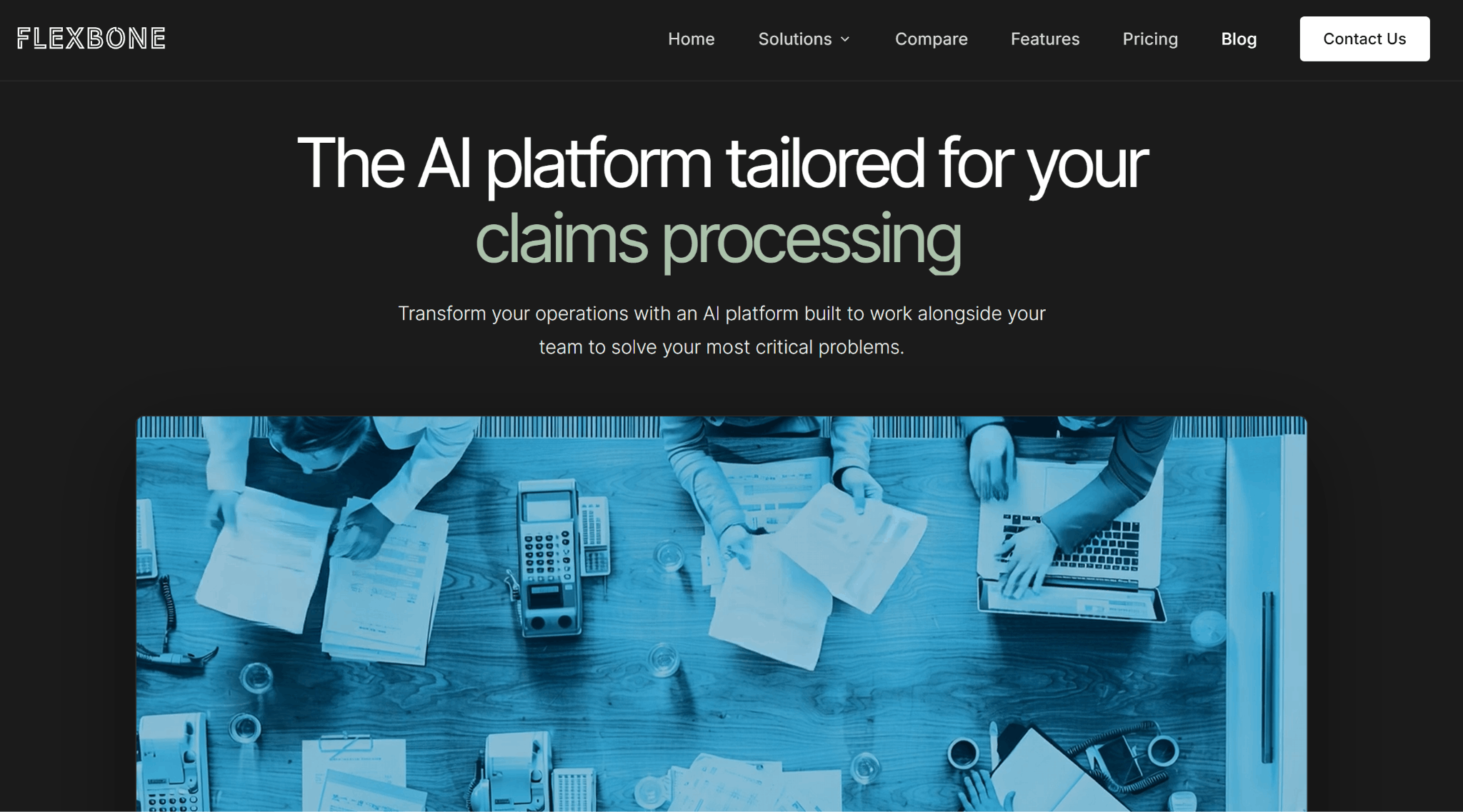
Flexbone maps a practice’s real calls first, then runs the AI in healthcare RCM agent in shadow mode before patients hear it.
| Best for | Specialty practices (ortho, dental, ASCs) with heavy front-desk volume |
| RCM stage | Front-end |
| Call direction | Patient-facing; payer data via 25+ portals |
| Key RCM workflows | Scheduling, eligibility verification, triage, recalls |
| EHR/PM integrations | 15+ systems incl. Epic, athenahealth, eClinicalWorks, ModMed. Write-back: yes |
| BAA | Yes |
| Pricing | Quote |
| Limits | Payer checks run through portals, not live calls, so details portals don’t show still need a person |
| KPI it moves | Containment rate, call abandonment |
| Verified on | Sep 30, 2026 |
Where Flexbone excels
Rollout discipline: typical go-live takes four weeks.
When to choose Flexbone
Choose it when patients hang up on hold, and you need coverage confirmed during the call.
Nanonets Health: document-first agents that also call payers
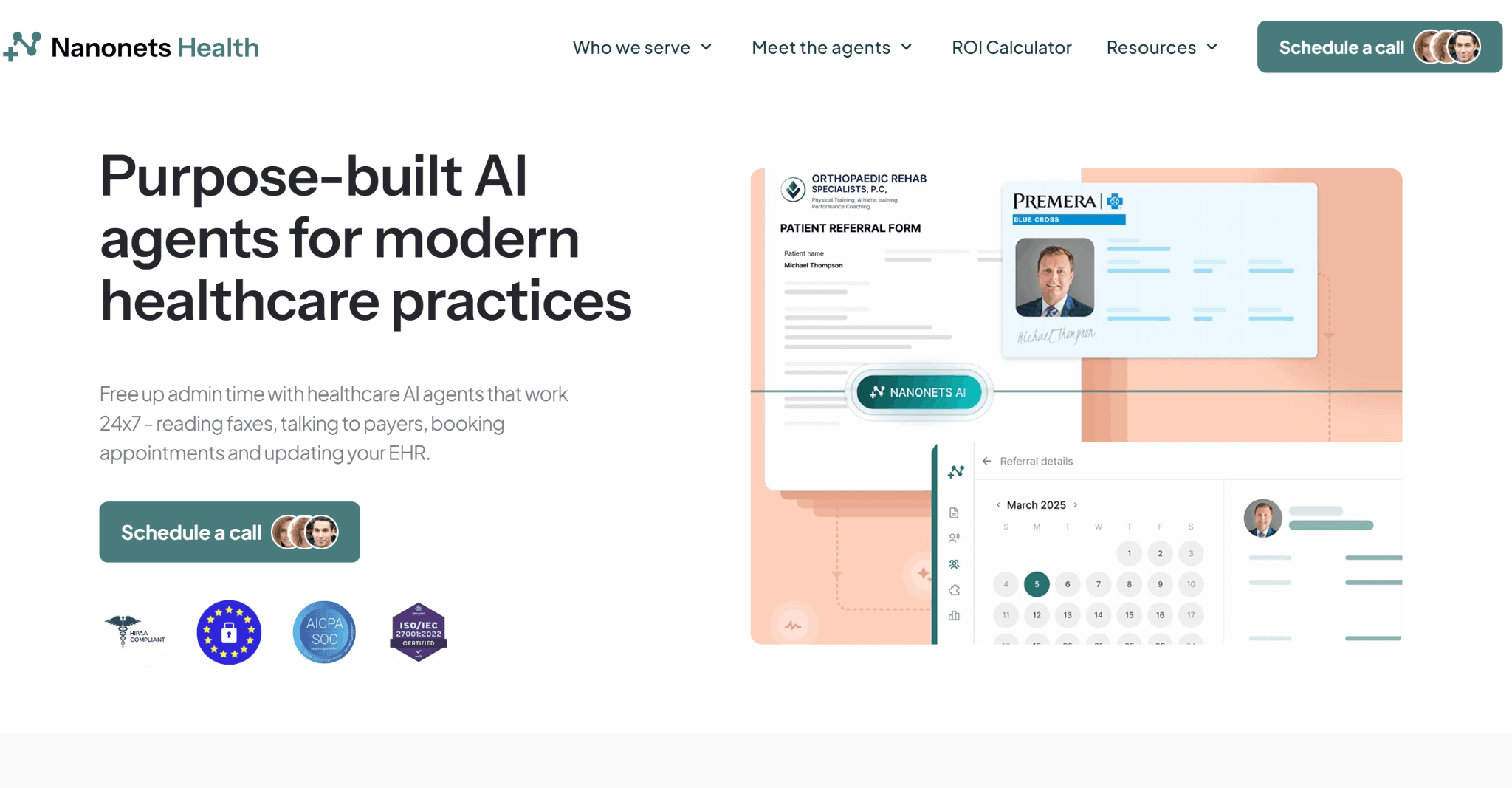
Nanonets Health started in document AI. Its agents read faxes, talk to payers, and update the EHR.
| Best for | Specialty practices with fax- and referral-heavy intake |
| RCM stage | All |
| Call direction | Both |
| Key RCM workflows | Referral intake, eligibility and benefits, prior authorization, billing |
| EHR/PM integrations | athenahealth, NextGen, eClinicalWorks, MEDHOST. Write-back: yes |
| BAA | HIPAA; SOC 2; ISO 27001 |
| Pricing | Quote |
| Limits | Voice is one channel in a document-first platform; ask which payer tasks run by phone |
| KPI it moves | Days in A/R (a regional hospital on its site: 54 → 42) |
| Verified on | Sep 30, 2026 |
Where Nanonets Health excels
Documents and calls in one flow, from fax intake to payer follow-up.
When to choose Nanonets Health
Choose it when intake arrives by fax.
Group C: patient access and inbound billing calls (health systems)
These platforms don’t call payers. They matter for patient collections: a patient who can pay on the first call shortens the cycle.
Hyro: Epic-centric patient access
Hyro runs voice, chat, and SMS agents for health system call centers and is deployed at 45+ health systems.
| Best for | Epic-based health systems with high inbound call volume |
| RCM stage | Front-end, patient collections |
| Call direction | Patient-facing |
| Key RCM workflows | Scheduling, billing questions, billing reminders |
| EHR/PM integrations | Epic (Showroom-listed), Salesforce, ServiceNow. Write-back: yes, into Epic |
| BAA | HIPAA |
| Pricing | Not published |
| Limits | No payer calls. Other EHRs are less documented |
| KPI it moves | Containment rate, call abandonment |
| Verified on | Sep 30, 2026 |
Where Hyro excels
Taking billing and scheduling calls off busy call-center queues.
When to choose Hyro
Choose it if you run on Epic.
PolyAI: multilingual inbound billing calls
PolyAI speaks 75+ languages and launched a direct Epic integration in August 2026.
| Best for | Health systems with multilingual patient billing calls |
| RCM stage | Back-end (patient collections) |
| Call direction | Patient-facing, inbound |
| Key RCM workflows | Bill payment, insurance updates, payment plans |
| EHR/PM integrations | Direct Epic integration via Connection Hub |
| BAA | HIPAA; card payments via PCI Pal (PCI DSS Level 1) with DTMF masking |
| Pricing | Not published |
| Limits | No payer calls. Integrations are set up with PolyAI’s team, not self-serve |
| KPI it moves | Containment rate (PolyAI says its agents resolve over half of transactions) |
| Verified on | Sep 30, 2026 |
Where PolyAI excels
Natural voice across languages, with card numbers kept out of the transcript.
When to choose PolyAI
Choose it when many billing callers prefer a language other than English.
Group D: developer platforms to build your own RCM agent
These sell voice infrastructure, not RCM workflows. Your team owns payer logic, IVR maps, write-back, and QA.
Retell AI: voice-first builder
Retell AI gives developers a voice infrastructure with IVR navigation, warm transfer, and batch calling built in.
| Best for | Engineering teams building their own agent |
| Call direction | Both |
| BAA | Self-serve BAA; SOC 2 Type I and II |
| Pricing | $0.07–0.31/min, depending on voice, LLM, and telephony |
| Limits | No payer knowledge; every payer IVR is yours to map and maintain |
| Verified on | Sep 30, 2026 |
When to choose Retell AI vs MindK
Choose Retell AI if your team will build payer logic and QA itself. Choose MindK if you want them pre-built.
Vapi: model-agnostic orchestration
Vapi orchestrates the speech, LLM, and voice providers you pick, billed at provider cost on top of its fee.
| Best for | Developers who want to swap models |
| Call direction | Both |
| BAA | HIPAA add-on $2,000/month; with your own model or carrier accounts, each provider needs its own BAA |
| Pricing | $0.05/min platform fee; speech, LLM, and telephony extra |
| Limits | Same build burden as Retell; costs spread across providers |
| Verified on | Sep 30, 2026 |
When to choose Vapi
Choose it when your volume absorbs the add-on and model control matters.
Telnyx: carrier-owned voice AI under one BAA
Telnyx owns its carrier network and runs speech, model, and telephony in one stack.
| Best for | Teams that want the shortest BAA chain |
| Call direction | Both |
| BAA | HIPAA on every account; one BAA across the stack |
| Pricing | $0.05/min with speech; LLM and telephony extra |
| Limits | No RCM logic included |
| Verified on | Sep 30, 2026 |
When to choose Telnyx
Choose it when you build in-house and want the fewest sub-processors touching PHI.
Group E: custom-built voice agent on your RCM stack
Between renting a SaaS agent and building from scratch sits a third route: an engineering partner assembles the agent from production-tested components and tailors payer logic and write-back to your systems. It fits when your payer mix breaks generic tools, or you sell an RCM product. See MindK’s experience below.
Looking for a ready-made payer call agent? Read Group A instead↑
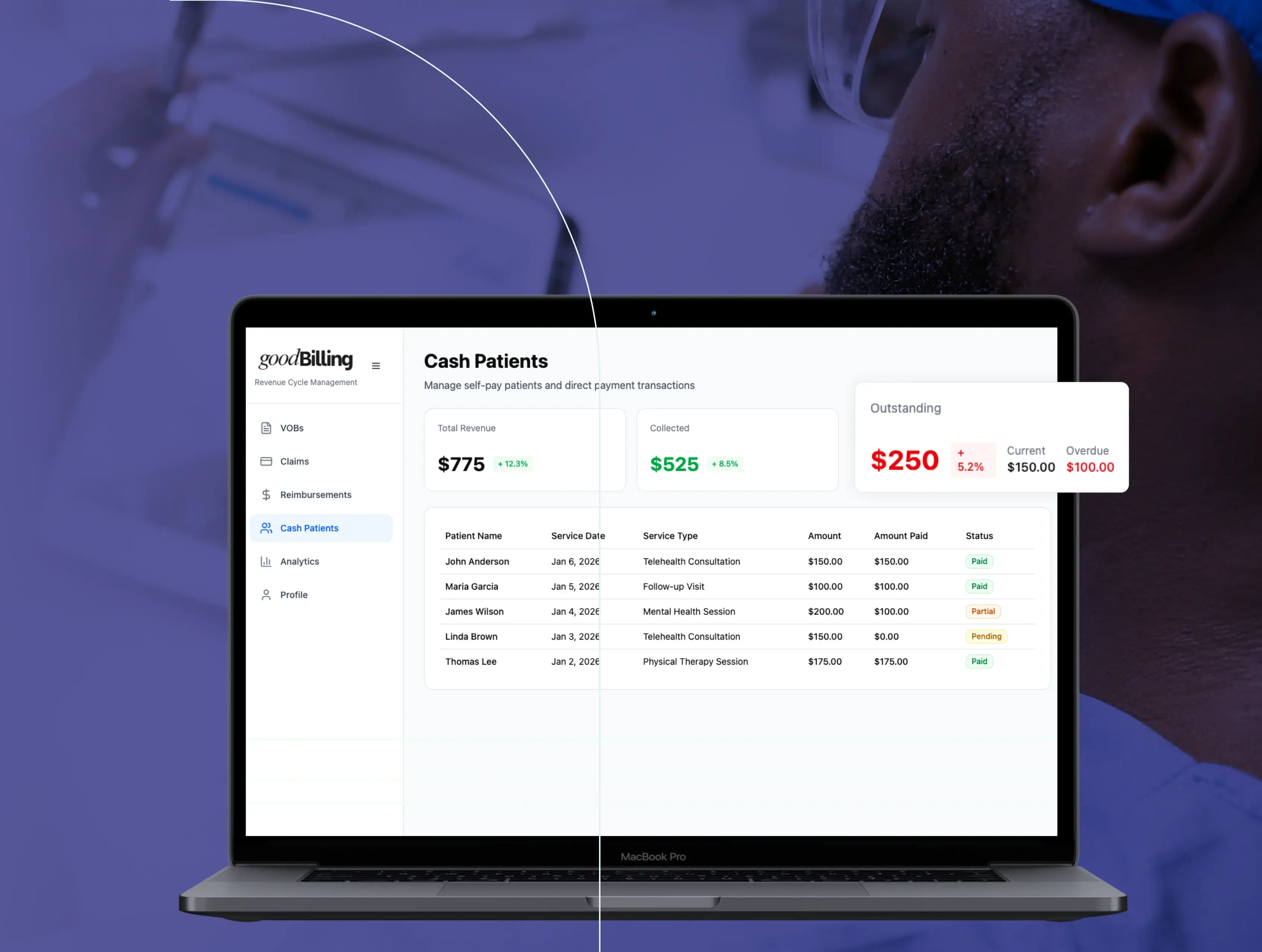
Goodbilling, an end-to-end RCM automation platform developed by MindK
How to choose the best AI voice agent for healthcare RCM calls
- Map the BAA chain. One call touches a carrier, speech-to-text, an LLM, text-to-speech, and storage. Check that each is covered.
- Check write-back. Ask for the exact fields written to your EHR or PM system and a sample call record.
- Ask about TCPA. The FCC ruled in 2024 that AI-generated voices count as artificial voices, so consent rules apply to AI calls to patients. Verify with counsel.
- Price per resolved call, including LLM, telephony, HIPAA add-ons, and exception-queue time.
MindK’s experience with RCM voice agents
Beyond the payer call agent in GoodBilling, MindK built the first EMR for lactation consultants, with RCM through a NextGen integration, scaling from 3,000 to 30,000+ monthly visits. Every project starts with a BAA before PHI is shared, and PHI segmentation, anonymization, and audit logs are part of the architecture. Explore our healthcare RCM solutions and EHR integration services.