
Looking for RCM developers?
Revenue cycle management software development companies are not all the same. The market is crowded with billing-service bureaus and off-the-shelf SaaS vendors that call themselves RCM companies. This guide covers a different category: the engineering firms that build custom RCM systems for medical billing companies, providers, and digital health products. These are builders you work with and own the result from, rather than a service you outsource to or a tool you subscribe to.
Seven revenue cycle management companies are profiled here, compared against the criteria that actually decide an RCM project: real revenue-cycle workflow experience, healthcare security and privacy engineering competence, data management and interoperability expertise, AI-native RCM capability, cost-effective delivery, and the range of services on offer.
Choosing the wrong partner isn’t a technical inconvenience. A claim-scrubbing engine that misses payer edits or an eligibility check that runs late shows up on the balance sheet as denied claims and rising AR days.
Which Type of RCM Service Do You Actually Need?
Before choosing a development partner, identify which part of the revenue cycle you need built. A firm that excels at interoperability plumbing is not interchangeable with one that ships ready-made AI agents, even though both call themselves RCM development companies.
Among the RCM software development firms on this list, the right match depends on what you’re building, how much you want to own, and your compliance profile. Use this selector before reading the full profiles.
| Service Type | When You Need It | Best Company Match | Why |
|---|---|---|---|
| Custom agentic RCM (owned) | You want AI to execute workflows and to own the solution outright | MindK | Prebuilt AI agents + expertise in building agentic US-based RCM products |
| RCM analytics & reporting | AR days, denial rate, and clean-claim visibility are the priority | EffectiveSoft | ISO 27001, Power BI dashboards, strong analytics engineering |
| Ready-made AI RCM engines | You want deployable agents for claim status, denials, or scrubbing | OSP Labs | Productized agents for claim status, denials, and scrubbing |
| Broad build with deep compliance | A complex, standards-heavy system across many workflows | ScienceSoft | Long track record; X12, FHIR, HL7; ISO-certified security |
| Wide integration coverage | Many EHR, PM, and clearinghouse integrations under one roof | Chetu | Wide integration coverage across EHR and clearinghouse tools |
| Interoperability & data exchange | Clean, standardized data flow is the foundation you lack | Taliun | FHIR/HL7/X12 pipelines, Mirth/Cloverleaf, Azure health APIs |
| Accelerator-based MVP / pilot | A bounded pilot budget and fast time-to-live | Mindbowser | 50+ RCM accelerators, HealthConnect CoPilot, fast pilots |
Full Comparison – RCM Software Development Companies
All seven RCM software development companies are compared across the dimensions that most directly determine project success.
| Company | HQ | Founded | Best For | Security & Certs | AI-Native RCM |
|---|---|---|---|---|---|
| MindK | US | 2009 | Agentic RCM, custom builds | HIPAA, SOC 2-ready, PHI segmentation | Ready-made agents + agentic RCM cases |
| EffectiveSoft | US / Europe | 2000 | Analytics, custom systems | HIPAA, HITECH, ISO 27001 | AI modules, RPA |
| OSP Labs | US | 2010 | Ready AI RCM engines | HIPAA, ISO 27001, SOC 2 | Productized agents |
| ScienceSoft | US / Europe | 1989 | Broad + compliance | HIPAA, ISO 27001, SOC 2 | AI/ML, automation |
| Chetu | US (FL) | 2000 | Broad stack, integrations | HIPAA, HL7, HITECH | AI-driven automation |
| Taliun | US (NJ) | 2019 | Interoperability & data | HIPAA, SOC 2 | Responsible-AI tooling |
| Mindbowser | US | 2013 | Accelerator MVPs | HIPAA, SOC 2, HITRUST-aware | AI accelerators |
Company Profiles – RCM Development In-Depth
1. MindK – Agentic RCM, Fully Owned by You
MindK is a revenue cycle management software development company that builds custom agentic RCM systems for medical billing companies, providers, and healthtech product companies, covering eligibility and benefits verification through to prior authorization, claim and denial management, and EHR/EMR connectivity.
Founded in 2009 and recognized by Inc. 5000, MindK runs its own production-grade RCM product, which processes high claim volumes, integrates with top EHRs, and runs voice and portal agents against real payers. That product is the proof point, since MindK doesn’t recommend patterns it hasn’t shipped itself. The prebuilt library is what cuts RCM development time by up to 80% while the client keeps full ownership of the code, data, and architecture.
| Location | US / Europe |
| Founded | 2009 |
| Model | Hybrid service + product (GoodBilling); client owns the solution |
| RCM Focus | Eligibility, VoB, prior authorization, claim automation, patient onboarding, EMR integration |
| AI Capabilities | Prebuilt RCM agents, payer portal automation, voice AI agents, structured data extraction, claim scrubbing, AI-accelerated engineering |
| Security | HIPAA-oriented architecture, SOC 2-ready controls, PHI segmentation, anonymization, encryption, audit logging, least-privilege access |
| Integration | Epic, Oracle Health, eClinicalWorks, athenahealth, NextGen, Optum, Availity, Waystar; bidirectional HL7 FHIR |
Why MindK leads this list
First, MindK sells outcomes rather than tools. In the AI era, few organizations want another dashboard to operate. They want the problem solved, and MindK ships working agents that execute eligibility, VoB, prior auth, and claim workflows directly. Second, it uses production-tested building blocks instead of forcing every client into one fixed workflow. The agents are reusable, while the surrounding product, integrations, data model, and approval logic stay custom to each client. Third, MindK designs for revenue-cycle reality: payer portals, phone trees, EMRs, signed clinical notes, billing rules, and human exceptions. Its AI-accelerated engineering delivers roughly 4-5× faster than traditional development, with senior engineers supervising every decision.
Case study – GoodBilling: End-to-End Agentic RCM
MindK built an AI-powered RCM platform connecting patient intake, real-time eligibility, agentic VoB, EMR integration, and claim generation into one pipeline. Most benefit checks run automatically, while complex cases such as self-funded plans route to a verification queue, with agents retrieving details through payer portals and voice workflows. Once a note is signed, EMR webhooks trigger logic that checks documentation against verified policy data and intended CPT codes and prepares claim data, all on a PHI-aware, encrypted, least-privilege architecture.
Result: processing high claim volumes while reducing manual touchpoints across intake, benefits verification, EMR data flow, and claim preparation. → Full case study
2. EffectiveSoft – RCM Analytics and Custom Systems
EffectiveSoft builds custom RCM systems and analytics platforms with a strong engineering pedigree and formal security posture. Its work spans medical billing and claims-processing systems, RCM analytics with Power BI dashboards, and automation modules that combine AI and RPA bots integrated into existing EHRs. The firm designs to HIPAA, HITECH, and CCPA, and holds ISO/IEC 27001 certification for its information security management system.
| Founded | 2000 |
| Best For | RCM analytics, reporting, custom billing systems |
| Security | HIPAA, HITECH, ISO/IEC 27001 |
| Integration | EHR/EMR, PMS, clearinghouses, payer systems; HL7, FHIR |
| AI | AI modules, RPA bots, predictive denial handling |
Where EffectiveSoft excels
Analytics and reporting engineering, meaning the work of turning revenue-cycle data into decision-ready dashboards, is a clear strength, backed by certified security practices. EffectiveSoft leans toward classic custom development and RPA rather than a library of prebuilt agents, so time-to-market depends on the scope of each build instead of reusable components.
3. OSP Labs – Ready-Made AI RCM Engines
OSP Labs has productized several agentic RCM capabilities into deployable engines: a Revenue Engine that auto-calls payers to check claim status, a Denial Engine that identifies root cause and auto-generates appeals, and a Claims Scrubbing agent that validates CPT, ICD-10, and HCPCS codes against payer rules before submission. The company reports metrics such as 95%+ first-pass clean-claim rates and large reductions in manual processing, and holds ISO 9001, ISO 27001, and SOC 2 Type II.
| Founded | ~2010 |
| Best For | Deployable AI RCM engines, denial and claim automation |
| Security | HIPAA, ISO 9001, ISO 27001, SOC 2 Type II |
| Integration | Epic, Cerner, athenahealth; HL7 FHIR |
| AI | Productized agents for claim status, denials, scrubbing |
Where OSP excels
If you want targeted AI agents for specific bottlenecks such as payer calls, denials, or scrubbing, with published performance claims, OSP’s productized engines are a fast route to value. Their model centers on OSP-built engines, so it’s worth clarifying how much of the final solution you own versus operate as a deployed product.
4. ScienceSoft – Broad Healthcare with Deep Compliance
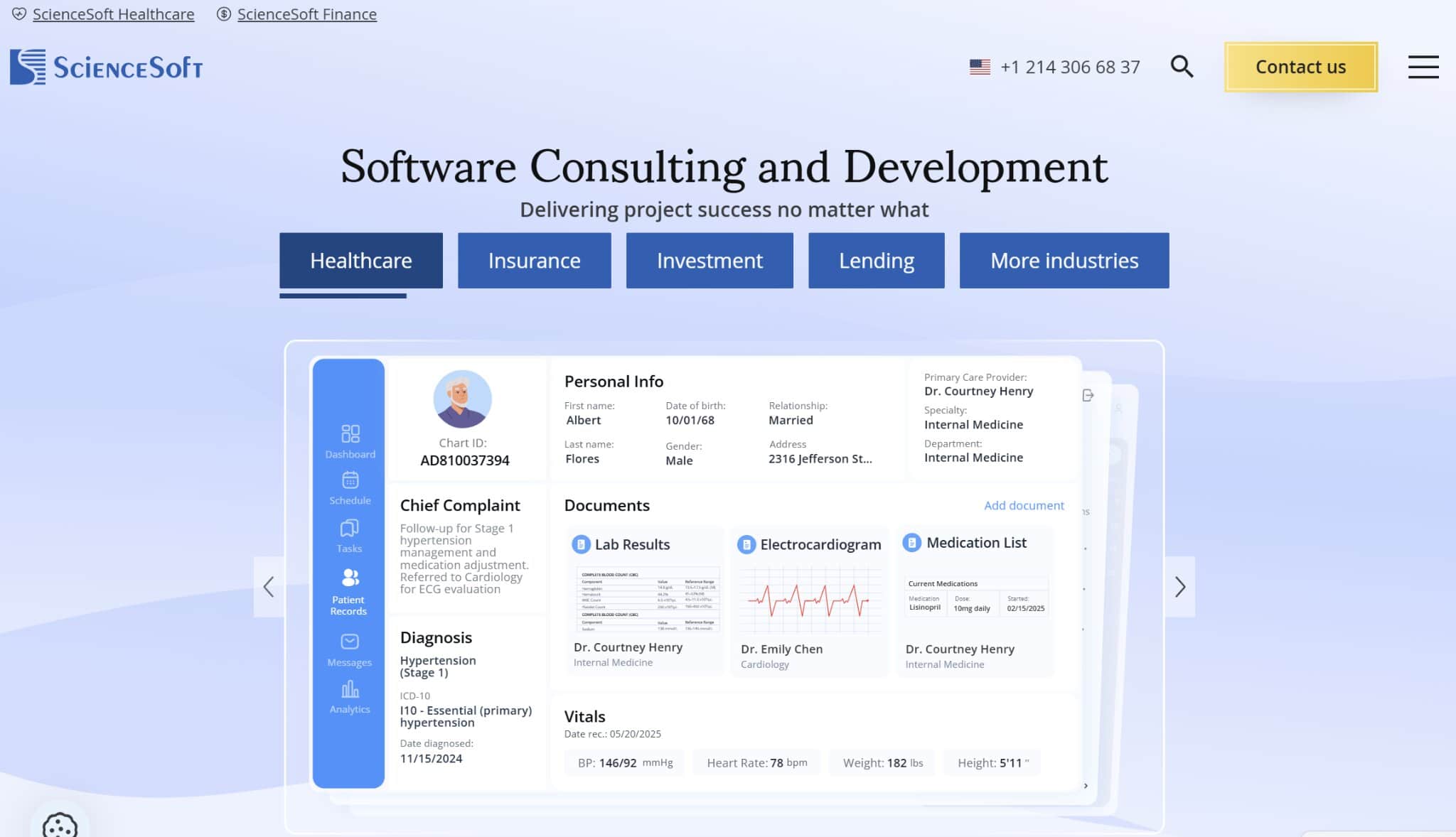
ScienceSoft brings one of the longest track records on this list, having worked in software since 1989 and in custom healthcare development since 2005, with wide experience across HIPAA, GDPR, the 21st Century Cures Act, and data-exchange standards including FHIR, HL7, DICOM, and X12 837/835. It builds RCM software and portals for providers and covers the full coding-standard landscape (CPT, ICD-10), with an ISO-certified security posture.
| Founded | 1989 (healthcare since 2005) |
| Best For | Broad healthcare builds with strong compliance |
| Security | HIPAA, ISO 27001, SOC 2 |
| Integration | FHIR, HL7, DICOM, X12 837/835 |
| AI | AI/ML, workflow automation |
Where ScienceSoft excels
Standards breadth and regulatory experience make ScienceSoft a safe pair of hands for complex, compliance-heavy builds. As a broad, multi-industry firm, its RCM work is one specialty among many rather than a singular product focus. That breadth is a strength for reliability, though it can be a trade-off if you want a partner defining the agentic-RCM category.
5. Chetu – Broad Stack and Wide Integration Coverage
Chetu is a large, general-purpose software developer with an extensive healthcare practice. Its RCM work covers eligibility verification, prior authorization, claims (status, denials, appeals), remittance, and coordination of benefits, with integrations across CureMD, athenahealth, Kareo, CareCloud, Veradigm, and clearinghouses such as Availity. Compliance spans HIPAA, HL7, HITECH, ONC-ATCB, and the 21st Century Cures Act.
| Founded | 2000 |
| Best For | Broad tech stack, many prebuilt integrations |
| Security | HIPAA, HL7, HITECH, ONC-ATCB |
| Integration | CureMD, athenahealth, Kareo, CareCloud, Veradigm, Availity |
| AI | AI-driven automation, predictive AR |
Where Chetu excels
Sheer breadth is the draw. If you need a wide range of integrations and modules under one roof, Chetu covers a lot of ground. That breadth is also the trade-off, since it’s a horizontal developer serving many industries rather than a specialist defining a new category in agentic RCM.
6. Taliun – Interoperability and Data Exchange
Taliun is an interoperability-first firm focused on connecting fragmented healthcare systems. Its platform handles clinical and financial data exchange across EHRs, PMS, RCM, billing, and payer systems using FHIR, HL7, CCDA, EDI X12, DICOM, and NCPDP, with tooling around Mirth Connect, Cloverleaf, and Microsoft Azure health APIs. Founded in 2019, it reports HIPAA and SOC 2 compliance and large-scale API throughput.
| Founded | 2019 |
| Best For | Interoperability, data pipelines, integrations |
| Security | HIPAA, SOC 2 |
| Integration | FHIR, HL7, CCDA, X12, DICOM; Mirth, Cloverleaf, Azure |
| AI | Responsible-AI data-quality tooling |
Where Taliun excels
If your core challenge is moving clean, standardized data between systems, which is the foundation any RCM automation depends on, Taliun’s interoperability focus is directly on point. It works best as the data-integration layer beneath a full agentic-RCM build, which makes it a strong complement to a workflow-automation partner rather than a replacement for one.
7. Mindbowser – Accelerator-Driven RCM Builds
Mindbowser builds RCM and digital-health products using a library of 50+ solution accelerators, including ClaimSolve for automated claims, Auth Automate for eligibility and prior auth, and HealthConnect CoPilot for EHR integration (Epic, Cerner, athenahealth, and more, with broad FHIR support). Founded in 2013, it positions accelerators as a way to cut development cost by roughly 40% and timelines by around 55%, and offers MVP/pilot programs in the $100K to $250K range with HIPAA and SOC 2 alignment.
| Founded | 2013 |
| Best For | Accelerator-based MVPs and pilots |
| Security | HIPAA, SOC 2, HITRUST-aware |
| Integration | Epic, Cerner, athenahealth, Open Dental; FHIR |
| AI | AI accelerators (ClaimSolve, Auth Automate, Metrics) |
Where Mindbowser excels
For teams that want to validate an RCM product quickly with a bounded pilot budget, the accelerator model shortens time-to-live meaningfully. The accelerators are Mindbowser components, so it’s worth clarifying ownership and long-term flexibility as the product scales beyond the pilot.
How to Choose an RCM Software Development Company
- Test workflow depth over slogans. Ask the firm to walk through a real revenue-cycle workflow. Vague talk about “streamlining billing” signals shallow domain knowledge, while specific answers about payer-specific edits, denial reason codes, and where a human should intervene reveal genuine RCM understanding.
- Look for architectural security over policy. Ask how PHI is handled during model training and data processing, going beyond which certifications they hold. Architectural compliance (encryption, PHI segmentation, least-privilege access, audit logging built into the engineering) holds up to an audit, whereas a stack of policy documents does not.
- Require bidirectional integration. Confirm they write results back into the EHR and clearinghouse, beyond simply reading data out. One-directional integrations cannot support real-time eligibility, VoB, or claim-status execution.
- Separate real AI from RPA. Distinguish scripted RPA from AI agents that make decisions in real time. Ask what the agent does autonomously, where control stays with your team, and how exceptions are routed.
- Confirm support and ownership. Payer rules and denial patterns change constantly. Confirm a post-launch support model, ideally with AI-assisted monitoring, and clarify whether you own the code, data, and architecture or merely license them.
Conclusion
Choosing the right RCM development partner comes down to one question before all others: has this firm built revenue-cycle automation that actually runs in production, and will you own what they build? The companies that can answer yes with specifics, references, and case studies are a small subset of the market that claims RCM capability.
MindK leads this list as the most comprehensive partner for organizations that want agentic RCM they fully own, backed by a production RCM product, a reusable library of AI agents, AI-accelerated engineering, and bidirectional integration experience. For specific needs, each firm brings focused strengths: EffectiveSoft for RCM analytics, OSP Labs for deployable AI engines, ScienceSoft for standards breadth, Chetu for wide integration coverage, Taliun for interoperability, and Mindbowser for accelerator-based pilots.
The evaluation framework is straightforward. Look for architectural security built into the engineering, integration that writes back into your systems, clear ownership of the code and data, and AI that executes workflows rather than scripts that only automate keystrokes. Apply these criteria consistently, and the list narrows to the healthcare RCM firms genuinely positioned to deliver automation that works.
Weighing build versus buy for your revenue cycle? Talk to MindK about your RCM project.