Healthcare Web Development
Services
Build the way your teams care for patients and operational tasks. Our healthcare web development agency decreases the total cost of ownership by 50–75% with ready-made AI agents, proven healthcare platforms, reusable infrastructure, and agentic engineering. Every decision is shaped and owned by experienced web developers.
Trusted by







The real challenges behind failed healthcare web projects
Most healthcare web development services fail before development. The usual causes are missed workflows, late compliance decisions, brittle integrations, weak scaling assumptions, and ownership models that limit change.
Generic charting breaks under specialty workflows
Clinical software breaks when it treats care delivery like a set of generic forms. Healthcare UX has to reflect how clinicians document, review, correct, escalate, and hand off work in real settings.
HIPAA, SOC 2, and FHIR constraints
Encryption, role-based access control, audit trails, key management, tenant isolation, backup strategy, and integration design need to be built into the foundation before the first release. Late compliance work usually means rework across infrastructure, data models, permissions, and release processes.
EHR and legacy integrations stall the project
Sandbox tests rarely show how Epic, Oracle Health/Cerner, NextGen, athenahealth, or an older HL7 feed behaves in production. Real integrations bring vendor-specific endpoints, scopes, resource subsets, mappings, and workflow assumptions that can reshape the project.
The lack of planning for performance under real load
Healthcare platforms have to handle usage spikes, reporting jobs, tenant growth, and data-heavy workflows without slowing clinical or operational work. Scale decisions belong in discovery, before growth turns into downtime.
SaaS lock-in limits how your healthcare platform grows
SaaS can work for narrow needs, but it limits control when your workflows, integrations, data model, and roadmap depend on a vendor’s product decisions. Custom development gives your team ownership of the platform and the freedom to evolve it around your operation.

3-4x faster time-to-value with AI. All code reviewed by humans
Agents connected to our Golden Repo
Research, synthesis, and requirement structuring compressed from weeks to days.
1/3 of the time saved on scaffolding for features, APIs, tests, and documentation.
40-50% faster issue detection across logs, code, and test results.
90%+ code coverage supported by AI-generated test suites and regression checks.
Reusable patterns that reduce boilerplate and speed up delivery.
Senior healthcare web developers
Product judgment that keeps scope tied to business value.
Healthcare workflow expertise across clinical, operational, and integration constraints.
Architecture decisions that protect scalability, security, and maintainability.
Code review, risk assessment, and quality control before release.
Compliance-aware decisions for PHI, access control, auditability, and data handling.

End-to-End Healthcare Web Development Services


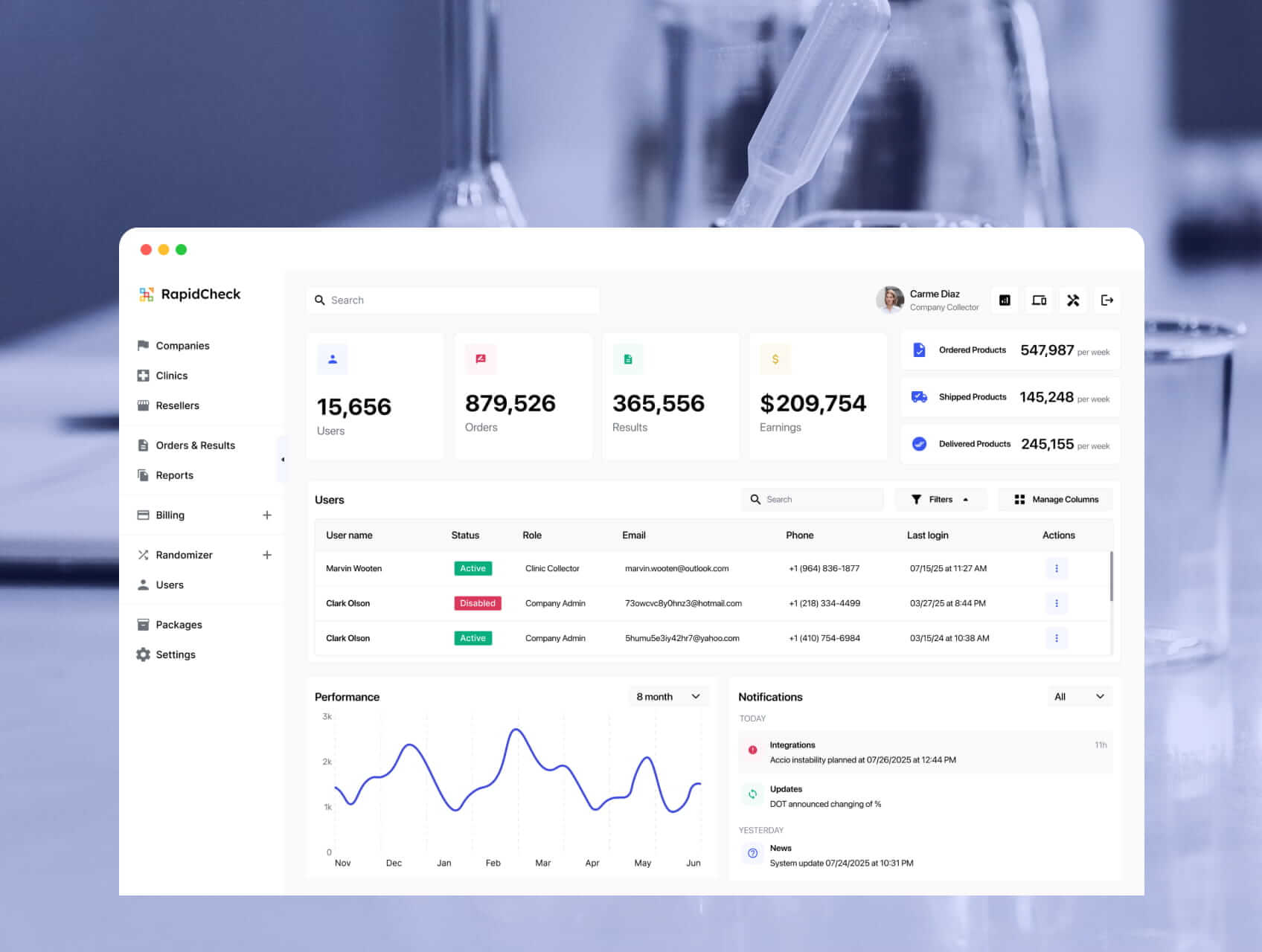
Web Software That Meets HIPAA, GDPR & SOC2 Requirements
Encryption at rest and in transit
Identity, access, and authentication
Audit logging and threat detection
PHI segmentation and anonymization
Tenant isolation and segmented services

Ready-to-use AI agents for healthcare workflows
Patient intake
Guides new patients through structured intake step by step, capturing demographics, history, and consent without a staff member re-entering the same data twice.
Document collection
Requests, receives, and organizes IDs, insurance cards, and referrals into the patient record automatically.
Staff handoff
Packages a completed intake into a clean summary and routes it to the right staff member the moment human review is needed.
Coverage checks
Queries payer systems in real time to confirm active coverage before an appointment is booked.
VoB support
Runs verification of benefits automatically, pulling deductible, copay, and coverage limits without a staff member on hold with a payer.
Structured summaries
Turns raw eligibility responses into a clean, standardized summary staff can act on immediately.
Portal login flows
Authenticates and navigates individual payer portals the way a staff member would, without a shared login spreadsheet.
Claim status checks
Logs into payer systems to pull real-time claim status instead of waiting on a callback.
Prior auth support
Submits and tracks prior authorization requests through each payer's own portal workflow.
Exception routing
Detects when a portal interaction needs human judgment and hands it off instead of guessing.
Voice calls
Places and holds real voice conversations with payer support lines to resolve claims and eligibility questions.
IVR navigation
Moves through payer IVR menus automatically, skipping the hold-and-select cycle a human would otherwise sit through.
Chat automation
Answers common patient questions in real time, escalating anything outside its scope.
Source-grounded answers
Answers clinical and administrative questions by citing the specific policy or document behind the answer, not a generic model response.
Internal knowledge search
Searches internal documentation, SOPs, and past cases to answer operational questions in seconds.
Policy lookup
Retrieves the exact payer or internal policy relevant to a given question instead of making staff search manually.

Seamless FHIR, HL7 & EHR
Web Integrations
FHIR API development
HL7 integration and mapping
EHR and EMR integrations

Our proven healthcare web development process
Discovery and scoping
Duration: 1–2 weeks
We start with stakeholder interviews, clinical workflow mapping, HIPAA risk assessment, and success metrics. AI helps capture requirements, while engineers make the architecture, integration, and compliance decisions that form a delivery plan the team can build against. At the same time, wireframes and interactive prototypes are created by our healthcare web design company to produce a distinct visual identity for your product..
Infrastructure and environment setup
Duration: 2 weeks
Our healthcare web development company sets up the cloud foundation, CI/CD, security hardening, monitoring, and encrypted backups early, so the product does not accumulate security or deployment debt before launch. AI can generate infrastructure-as-code, where it is safe to use, but engineers review and validate every output before it reaches production.
Iterative delivery
Development runs in two-week Scrum sprints, with AI accelerating code generation, test creation, debugging, and documentation. Engineers own quality gates, clinical-safety reviews, architecture choices, and integration decisions, so speed does not come at the expense of production readiness.
Testing and launch
Duration: 1.5–2 weeks
HIPAA, SOC 2, and ONC readiness checks run alongside AI-assisted UAT, self-healing end-to-end tests, performance validation, and release preparation. If something fails a check, we document the issue and fix it before release.
Post-launch support and scaling
Duration: ongoing.
After launch, we continue performance monitoring, security monitoring, and feature delivery. AI-assisted operations keep routine work efficient, while engineers handle architecture changes, security decisions, integration failures, and clinical workflow trade-offs.

Why healthcare teams choose MindK
Healthcare is all we build
We build from patterns proven in real healthcare products, where traffic, audits, integrations, and clinical workflows expose weak decisions fast.
Full ownership without SaaS lock-in
Your team owns the code, data, cloud infrastructure, and architecture, so your roadmap stays under your control.
Accelerated delivery
Reusable healthcare components, proven architecture patterns, and AI-assisted engineering help you reach the first release faster with fewer avoidable build decisions.
AI as a product differentiator
We add AI where it can execute real healthcare workflows, including intake, eligibility, payer communication, voice, chat, and human review, with PHI safeguards built in.
Complimentary services for healthcare teams
Interoperability and EHR integrations
HIPAA compliance and healthcare security consulting
Healthcare AI consulting
Healthcare mobile app development
Agentic RCM and billing automation
RPM app development
DevOps and cloud for healthcare
AI implementation and data readiness
What
our
clients
say
-

Allison Erickson
Director of Product, The Lactation Network
USA Such quality work in such efficient timing
«I have nothing but great things to say about our partnership with MindK and the solid work they have done and continue to do for the growth of our company. Our rapport is strong which is a reflection of their professionalism, hard work, and great outputs.»
-

Al Hariri
Co-Founder, Vitagene
USA Results-oriented and
outcome-driven«I can tell you confidently that they are different from your regular agency that just wants to charge as much money for their work as they can get away with. MindK is completely results-oriented and outcome-driven.»
-

Jason Lutton
CEO, International Surrogacy Center
Impressed with their ability to understand our industry
«MindK reduced the time a surrogate takes to complete an online application, increased the number of completed applications, and streamlined our intake process, resulting in fewer staff man hours needed to complete the backend processes for finalizing an applicant.»



Let's Talk About Your Healthcare Web Project
Drop us a few words about your project. We will reply within 24 hours to set up a free strategy session before you hire expert healthcare web developers.