Let's build a great product
We compared 6 HIPAA-compliant chatbots for healthcare billing: payer chat, patient billing chat, and no-code platforms, with BAAs, PHI handling, and pricing.
TL; DRThe best HIPAA-compliant chatbot for your team depends on who sits on the other side of the chat: a payer representative, a patient with a bill, or a website visitor. Benefit checks in payer web chat, with results in your own system – MindK Patient billing questions, payments, and payment plans – Collectly Billing support for practices already on Inbox Health – Inbox Health Patient access chat inside Epic or Cerner workflows – Hyro A no-code chatbot with a signed BAA on a small budget – Chat-Data An omnichannel chat platform with on-premises deployment – Comm100 Before you sign, ask who else touches your patients’ data: the model provider, the hosting company, and any tool the chatbot calls. |
In Bandwidth’s 2026 patient preferences survey, 47.7% of patients said AI self-service such as AI chat would probably improve their healthcare experience. The report ran in April 2026.
On the payer side, UnitedHealthcare tells providers that chat in its portal reaches the same experts as the phone line. So a billing team now works two kinds of chat: patients asking about a bill, and payer representatives answering benefit questions. A HIPAA-compliant chatbot handles protected health information (PHI) under a business associate agreement (BAA) with each vendor that touches it, and the tools below differ in how much of that chain they cover.
What Are the Best HIPAA-Compliant Chatbots for Healthcare?
Among the best healthcare chatbots for billing teams, the three to shortlist first are MindK, Collectly, and Chat-Data. The full comparison and three more tools follow below.
| Tool | Why it’s in the top 3 | Setup you plan for |
|---|---|---|
| MindK | Accepts a benefit value into the record only when the payer wrote it | Configuration for your payers, data points, and review rules, plus the link to your revenue cycle management (RCM) system |
| Collectly | Updates patient contact and insurance details inside the billing conversation | Collectly’s RCM platform connected to your electronic health record (EHR) or practice management (PM) system |
| Chat-Data | Lowest published price for a signed BAA on this list: $95 a month on the Standard plan | A no-code build in which you upload your own FAQs and billing policies |
Clinical or Administrative: Which Healthcare Chatbot Do You Need?
An administrative chatbot handles billing inquiries, insurance FAQs, coverage questions, and payer conversations, while a clinical chatbot helps clinicians with documentation and medical questions. This list compares administrative healthcare chatbots for the revenue cycle.
If you need the clinical kind, BastionGPT gives clinicians GPT, Claude, and Gemini models in one workspace with a signed BAA on every plan, and CompliantChatGPT drafts SOAP notes and anonymizes PHI before it reaches an AI model. General help desk and enterprise chat platforms such as HappyFox and Yellow.ai also sell to healthcare and cover contact center work beyond billing. Teams with developers can also build their own bot on cloud services covered by the cloud provider’s BAA, such as Microsoft Azure AI Health Bot and Amazon Lex. Patient engagement platforms such as Luma Health cover scheduling, reminders, intake, and payments in one platform for health systems.
How Did We Compare HIPAA-Compliant Chatbots?
We checked the pages of ten vendors on November 18, 2026, ranked six, and asked each the same five questions:
- Who does the chatbot talk to: payers, patients, or website visitors?
- Does the vendor sign a BAA, and on which plan?
- What happens to PHI before it reaches the AI model?
- When does a conversation go to a person on staff?
- Which EHR or PM systems does it connect to, and what does it cost?
Pegasus One builds chat and voice bots that health plans deploy, so it answers on the payer’s side of the conversation and stays off the list. BastionGPT and CompliantChatGPT are clinical chatbots, covered in the section above, and patient intake chatbots and other HIPAA-compliant intake tools appear in our patient intake software comparison. Figures in this article are the vendors’ own unless we link a different source.
MindK publishes this blog, so its profile uses the same fields as the other five, limits included.
What Makes a Healthcare Chatbot HIPAA Compliant?
A chatbot is HIPAA compliant when the people and companies behind it protect PHI under signed agreements and technical controls. Check five controls on each tool.
| Control | What to check | Why it matters |
|---|---|---|
| A BAA chain | A BAA with the chatbot vendor and coverage for its AI model provider and hosting | One unsigned link in the chain leaves PHI unprotected |
| PHI handling before the model | Whether the tool masks identifiers or sends raw PHI to the model | Masked data limits what a model provider ever sees |
| Access and audit | Role-based access, multi-factor sign-in, and conversation logs | You can show who saw which conversation |
| Human handoff | Rules that pass a conversation to staff, and an option to approve replies | A person catches answers the chatbot shouldn’t send |
| Risk analysis and breach response | A documented security risk analysis and a breach notification process in the BAA | HIPAA requires a business associate to report a breach to the provider no later than 60 days after discovery |
Where Does Chat Work Break Down for a Billing Team?
It breaks in five places, and payer chat shows all of them, because a verifier types the same questions all day.
| Step | What staff do today | What tends to go wrong |
|---|---|---|
| Open the chat | Sign in, pick menu options, and enter provider and member details | A wrong menu choice sends the chat to another department |
| Wait for a person | Watch a queue and hold messages | The chat times out while staff work on something else |
| Ask about benefits | Type questions about copays, deductibles, and authorization rules | The rep answers three fields in one message along with a hold note |
| Record the answers | Copy values into the PM system | A value the rep never stated ends up in the record |
| Close the chat | Ask for a reference number | The chat ends without one, so a later dispute has no proof |
Picture a verification lead at a behavioral health group with 25 locations. Her team chats with payers all afternoon to confirm visit limits and telehealth coverage for next week’s intakes. Each chat takes a person’s full attention for its whole length, and someone still retypes the answers into the PM system before anyone can bill.
How Do These Healthcare Chatbots Compare?
They differ in who they talk to and how they handle PHI. The table follows the order of the groups below: payer chat first, then patient billing chat, then platforms you set up yourself.
| Tool | Talks to | PHI and compliance | Hands off to staff | Pricing |
|---|---|---|---|---|
| MindK | Payer chat representatives and payer bots | Masks known identifiers before the model; signs a BAA | By configured rules, with an optional approval step | Not published |
| Collectly | Patients | HITRUST, SOC 2, and HIPAA (vendor-stated) | When the case needs staff | Not published |
| Inbox Health | Patients | HIPAA-compliant assistant (vendor-stated) | Right away when a question needs judgment | Not published |
| Hyro | Patients | HIPAA and SOC 2; personally identifiable information (PII) redaction (vendor-stated) | When an answer needs a person | Not published |
| Chat-Data | Website and messaging visitors | BAA on the Standard plan; Anthropic Claude under BAA | Live chat escalation | Plans from $18.99 a month |
| Comm100 | Patients and members | SOC 2 Type II, ISO 27001, and Payment Card Industry Data Security Standard (PCI DSS); signs BAAs | Configurable transfer rules | Not published on the reviewed page |
Which Chatbot Handles Payer Chats for a Billing Team?
MindK is the one tool here that works payer web chat from the provider’s side through to a structured benefit result.
1. MindK: Best for Benefit Checks in Payer Web Chat
For verification of benefits (VoB) in payer chat, MindK’s Chat Agent runs the conversation while MindK’s portal automation opens the payer’s chat window; our payer portal automation comparison covers that portal side. The agent handles menus, search fields, and date pickers, tells a payer bot from a live representative, answers the payer’s own questions, and waits through hold messages without ending the chat.
The model writes the messages, and the business rules sit outside it. MindK tracks each required benefit field in a separate state, and the verification counts as complete only when those fields and the payer’s reference number are in. A separate guard checks each outgoing message before it reaches the payer.
When a payer chat can’t finish the check, MindK passes the case to its AI voice agent, which calls the payer. One verification can move from the portal to chat to a phone call without staff starting over.
| Best for | Specialty practice networks that verify benefits with payers that offer chat |
| Conversations handled | Payer web chat for VoB: network status, coverage, prior authorization and referral rules, visit limits, telehealth coverage and copay, office visit copay, coinsurance, deductible and out-of-pocket status, and the payer’s reference number |
| PHI handling | Masks known identifiers before the model sees a message and controls when they return at the output boundary |
| Escalation to staff | An optional approval gate holds a reply for a person; each ending carries a next step such as rerun, fix input data, switch channel, or contact another administrator |
| Integrations | Your EHR, RCM, and billing systems; model providers and payload format are configurable |
| Security | Signs a BAA |
| Results (MindK data) | 87.6% of 266 payer chats in September and October 2026 ended with a completed verification, and 97% once cases the payer closed on its side are set aside. A completed check costs $1.88, against $13.61 for a manual one |
| Pricing | Not published |
| Limits | Payer-facing VoB is the only chat workflow in production. Patient billing and intake chat are configurable extensions without a public case. No self-serve subscription |
| Verified on | Nov 18, 2026 |
What stands out
The agent keeps four states apart for each benefit: not known yet, not applicable, unobtainable, and refused by the payer. It also treats related values separately, so a zero coinsurance never fills in a zero copay unless the rep said so. Those rules matter for any medical billing chatbot or conversational AI for RCM automation, because its output feeds billing directly.
MindK’s production numbers show what those rules do. Every completed verification carries all 13 benefit fields, and 99.6% carry the payer’s reference number. Since MindK began checking each value against the payer’s own message, the agent has entered no value the rep didn’t state. Before that check, 171 of 1,000 conversations contained one. The agent also runs up to 14 payer chats at once.
Look elsewhere if…
Your main chat volume comes from patients asking about their bills. Collectly and Inbox Health run that conversation in production today. For payers that answer only by phone, MindK’s AI voice agent covers the call.
Which Chatbots Answer Patient Billing Questions?
Collectly, Inbox Health, and Hyro answer patients and act on what they ask for. Cedar’s Kora works the same billing conversations, mainly by voice and two-way text.
2. Collectly: Best for Patient Billing Questions and Payments
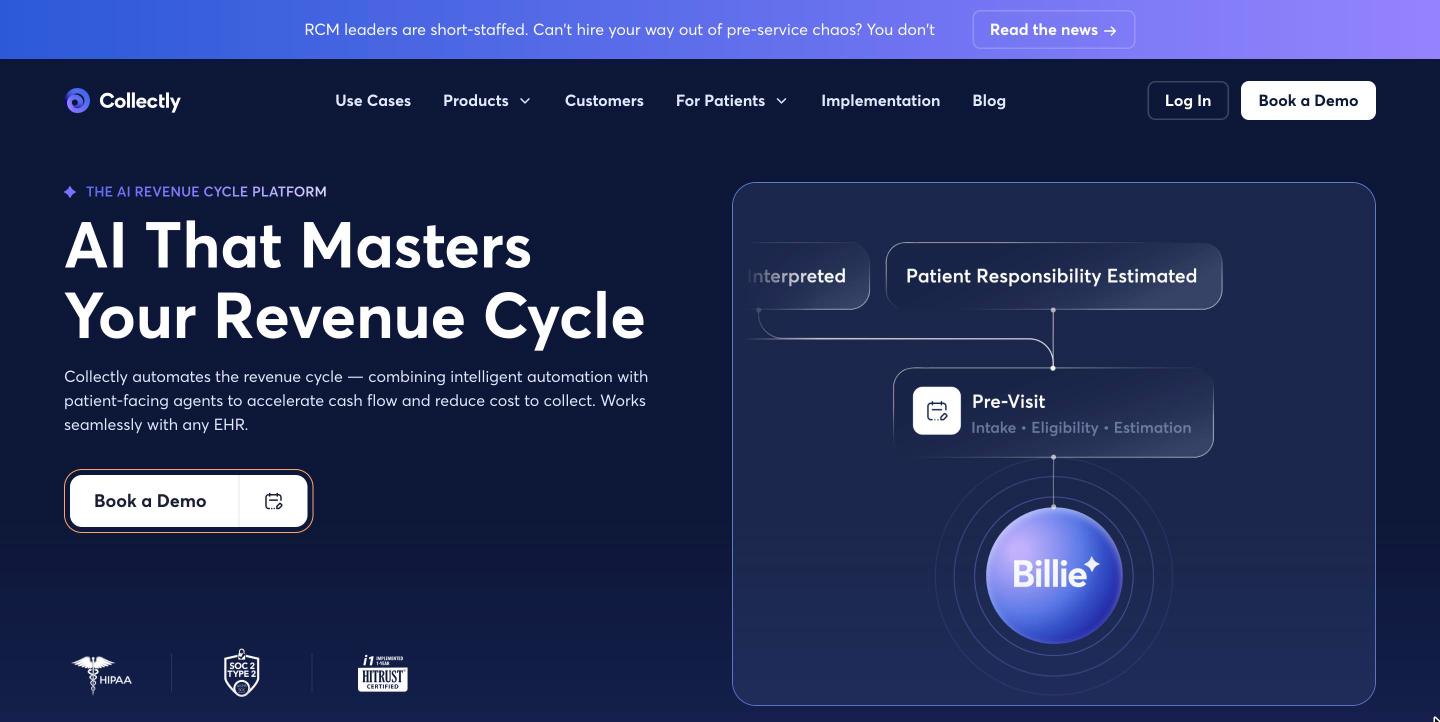
Practices that want one agent for patient balances can hand those conversations to Billie, Collectly’s AI agent for patient billing. Billie answers billing questions, handles disputes, takes payments, and sets up payment plans.
It works around the clock across chat, text, email, voice, and the web and communicates in 250+ languages (vendor-stated).
| Best for | Practices and RCM teams with high patient balance volume |
| Conversations handled | Billing questions, disputes, payments, and payment plans |
| PHI handling | Not described on the reviewed page |
| Escalation to staff | Escalates to staff only when the case needs it |
| Integrations | AdvancedMD, athenahealth, Epic, Cerner, and eClinicalWorks appear on the demo form |
| Security | HITRUST certification, SOC 2, and HIPAA (vendor-stated) |
| Pricing | Not published; demo first |
| Limits | Talks to patients only; payer conversations stay with staff or another tool |
| Verified on | Nov 18, 2026 |
What stands out
Collectly says it serves 3,000+ healthcare facilities, which gives a practice a wide pool of peers to ask before it signs.
Collectly or MindK?
Collectly fits when patient balances drive your chat volume. MindK fits when your verifiers spend their day in payer chat. A group with both problems can run them side by side, since they talk to different people.
3. Inbox Health: Best for Practices Already on Its Billing Platform
If your practice or billing company already sends statements through Inbox Health, its AI billing assistant comes inside the same platform. It answers patient billing questions across phone, text, email, and live chat in 60 languages.
The assistant also updates patient addresses, collects insurance information, issues paper statements, and enrolls patients in payment plans under rules the practice sets.
| Best for | Billers and practices that use Inbox Health for patient billing |
| Conversations handled | Patient billing questions and the back-office updates they trigger |
| PHI handling | Not described on the reviewed page |
| Escalation to staff | Routes the conversation to a human agent as soon as a question needs judgment |
| Integrations | Connects with dozens of PM systems (vendor-stated) |
| Security | HIPAA-compliant (vendor-stated) |
| Pricing | Not published |
| Limits | Built into Inbox Health’s platform, so it fits current customers best |
| Verified on | Nov 18, 2026 |
What stands out
The assistant does back-office work during the chat, so an address change or a payment plan doesn’t wait for a staff task queue.
Inbox Health or MindK?
Inbox Health suits a team that wants patient billing chat inside its statement platform. MindK suits a team whose bottleneck sits on the payer side of verification.
4. Hyro: Best AI Patient Access System for Health Systems on Epic or Cerner
Large provider organizations on Epic, Cerner, or athenahealth can add Hyro’s AI agents across chat, voice, and SMS without waiting for an EHR roadmap. Hyro says its agents run natively in those EHRs with bi-directional syncs and are live across 50+ enterprise health systems.
Its Coverage OnCue agent reaches patients before Medicaid and Marketplace deadlines, answers coverage questions from approved guidance, and hands off to staff when an answer needs a person.
| Best for | Enterprise health systems and large multispecialty groups |
| Conversations handled | Scheduling, refills, routing, coverage and re-enrollment questions; billing questions go to a live specialist |
| PHI handling | PII redaction protocols (vendor-stated) |
| Escalation to staff | Hands off to the team when an answer needs a person |
| Integrations | Epic, Cerner (Oracle Health), athenahealth, and Salesforce |
| Security | HIPAA compliance and SOC 2 certification (vendor-stated) |
| Pricing | Not published |
| Limits | Built for enterprise health systems; the reviewed page doesn’t show billing questions resolved without staff |
| Verified on | Nov 18, 2026 |
What stands out
Hyro lists itself on Epic’s AI Agent Showroom, which gives Epic customers a way to check fit before a pilot.
Hyro or MindK?
Hyro fits a health system that wants one agent across patient access channels. MindK fits a billing team whose work stalls in payer chat.
Which HIPAA Chatbot Platforms Can a Practice Set Up Itself?
Chat-Data and Comm100 give you the platform, the BAA, and the security controls; you supply the content and the workflows.
5. Chat-Data: Best for a Signed BAA on a Small Budget
Solo practitioners, small dental clinics, and multi-location primary care groups can build a HIPAA-compliant AI chatbot in Chat-Data without an IT team. Through Chat-Data, the chatbot runs on Anthropic’s Claude with BAA coverage, and the vendor offers a BAA of its own to the practice.
Deployments reach 10+ channels, including websites, patient portals, and messaging apps, and complex questions can move to live chat.
| Best for | Small practices that want a website chatbot for FAQs, intake details, and appointment requests |
| Conversations handled | Patient FAQs, intake details, appointment requests, and insurance questions |
| PHI handling | Encrypted storage and permission-gated access to conversations |
| Escalation to staff | Live chat escalation for complex inquiries |
| Integrations | Webhooks, application programming interface (API) calls, and custom endpoints that you configure |
| Security | AES-256 encryption at rest, TLS 1.2+ in transit, multi-factor sign-in, and US or Swiss data residency |
| Pricing | Plans from $18.99 a month |
| Limits | A general-purpose builder: billing rules, payer logic, and system integrations are yours to set up |
| Verified on | Nov 18, 2026 |
What stands out
Chat-Data spells out its BAA chain on the page: Anthropic to Chat-Data, Chat-Data to your practice. That makes it easy to see which link covers what.
Chat-Data or MindK?
Chat-Data fits a practice that wants a patient-facing website chatbot this month. MindK fits a billing operation that needs payer conversations finished and written into its system.
6. Comm100: Best for Omnichannel Chat with On-Premises Deployment
Organizations with strict data rules can run Comm100 on-premises and keep patient data inside their own infrastructure. Its AI Agent works alongside live chat, ticketing, and a knowledge base, and a team can buy the agent alone or with the other modules.
The AI answers from the organization’s own knowledge and policies, and staff can review past conversations and correct responses. That suits teams that want HIPAA compliant chat for live agents and AI in one platform.
| Best for | Health systems, large groups, and health plans with in-house contact center teams |
| Conversations handled | Patient and member inquiries across channels |
| PHI handling | Agents access PHI under access controls and end-to-end encryption (vendor-stated) |
| Escalation to staff | Configurable rules for when a conversation moves to a human agent |
| Integrations | Live chat, ticketing, and knowledge base modules |
| Security | AES-256 at rest, TLS 1.2 in transit, annual third-party HIPAA assessments by SecurityMetrics, SOC 2 Type II, ISO 27001, and PCI DSS; signs BAAs |
| Pricing | Not published on the reviewed page |
| Limits | The healthcare customers named on the reviewed page are Canadian public organizations; RCM workflows are yours to build |
| Verified on | Nov 18, 2026 |
What stands out
On-premises deployment suits organizations whose data rules go beyond HIPAA, and Comm100 lists it as a standard option.
Comm100 or MindK?
Comm100 fits a contact center that wants one governed chat platform for many inquiry types. MindK fits a revenue cycle team that wants a finished benefit check from each payer chat.
How Do You Choose a HIPAA-Compliant Chatbot?
Ask each vendor the same five questions on the first call, and read the BAA before you load any patient data.
| Question for the vendor | Why it matters |
|---|---|
| Which of your plans includes a signed BAA? | Some vendors offer a BAA only on higher tiers |
| Which AI model provider processes our conversations, and is it under a BAA? | The model provider is part of the chain |
| Do you mask identifiers before the model sees a message? | Masking limits PHI exposure even inside a covered chain |
| Can a person approve replies before they go out? | Review on day one lowers the risk of a wrong answer reaching a patient or payer |
| Does the chatbot only read from our EHR or PM system, or also write to it? | Write access lets a chat update the record; read-only access leaves the update to staff |
Which HIPAA-Compliant Chatbot Should You Pick?
Pick MindK when your verifiers spend hours in payer chat and you want structured benefits in your own system. Pick Collectly or Inbox Health for patient billing conversations, Hyro for patient access chat across Epic or Cerner workflows, Chat-Data for a low-cost website chatbot with a signed BAA, and Comm100 for an omnichannel platform you can run on-premises.
To scope a payer chat workflow inside your current systems, see MindK’s revenue cycle management development services.
FAQ: HIPAA-Compliant Chatbots
How much does a HIPAA-compliant chatbot cost?
Most vendors on this list don’t publish prices. Chat-Data does: plans start at $18.99 a month, and its BAA comes with the Standard plan at $95 a month. Payer and patient billing agents such as MindK, Collectly, and Hyro price after a demo or scoping call, because the cost depends on volume and integrations.
Is Claude AI HIPAA compliant?
Claude can process PHI when a signed agreement covers the route you use to reach it. Anthropic signs a BAA for its HIPAA-ready services, including the Claude API and Claude Enterprise plans, though not every feature falls under it. AWS lists Amazon Bedrock, which serves Claude models, among its HIPAA-eligible services. MindK’s Chat Agent runs Claude through Amazon Bedrock for its payer chat work.
Which AI agent platform is HIPAA compliant?
A platform qualifies when its vendor signs a BAA and covers the model provider and hosting behind it. On this list, Chat-Data offers a BAA on its Standard plan, Comm100 signs BAAs with customers, and MindK signs a BAA for its payer chat agent. For payer chat in eligibility and benefits verification, MindK is the one platform here built to finish the conversation with a structured result.
How do healthcare chatbots integrate with EHR systems?
Most connect through the EHR’s APIs or the vendor’s own integrations, and the main question is whether the chatbot only reads data or also writes it back. Hyro lists native integrations with Epic, Cerner, and athenahealth with bi-directional syncs, and Collectly names AdvancedMD, athenahealth, Epic, Cerner, and eClinicalWorks. MindK writes payer chat results into the client’s RCM or billing system in the fields the team already uses.
How long does it take to deploy a healthcare chatbot?
It depends on how much of your workflow the chatbot has to learn. A no-code builder such as Chat-Data says setup takes minutes for FAQs and intake, while Hyro cites a client that went live in 60 days. Agents that work payer conversations, such as MindK’s, need configuration for each payer, data point, and review rule before they run on live cases. MindK puts a payer chat workflow live in 2 to 4 weeks.