We compared eight insurance eligibility verification software tools by how they verify (electronic 270/271, payer portal, or phone), who they fit, which EHR and PM systems they name, and how they’re priced, including AI agents first proven in MindK’s own RCM product for the self-funded and TPA plans that electronic checks leave half-answered.
TL; DRThe best insurance eligibility verification software is the one that still returns a usable answer when a payer’s electronic response comes back thin. Self-funded and complex plans verified by phone and portal, written back to your RCM system – MindK (pre-built agents configured to your payers) A packaged voice agent for benefit calls – Prosper AI Real-time checks through an API – pVerify Enterprise eligibility and coverage discovery on Epic – Experian Health Free lookups with sponsoring health plans – Availity Essentials Verification inside a therapy front office – Solum Health Batch checks and cost estimates for eye care and ENT – Promptly Dental benefits from payer portals – Weave |
Eligibility checks eat more staff time than most schedules allow for. When Experian Health surveyed 210 revenue cycle leaders in 2024, 43% put a repeat eligibility check at 10 to 20+ minutes (Becker’s).
Software saves most of that time when it sends the payer an X12 270 request and copies the 271 reply into the practice management (PM) system. Fully funded commercial plans and Medicare usually return complete answers. Self-funded employer plans, plans run by third-party administrators (TPAs), and some regional Medicaid plans often return active coverage and little else.
Staff fill that gap in payer portals and on the phone. By MindK’s estimate, a verification of benefits (VoB) call can take 15–60 minutes of manual work per case. The tools below differ in how much of that second step they take off your team.
How We Compared Eligibility Verification Tools
We read each vendor’s product pages, case studies, and the payer pages that describe their portals on October 21, 2026. For every tool, we noted how it verifies (electronic 270/271, portal, or phone), who it fits, which EHR and PM systems it names, and how it’s priced. Figures in this article are the vendors’ own unless we link a different source.
Where Verification Breaks in a Specialty Practice Network
Eligibility looks like one check at scheduling. A group that bills dozens of payers runs it as four separate steps, and each payer handles them a little differently.
| Step | What staff do today | What tends to go wrong |
|---|---|---|
| 1. Pre-visit check | Run a batch 270 request for tomorrow’s schedule | Lapsed or changed coverage turns up at the front desk |
| 2. Benefit detail | Read the 271 for visit limits, specialty copays, and carve-outs | Self-funded and TPA plans return active coverage with no specialty benefits |
| 3. Payer follow-up | Log in to the portal or call the payer, wait on hold, note the reference number | Calls stack up, and cases sit without an owner when a portal changes |
| 4. Record the answer | Type benefits into the PM system or EHR | Billers re-key notes, and claims go out with the wrong copay or a missing authorization |
Take a revenue cycle director who runs 14 physical therapy (PT) and orthopedic locations after two acquisitions. A batch tool clears most of each morning’s schedule. Four verifiers then spend the rest of the day on hold with self-funded plans, asking about remaining visits and MRI authorization rules. A faster 270/271 tool won’t shorten that queue. Step 3 is where she loses the hours.
Insurance Eligibility Verification Software Compared
The first two tools handle the payer follow-up in step 3. The next three cover the electronic check, and the last three bundle verification into a front-desk suite for one type of practice.
| Tool | How it verifies | Best for | EHR/PM | Pricing |
|---|---|---|---|---|
| MindK | Voice and portal agents on top of your current tech stack | Specialty networks with complex payers | Works inside your existing systems | Not published; scoped per project |
| Prosper AI | Voice agent calls payers | Outpatient groups and billing firms | Writes to the EHR or system of record | Not published |
| pVerify | Real-time 270/271 via API and portal | Practices, billers, health IT vendors | 50+ API endpoints | Tiered; listed on site |
| Experian Health | Real-time and batch 270/271 with enrichment | Health systems and large groups | Epic; eCare NEXT, OneSource | Not published |
| Availity Essentials | Multi-payer portal lookups | Any practice, one patient at a time | Web portal | Free with sponsoring plans |
| Solum Health | Real-time checks by CPT code | PT, applied behavior analysis (ABA), speech, and occupational therapy practices | Syncs to the EHR | Not published |
| Promptly | Daily batch checks up to 10 days out | Eye care, ENT, and specialty practices | Nextech, NextGen, ModMed, and others | Custom quote |
| Weave | Pulls benefits from dental portals | Dental practices | Dental PMS writebacks | Plans on site |
Tools That Finish Verification for Complex Payers
These two use AI agents to call payers and work portals when the 271 response leaves questions open.
1. MindK: Payer Calls and Portal Navigation for Complex Plans
MindK’s agents take the complex plans and TPA cases that your verifiers would otherwise spend the afternoon calling about. About 80% of the VoB agent comes ready from production use. For each client, MindK sets up the payer list, the interactive voice response (IVR) route for each payer, and the point where a case goes back to a person.
On a call, the AI voice agent stays on the line until the rep confirms the benefits your billers asked for and gives a reference number. MindK has configured 20 insurers so far. When a call fails, the agent sorts it into one of 13 outcome classes and plans the next step, such as correcting an invalid member ID and calling again. The agent returns results to your system of record in the fields your billers use.
| Best for | Physical therapy and rehab, behavioral health, orthopedics and pain management, cardiology, gastroenterology, and other specialty networks; agents adapt to each specialty’s payer rules |
| Verification scope | VoB, eligibility and coverage, and patient intake calls by phone; payer portal agents for status checks and retrieval |
| Integrations | Writes into your current EHR or RCM system; |
| Pricing | Not published; scoped per implementation |
MindK first built these agents for GoodBilling, its own revenue cycle management (RCM) product for US medical practices, which handles eligibility, benefits verification, and claims for the 300 practices it has onboarded.
MindK sells configured agents with integration work, so a small practice that needs one simple check will pay for more than it uses. If most of your plans return complete 271 responses, pVerify or Availity Essentials will cost less. Groups that want to own the whole intake-to-claim workflow can have MindK build custom RCM solutions around the same agents.
2. Prosper AI: A Packaged Voice Agent for Benefit Calls
Prosper AI sells a set of voice agents for outpatient specialty groups, health systems, and billing firms. Its benefit verification agent calls payers when portals fall short, works the phone tree, waits on hold, and talks to reps, using Prosper’s standard question sets or ones tailored to your workflow.
Prosper lists a service-level agreement (SLA) under 2 hours and up to 60 data points per benefit call. It also sells scheduling and reminder agents, so one contract can cover AI insurance verification and front-desk calls.
| Best for | Outpatient groups and billing firms that want a packaged agent with a published SLA |
| Verification scope | Benefit verification calls; also prior authorization, claim status, and denial follow-up agents |
| Integrations | Writes results to the EHR or system of record |
| Pricing | Not published |
Prosper works by phone, so routine checks still need a 270/271 tool. Compare Prosper’s standard question sets with your own exception rules before you sign. Pharma hubs and manufacturer support programs fit Infinitus better; we covered it in our guide to AI voice agents for healthcare RCM.
Real-Time Eligibility Verification Tools
These three send electronic requests and clean up the payer’s response. Most practices set up this layer before they add agents.
3. pVerify: Eligibility Checks Through an API
pVerify belongs to Interra Health, the company DoseSpot and Arrive Health formed when they merged in 2026. Its API has 50+ endpoints, and pVerify says it connects to over 1,500 payers.
Weave, one of the tools in this list, appears among its customers. That makes pVerify a common choice for teams that build eligibility verification software into their own PM workflow or app.
| Best for | Practices, billing companies, and health IT vendors that want checks through an API or web portal |
| Verification scope | 270/271 checks, coverage discovery, claim history |
| Integrations | API with 50+ endpoints |
| Pricing | Tiered; pricing page on site |
pVerify returns what the payer sends electronically. Self-funded plans with thin 271 responses still need a portal or phone follow-up.
4. Experian Health: Eligibility Checks for Hospitals on Epic
Hospital registration teams work in Experian’s eCare NEXT or OneSource. On top of the 271, Experian pulls extra detail from payer websites and warns staff when the plan code on an account is wrong. It lists 900+ payer connections.
Providence chose Experian for its Epic integration and, according to Experian, saved $18 million in potential denials in five months.
| Best for | Health systems and large groups that want eligibility and coverage discovery under one contract |
| Verification scope | Real-time and batch eligibility, normalized responses, bad plan code detection, Medicare Beneficiary Identifier (MBI) lookup, coverage discovery |
| Integrations | Epic; eCare NEXT, OneSource, BatchSource, and EDI |
| Pricing | Not published |
Expect an enterprise implementation. Experian’s eligibility product doesn’t call payers, so complex plans still land with staff or a separate agent.
5. Availity Essentials: Free Lookups Across Many Payers
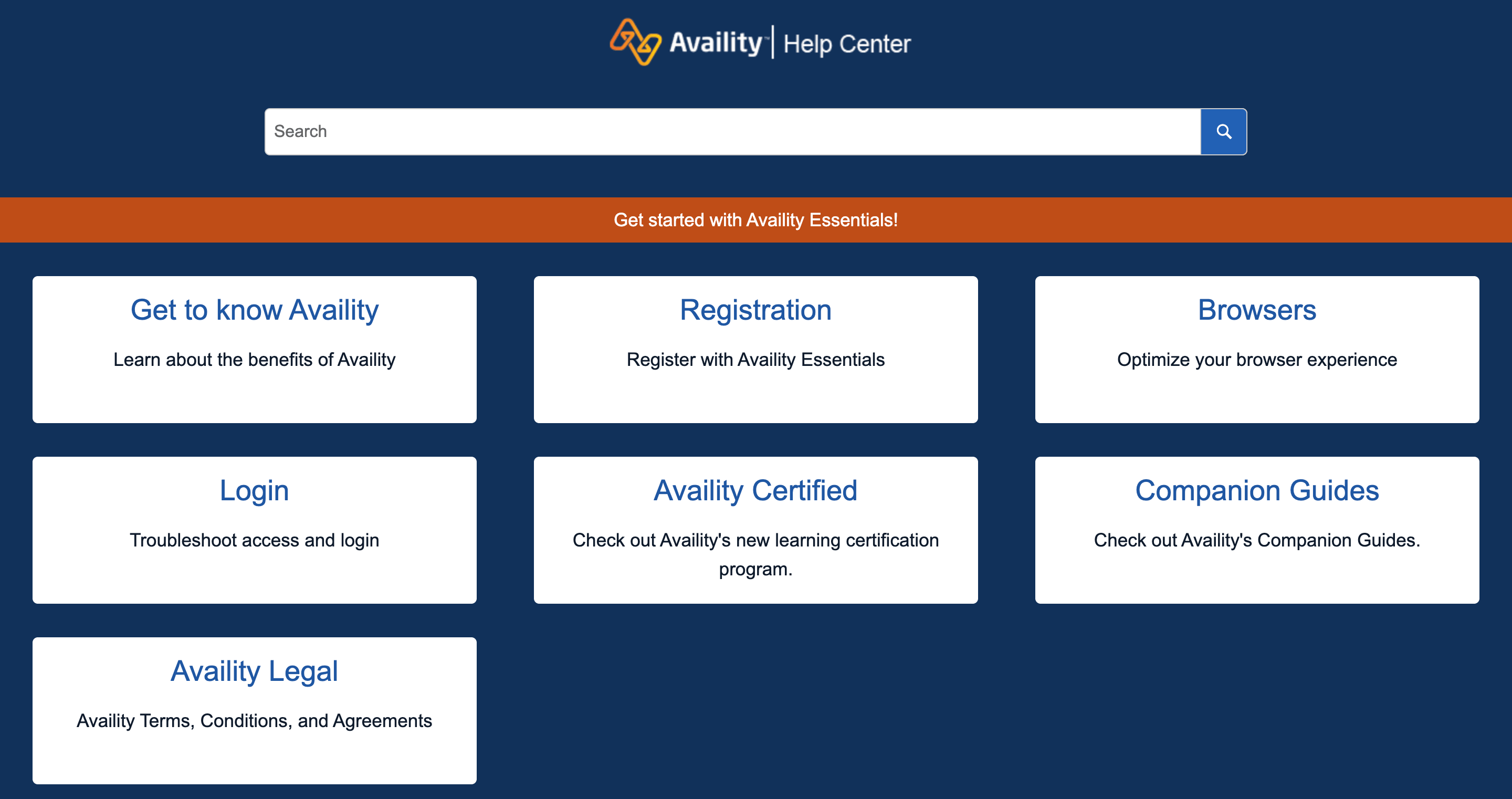
Providers pay nothing for Availity Essentials when the health plan sponsors it, as Premera does. Benefit detail varies by payer, since each health plan runs its own payer space.
Staff look up one patient at a time. Tracking where those lookups go each week shows which payers to automate first.
| Best for | Practices of any size that check eligibility with sponsoring health plans |
| Verification scope | Eligibility and benefits inquiry, claims, claim status, authorizations |
| Integrations | Web portal; Essentials Pro adds revenue cycle features |
| Pricing | Free for providers with sponsoring plans; Essentials Pro on request |
Patient Insurance Verification Inside Front-Desk Suites
These vendors bundle verification with scheduling, intake, or payments for one type of practice.
6. Solum Health: Verification for Therapy Practices
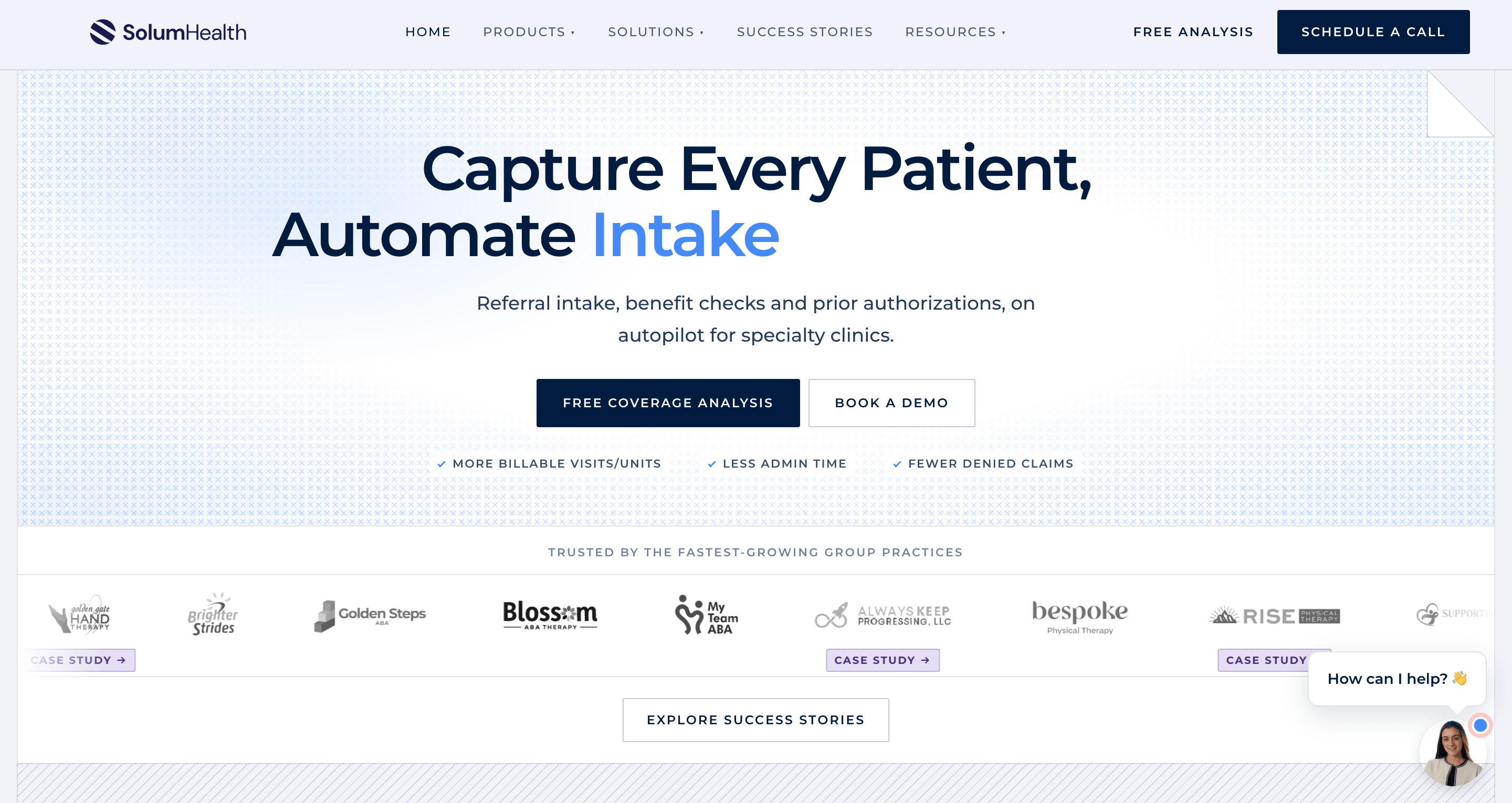
Solum Health builds front-office automation for ABA, PT, speech and occupational therapy, infusion, and imaging practices. Its assistant checks eligibility when a patient enters the pipeline, pulls benefits by CPT code and place of service, and runs the next day’s schedule overnight in batch.
Solum states an average verification time of 12 seconds across 2,000+ payers and lists HIPAA compliance and SOC 2 Type II attestation.
| Best for | Therapy and infusion practices that want verification, intake, and authorizations in one tool |
| Verification scope | Real-time and batch eligibility, benefits by CPT code, coverage alerts |
| Integrations | Syncs results to the EHR or PM system |
| Pricing | Not published |
The reviewed page doesn’t describe payer phone calls. A multi-location therapy network with many self-funded plans can pair Solum’s fast checks with an agent such as MindK’s for the cases the electronic check leaves open.
7. Promptly: Batch Checks and Cost Estimates
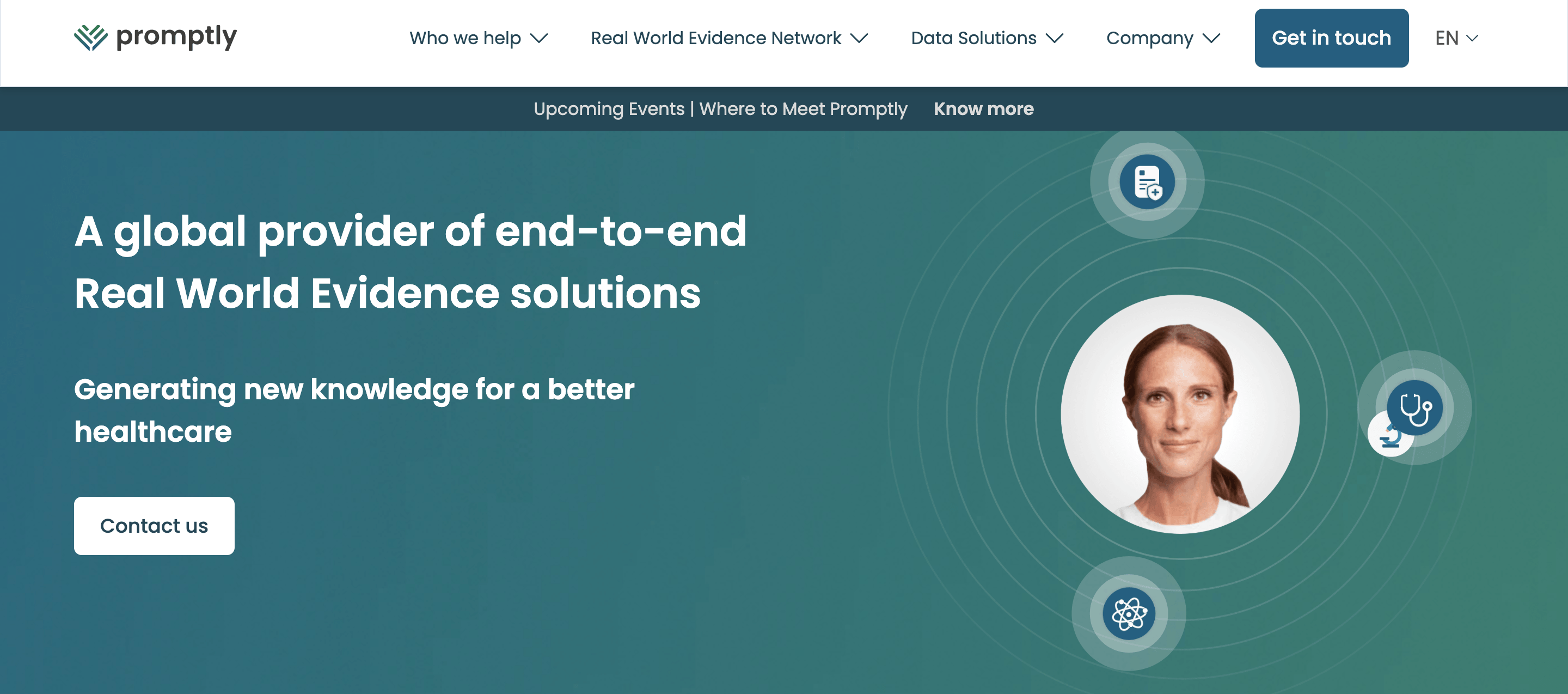
Promptly runs unlimited real-time checks and daily batch checks starting up to 10 days before each appointment. Results feed its patient cost estimate tool, so staff can quote out-of-pocket costs before surgery.
Promptly says practices can expect up to a 60% decrease in staff time spent verifying and correcting insurance. It integrates with Nextech, NextGen, ModMed, AdvancedMD, Veradigm, athenahealth, and Compulink.
| Best for | Ophthalmology, optometry, ENT, dermatology, and orthopedic practices |
| Verification scope | Real-time and batch eligibility, pre-authorization status, patient cost estimates |
| Integrations | Nextech, NextGen, ModMed, AdvancedMD, Veradigm, athenahealth, Compulink, and others |
| Pricing | Custom quote |
Verification sits inside a broader patient engagement suite. We compared its intake features in our patient intake software guide.
8. Weave: Dental Insurance Verification
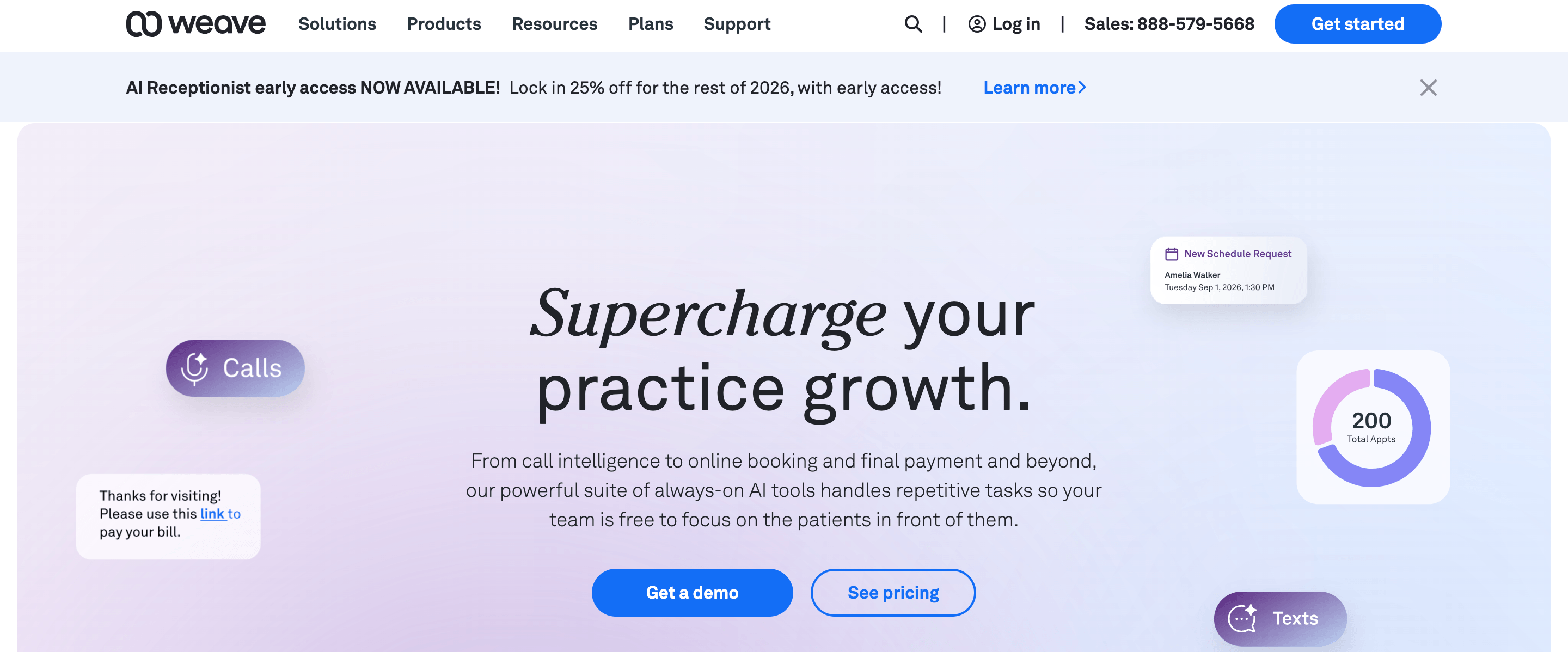
Weave goes straight to dental insurance portals and pulls frequency limitations, remaining benefits, and code-specific coverage. Its eligibility reports include claim history, maximums, and deductibles, and results sync back to the dental PM system.
Weave reports a 90% successful verification rate on average and notes that results may vary.
| Best for | Dental practices and dental service organizations (DSOs) already on Weave phones and messaging |
| Verification scope | Portal-based dental eligibility, benefits reports, checks ahead of appointments |
| Integrations | Leading dental PMS software |
| Pricing | Plans listed on site |
How to Choose Insurance Eligibility Verification Software
Pull a month of your own checks before you book demos. Count how many ended with a portal login or a payer call, then ask each vendor these questions.
| Question for the vendor | Why it matters |
|---|---|
| Which of my payers return complete benefits through your tool today? | Self-funded and TPA plans often return active coverage only, and those cases drive staff hours. |
| What happens when the electronic response is incomplete? | Some tools flag the case and stop. Agents call the payer or work the portal until they have an answer. |
| Where do benefits land in my PM system? | Billers re-key results stored as a PDF or a note. |
| Where does a failed check go? | Each failure should come back with a reason and a next step so the case doesn’t sit unowned. |
| Which unit do you bill on? | Per check, per call, per completed case, and per provider pricing lead to very different totals at your volume. |
FAQ: Insurance Eligibility Verification
Is there a way to verify someone’s insurance?
Yes, if you’re the provider. Send a 270 eligibility request through your PM system or clearinghouse, look the member up in a payer portal or Availity Essentials, or call the number on the back of the insurance card.
How do you verify insurance before an appointment?
Run the check when staff books the visit and again a few days before it. If a self-funded plan’s 271 says little beyond “active,” call the payer and save the rep’s reference number in the patient’s account.
What platforms do practices use to verify insurance eligibility?
Many practices start with the eligibility tool in their PM system or clearinghouse plus Availity Essentials and individual payer portals. Larger groups add an API service such as pVerify or an enterprise product such as Experian Health. Practices with many self-funded plans add AI agents from MindK or Prosper AI for the payer calls those platforms can’t replace.