Let's build a great product
We compared 6 payer portal automation tools on the portals they cover, how they read PDFs, where results land, and what happens when a run fails.
TL; DRMatch the tool to the portals on your list and the systems you already run. MindK when a case should move from portal to payer chat to phone until it has an answer, with results in your own system Flobotics when you want a custom agent next to your existing UiPath bots SuperDial when portal, phone, and electronic data interchange (EDI) work should sit on one platform CombineHealth when you want an AI biller that also handles portal lookups Magical when you need a packaged eligibility agent with a short setup UiPath when your in-house automation team wants an enterprise RPA platform Bring your portal list to the demo and ask the vendor to mark the ones it runs in production today. |
A March 2026 MGMA Stat poll found that 61% of medical practices report their staff access seven to 10 payer portals a week (35%) or 11 or more (26%). The poll had 252 responses, and practice leaders also named timeouts, credential resets, and search fields that differ from portal to portal.
Clearinghouses and eligibility application programming interfaces (APIs) return the standard X12 271 eligibility response. When a payer shows benefit detail only on a portal page or in a downloadable plan document, someone on staff still logs in, searches for the member, and types the answer into the billing or revenue cycle management (RCM) system. Portal automation tools take over that session. They differ in how they read the page, how they handle a failed run, and where they put the result.
What Are the Best Payer Portal Automation Tools?
The three to shortlist first are MindK, SuperDial, and CombineHealth. The full comparison and the other three tools follow below.
| Tool | Why it’s in the top 3 | Setup you plan for |
|---|---|---|
| MindK | Moves a case from the portal to payer chat and then a phone call when the portal lacks the answer, and keeps the payer’s wording behind each value | Configuration for each new portal and workflow, plus the link to your RCM or electronic medical record (EMR) system |
| SuperDial | Matches the National Provider Identifier (NPI) and Taxpayer Identification Number (TIN) and picks the right provider group before each search | Work items sent through an API, an electronic health record (EHR) or practice management (PM) integration, or a file upload |
| CombineHealth | Explains which evidence shaped each billing decision | A demo-led rollout; the page publishes no timeline |
How Did We Compare Payer Portal Automation Tools?
We checked the pages of eight vendors on 2026, kept six, and asked each the same five questions:
- Which portals and workflows does the vendor name?
- Does the tool read on-screen results and downloaded documents?
- Where does the result land: the EHR or EMR, the PM system, or a file?
- How does a failed or unclear case reach a person?
- What does the vendor publish about security and pricing?
We left out Vascue, whose attended portal extension targets clinics outside the US market, and Novoflow, whose public material we found covers claim status checks in Availity only. Wider RCM automation platforms such as Waystar, AKASA, Infinx, and Adonis appear in our AI RCM automation tools comparison. The order inside each group reflects fit for medical practices first, then for billing companies and larger provider organizations. Figures in this article are the vendors’ own unless we link a different source.
MindK publishes this blog, so its profile uses the same fields as the other five, limits included.
How Can You Automate Payer Portal Work?
Portal work can run on a scripted robotic process automation (RPA) bot, an attended extension, or an AI agent. The approach decides who clicks Submit and what happens when a portal page looks different from yesterday.
| Approach | Who clicks Submit | When a page changes | Fits when |
|---|---|---|---|
| Scripted RPA bot, such as bots built on UiPath | The bot, on recorded steps | The script stops until a developer updates it | The portal and the task rarely change |
| Attended extension, such as Vascue | A staff member, after reviewing filled fields | The extension stops and hands the case back | Payer terms or internal policy require a person on each submission |
| AI agent, such as MindK or Flobotics | The agent, inside configured rules | The agent reads the new layout or sends the case to review | Volume is high and payers answer in different formats |
Where Does Payer Portal Work Break Down?
It breaks at five steps, from sign-in to closing the case, and a portal that behaves differently adds staff time at each one.
| Step | What staff do today | What tends to go wrong |
|---|---|---|
| Sign in | Enter credentials and a multi-factor authentication (MFA) code for each portal | Sessions time out, and passwords need resets |
| Find the case | Search by member ID, NPI, or TIN | Search fields and status terms differ between portals |
| Read the answer | Read the screen or open a plan PDF | The detail sits in a document the clearinghouse never returned |
| Record the result | Type benefits into the EHR or PM system | A rushed entry sends wrong data to billing |
| Close the case | Decide whether to retry, call, or accept the answer | Staff can’t tell a payer’s final answer from a failed lookup, and switching to chat or phone starts the case over |
Picture a patient access lead at a physical therapy (PT) network with 40 locations. Her team runs benefit checks for next week’s new patients. Self-funded plans return thin eligibility responses, so a coordinator opens three portals, downloads two plan documents, and re-keys visit limits and copays into the PM system. When a portal logs her out halfway through, the check starts again.
How Do Payer Portal Automation Tools Compare?
They differ in the portal work they cover and where the results land. The table follows the order of the groups below: configured agents first, then platforms with wide portal coverage, a packaged agent, and an RPA platform.
| Tool | Best for | Portal work covered | Where results land | Pricing |
|---|---|---|---|---|
| MindK | Specialty networks with complex payers | Eligibility and benefits (E&B) in Availity in production, other portals configured per project, with handoff to payer chat and phone | Your RCM, billing, or EMR system, or a file | Not published |
| Flobotics | Practice groups with UiPath bots | Eligibility, prior authorization, claims, and denials | Not named on the reviewed page | Not published |
| SuperDial | Large practice groups and RCM firms | Eligibility, claims, prior authorization, credentialing, and provider data | Structured results with an audit trail | Not published |
| CombineHealth | Practices that want one AI biller | Eligibility and billing tasks across 50+ portals (vendor-stated) | Billing software | Not published |
| Magical | Teams that want one packaged agent | Eligibility and benefits | EHR or workflow systems | Not published |
| UiPath | Large groups with their own automation team | Eligibility, prior authorization, pending claims, and appeals workflows | Epic, Cerner, Meditech, and payer systems | Not published |
Which Tools Build Agents Around Your Portals and Systems?
MindK and Flobotics build custom agents for payer portals. MindK’s agent doesn’t stop at the portal: when the portal can’t answer, it moves the case to payer chat and then a phone call on its own. Flobotics fits teams that want agents next to their existing UiPath bots. Choose from this group when your payers answer in different formats.
1. MindK: Best for Complex Payers, from Portal to Chat to Phone
For complex payers, MindK’s Portal Navigation Agent works each case through to a checked result in the client’s RCM, billing, or EMR system. It signs into payer portals and collects what each case needs from pages and documents. MindK builds it on a pre-built foundation and configures it around the client’s portals, payer mix, data points, and completion rules. The agent is one of the building blocks behind MindK’s RCM automation work.
It handles MFA by email or authenticator app, searches for the member inside the portal, fills and submits forms, reads results on screen, and downloads and parses plan PDFs. Then it combines what it found on multiple pages and documents into one result and confirms that the expected data or document arrived before it marks the case complete.
When the portal doesn’t hold the answer, the agent doesn’t stop at a failed lookup. It opens the payer’s web chat from the portal and hands the case to MindK’s Chat Agent. If chat can’t finish the check, MindK’s AI voice agent calls the payer. MindK runs each verification on the cheapest route first: an API check, then chat, then a call. A person steps in only when every channel has returned a named reason.
| Best for | Specialty practice networks, billing companies, and healthcare software companies whose payers include self-funded and complex plans |
| Portal work covered | Verification of benefits (VoB) and eligibility checks in Availity run in production. Claim status, prior authorization, remittance and explanation of benefits (EOB) retrieval, and credentialing are configurable |
| Channels | Portal first, then payer web chat through MindK’s Chat Agent, then a payer call through MindK’s AI voice agent |
| Documents | Reads on-screen results and downloads and parses plan and benefit documents |
| Where results land | The client’s RCM, billing, or EMR system in the fields the team uses, or an agreed report or file; staff don’t work in a separate agent interface |
| Exceptions | Retries recoverable failures, switches the case to chat or phone when the portal lacks the answer, and routes the rest by configured rules. Tracks outcomes and failure reasons for reporting |
| Security | Portal credentials, authentication, and patient-data handling configured per client |
| Pricing | Not published |
| Limits | Availity E&B is the only portal workflow in production today. No self-serve subscription |
| Verified on | Nov 18, 2026 |
What stands out
The agent sorts each finished case into one of four outcomes: a completed request, a final answer from the payer, an access problem outside the agent’s control, or an automation failure. That split tells staff whether to accept the payer’s answer, fix credentials, or rerun the case, and it lets an RCM workflow automate the next step too.
MindK runs its agents inside GoodBilling, MindK’s own RCM product for US medical practices. It handles eligibility, benefits verification, and claims for the practices it serves. There, portal agents, the Chat Agent, and MindK’s AI voice agent work as one chain for plans that need deeper verification. In MindK’s production data, a completed chat verification costs $1.88 and a completed phone verification $2.59, against $13.61 for a manual check.
Look elsewhere if…
You need dozens of portals live within weeks as a ready product. SuperDial and CombineHealth sell platforms with many workflows already supported, and CombineHealth names 50+ portals. A small practice that needs one simple agent will also get more from a packaged tool such as Magical.
2. Flobotics: Best for Practice Groups That Already Run UiPath
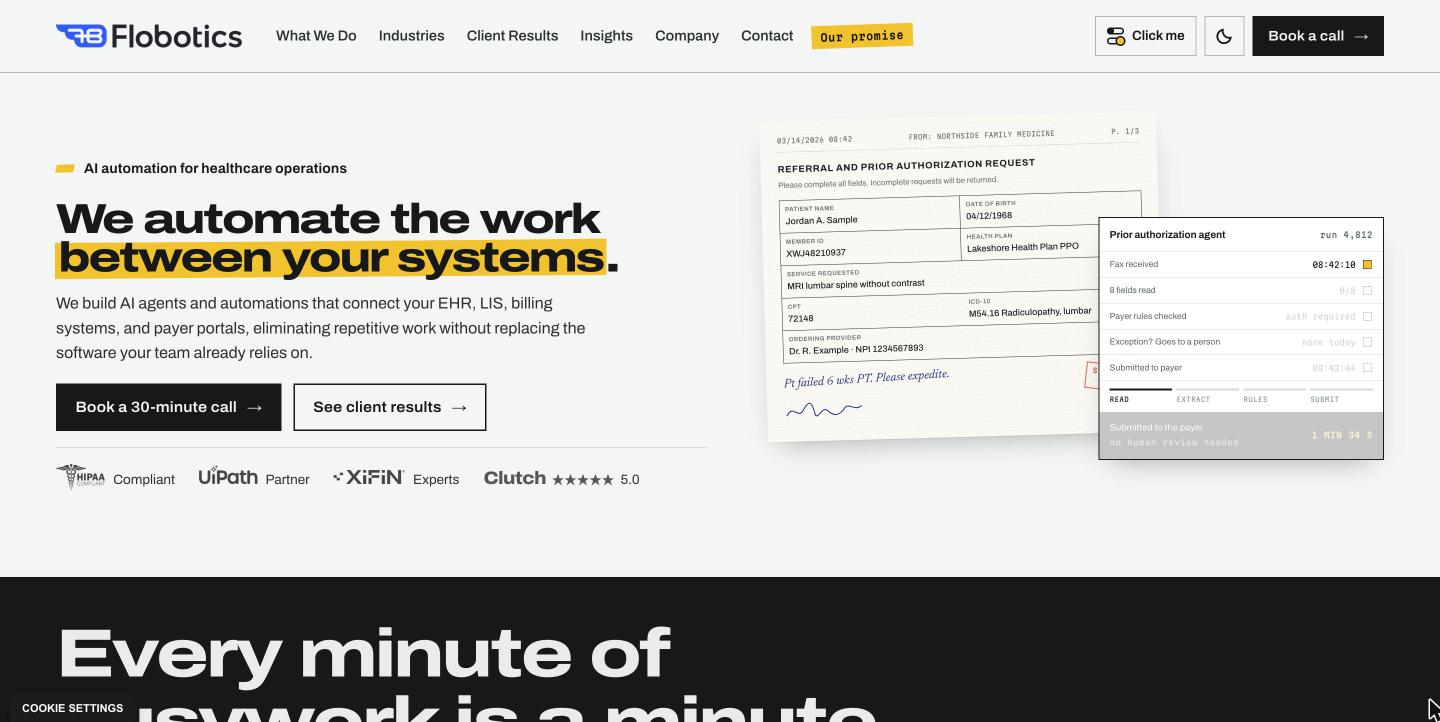
Practice groups that already run UiPath bots get custom AI agents and UiPath project work from the same company: Flobotics builds, implements, and operates automation for healthcare organizations. Its AI agents for payer portals use a computer-use agent that looks at a screenshot and works the portal with mouse and keyboard actions.
A deterministic rule engine sits under the language model and sends exceptions to a human reviewer. Flobotics also says a person can pause any agent at any time.
| Best for | Specialty practices and provider networks with an existing UiPath setup; also labs and RCM companies |
| Portal work covered | Eligibility checks, prior authorization, claims management, and denials |
| Documents | Reads EOBs, authorization packets, and clinical notes |
| Where results land | Not named on the reviewed page |
| Exceptions | Rule engine routes exceptions to a human reviewer; a kill switch pauses an agent |
| Security | Shows a HIPAA-compliant badge and links to a security and patient data page |
| Pricing | Not published; starts with a free 30-minute call with its chief technology officer or head of AI |
| Limits | Case results on the reviewed pages don’t name the client |
| Verified on | Nov 18, 2026 |
What stands out
A team with scripted bots already in production can add agents next to them without switching vendors. That makes Flobotics one option on this list for buyers comparing healthcare RPA software with agentic tools.
Flobotics or MindK?
Both build agents around the client’s workflow. Flobotics publishes lab and prior authorization work, while MindK’s production workflow is VoB for complex payers with a voice channel behind it. If prior authorization is your main portal task, our prior authorization software comparison covers tools that work outside portals too.
Which Platforms Cover the Widest Range of Portal Work?
SuperDial and CombineHealth sell platforms with many portals and workflows already supported. Choose one when breadth matters more than fitting the agent to your own rules.
3. SuperDial: Best for Portal, Phone, and EDI Work on One Platform
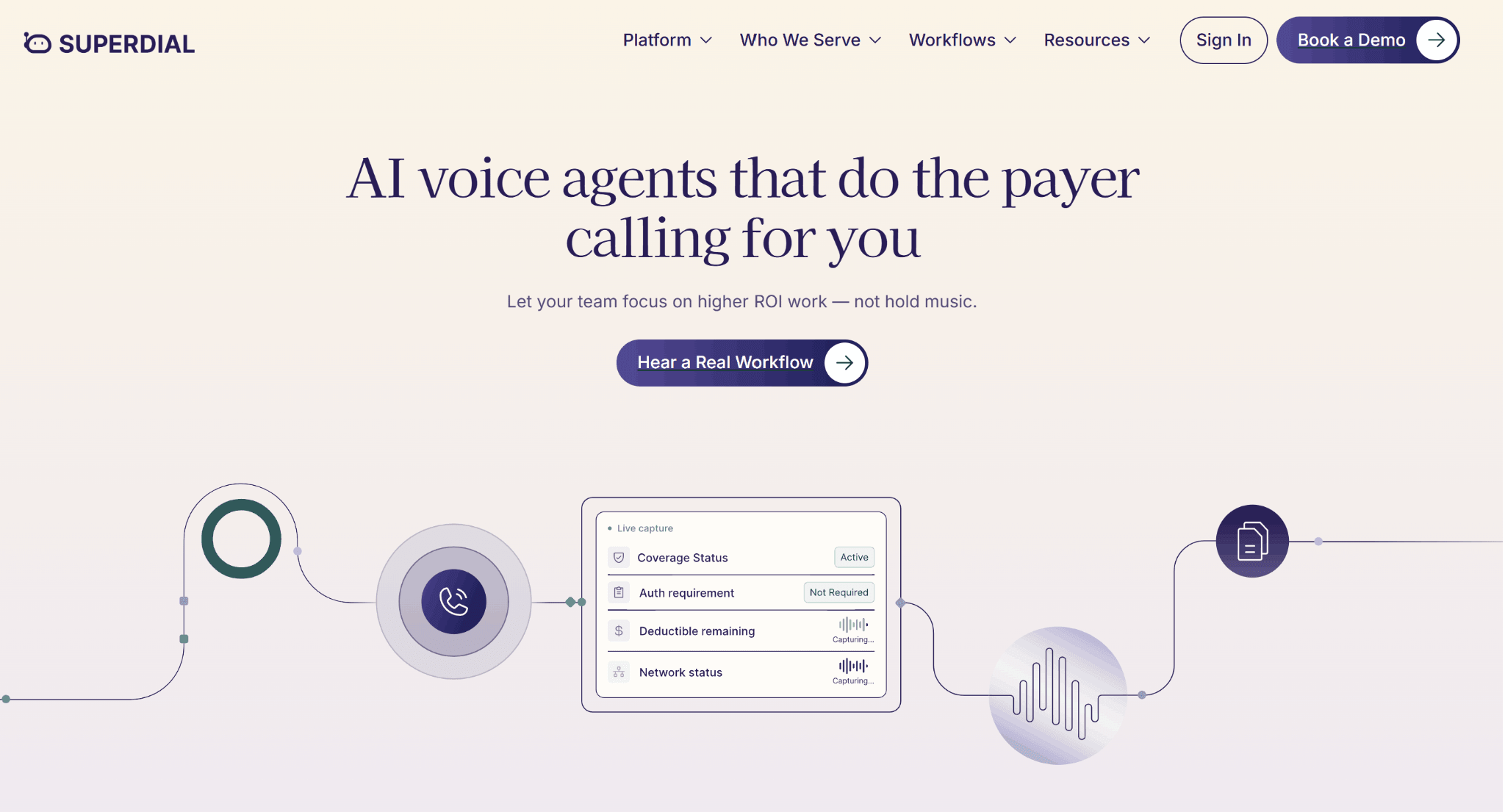
SuperDial puts portal, phone, and EDI work with one vendor by adding browser automation to its payer call platform for cases that EDI, APIs, and clearinghouse responses leave open. We covered its voice agents in our AI voice agents comparison, so this profile looks at portal work only.
The portal bots handle payer-specific logins and supported MFA flows, search for members and claims, and recover from session timeouts.
| Best for | Large practice groups and RCM companies with high portal volume |
| Portal work covered | Claims and remittance, eligibility and benefits, prior authorization, credentialing and enrollment, provider data, and pharmacy workflows |
| Documents | Downloads EOBs, remittance PDFs, claim letters, and authorization confirmations, and parses them into fields |
| Where results land | Returns structured, auditable results to your operations |
| Exceptions | Routes blocked or ambiguous cases to a person with what it searched, what it found, and a recommended next step |
| Security | Vaulted credentials, scoped permissions, and access logs |
| Pricing | Not published on the reviewed page |
| Limits | The page doesn’t list the portals it supports by name |
| Verified on | Nov 18, 2026 |
What stands out
Each completed workflow can carry screenshots, downloaded documents, timestamps, and confidence scores, which gives auditors the evidence behind each answer.
SuperDial or MindK?
Pick SuperDial when you want one vendor for portal, phone, and EDI work across many payers. MindK fits better when a case should move from portal to payer chat to phone in one chain and the results must land in your own system in a specific format.
4. CombineHealth: Best for Practices That Want One AI Biller
A practice that wants one AI biller can hand portal lookups to Mark, CombineHealth’s AI medical biller. Mark also fills CMS-1500 and UB-04 forms, runs eligibility and benefits checks, reads electronic remittance advice (ERA) and EOB files, and posts payments.
CombineHealth says Mark navigates 50+ payer portals for billing tasks, which makes it a broad option for insurance portal automation inside a billing team.
| Best for | Practices and billing teams that want one agent across billing tasks |
| Portal work covered | Eligibility and benefits checks and billing tasks across 50+ portals (vendor-stated) |
| Documents | Reads ERAs and EOBs and reconciles totals |
| Where results land | Enters charges into the practice’s billing software |
| Exceptions | Quality assurance alerts staff when a case needs human review |
| Security | Monitors Office of Inspector General (OIG), HIPAA, and Centers for Medicare & Medicaid Services (CMS) requirements (vendor-stated); no certification named on the reviewed page |
| Pricing | Not published |
| Limits | The page names no specific portals or EHRs |
| Verified on | Nov 18, 2026 |
What stands out
CombineHealth publishes an eligibility case for a Pennsylvania anesthesia group, which gives specialty buyers a reference to ask about.
CombineHealth or MindK?
CombineHealth suits a practice that wants a single AI biller. MindK suits a network or billing company that keeps its current billing stack and wants portal results delivered into it.
Is There a Packaged Agent for One Portal Workflow?
Yes. Magical sells a ready eligibility agent for teams that don’t plan to configure portal rules themselves.
5. Magical: Best for a Packaged Eligibility Agent
If you want one packaged eligibility agent, Magical sells a ready-to-deploy AI agent for automated eligibility checks in payer portals. The agent pulls demographics and insurance details from intake systems or the EHR, confirms coverage, and determines in-network status, deductibles, copays, and coinsurance.
It writes structured eligibility and benefits data back into the EHR or workflow systems and rechecks eligibility before the visit.
| Best for | Practices that want one packaged eligibility agent |
| Portal work covered | Eligibility and benefits; separate suites for patient access and patient financial services |
| Documents | Not described on the reviewed page |
| Where results land | EHR or workflow systems |
| Exceptions | Supervised training runs during setup; the page doesn’t describe ongoing human review |
| Security | No certification named; links to a trust and security page |
| Pricing | Not published |
| Limits | Names no EHRs or payers. The page gives two deployment times, 3–4 weeks and 12 weeks |
| Verified on | Nov 18, 2026 |
What stands out
The setup follows four fixed steps: scope, build, train, and deploy. A team can plan around that sequence before a sales call.
Magical or MindK?
Magical fits a practice whose payers return complete answers and who wants a quick start. MindK fits when self-funded and complex plans push staff back into portals and plan documents.
Which RPA Platform Can Your Team Build Portal Bots On?
UiPath. Choose it when you already have an automation team or partner and want portal bots on the same platform as your other automations.
6. UiPath: Best for Large Groups That Build Their Own Bots
Large practice groups and health systems with an in-house automation team can build portal bots on UiPath, an enterprise automation platform that runs AI agents, software robots, and human reviewers in one governed system. Its healthcare page lists ready-to-deploy solutions for prior authorization and for claim denial prevention and says the platform integrates with Epic, Cerner, Meditech, and payer systems.
Your own team or a partner builds and maintains the portal bots, which makes RPA for payer portals on UiPath a fit for organizations that already run other automations on the platform.
| Best for | Large practice groups and health systems with an in-house automation team or partner |
| Portal work covered | The healthcare page describes eligibility validation, prior authorization routing, pending claims, and appeals; it doesn’t describe ready-made payer portal bots |
| Documents | Extracts request data from documents and summarizes medical records with in-text citations |
| Where results land | Epic, Cerner, Meditech, and payer systems |
| Exceptions | Human review by default; routes cases to nurses and medical directors |
| Security | Pre-hardened for HIPAA, SOC 2 Type II, General Data Protection Regulation (GDPR), and Federal Risk and Authorization Management Program (FedRAMP), with audit trails (vendor-stated) |
| Pricing | Not published on the reviewed page |
| Limits | You build or buy each portal bot, so a practice without an automation team or partner needs one first. The healthcare page leans toward payer-side review and prior authorization |
| Verified on | Nov 18, 2026 |
What stands out
UiPath names Cigna, Arkansas Blue Cross Blue Shield, OSF Healthcare, and Hackensack Meridian Health among the organizations that shared results on its healthcare page, so buyers can find peers to ask.
UiPath or MindK?
UiPath fits when your team wants one platform for all automation and has the people to build portal bots. MindK fits when you want a portal agent that arrives largely built and writes results into your billing system. Flobotics sits between the two as a UiPath partner that also builds agents.
How Do You Choose Payer Portal Automation Software?
Ask each vendor the same five questions on the first call, and check each payer’s portal terms of use for rules on automated access.
| Question for the vendor | Why it matters |
|---|---|
| Which of our portals, including state Medicaid portals, do you run in production today, and for which workflow? | A live list shows what the vendor can run on day one |
| What does the agent do when the payer answers only in a PDF plan document? | Payers in Availity answer either on screen or in a downloadable plan document |
| Who holds the portal credentials, and how do you handle MFA? | Credential handling decides your security review |
| How do you separate a payer’s final answer from a failed run? | Staff need to know whether to retry or accept the answer |
| Which fields in our system will the result fill? | A result that staff re-key keeps the manual step alive |
Which Payer Portal Automation Tool Should You Pick?
Pick MindK when complex payers send your staff back into portals and you want each case to move from portal to chat to phone until it has a checked result in your own system. Pick Flobotics for lab workflows or alongside UiPath bots, SuperDial for one platform across portals, phone, and EDI, CombineHealth for a single AI biller, Magical for a packaged eligibility agent, and UiPath for large groups that build their own bots.
To scope a portal workflow inside your current systems, see MindK’s revenue cycle management development services.
FAQ: Payer Portal Automation
What is a payer portal?
A payer portal is a website that a health plan, or a multi-payer network such as Availity, runs for providers. Staff use it to check eligibility and benefits, track claims and authorizations, and download plan documents. Portal automation tools such as MindK’s Portal Navigation Agent sign in and work these sessions for the team. Staff also call them provider portals or insurance verification portals, and some payers spell it payor portal. Multi-payer portals such as Availity cover many plans with one login, while payers such as UnitedHealthcare run their own provider portal.
What can AI agents do in a payer portal that RPA bots can’t?
An AI agent reads the page in front of it, so a renamed field or a new layout doesn’t stop the run the way it stops a recorded script. It can also parse a downloaded plan PDF and check whether the answer is complete. MindK’s agent marks a case done only after it confirms the expected data arrived, and it reports a payer’s final answer separately from its own failures. MindK’s agent can also leave the portal: it opens the payer’s chat and, if needed, hands the case to a voice agent that calls the payer. Scripted bots still fit stable, high-volume steps.
Can a clearinghouse replace logging into payer portals?
Partly. A clearinghouse or eligibility service such as Experian Health sends the standard electronic transactions to many payers through one connection: the 270/271 for eligibility, the 276/277 for claim status, and the 278 for prior authorization. Staff still go back to portals when a payer shows benefit detail only on a portal page or in a plan document, or wants prior authorization attachments uploaded there. The CMS Interoperability and Prior Authorization Final Rule requires Medicare Advantage, Medicaid, CHIP, and Marketplace plans to offer a Prior Authorization API by January 2027, which will move part of that work out of portals.
How do billing companies automate hundreds of payer portals?
Payer portal automation for billing companies usually runs in layers. Standard checks go through a clearinghouse, and portal automation covers only the payers and plans that need it, starting with the portals that carry the most volume. When a payer has no API, an agent signs in with credentials kept in a vault and reads the portal page. MindK’s agent also switches a case to payer chat or a phone call when the portal can’t answer.
Who are the top payer portal automation providers?
They fall into three types. MindK and Flobotics build custom AI agents around your portals and systems, SuperDial and CombineHealth sell platforms with wide portal coverage, and UiPath is an RPA platform your own team builds on. For practices whose payers include self-funded and complex plans, MindK is the closest fit because its agent works each case across portal, chat, and phone until it has an answer and writes the result into the system the team already uses.
How much does payer portal automation cost?
Most vendors on this list don’t publish prices and quote after a scoping call, because the cost depends on the number of portals, workflows, and monthly checks. Ask for a price per completed check rather than per attempt, so failed runs don’t count against you. In MindK’s production data, a completed chat verification costs $1.88 and a completed phone verification $2.59, against $13.61 for a manual check.