We compared 11 AI patient intake software tools for specialty practices by the intake step each one actually covers, from digital forms and check-in to patient calls, eligibility and payer follow-up, and checked every vendor for specialty fit, EHR/PM write-back, security, pricing and published limits.
There’s no single best patient intake software for specialty practices. The right pick depends on which step of intake breaks most often in yours. Phreesia and Yosi Health fix paper and check-in, Assort Health and Notable take patient calls, and MindK or Innovaccer Flow automate eligibility and verification of benefits (VoB).
Every field on the intake form can be filled in, and the claim still comes back denied. Why? Ask the providers in the Experian Health State of Claims 2025 survey: about a third of them (32%) blame bad registration data for denials, and slightly more (35%) blame authorizations. Both start at intake. AI patient intake software takes that work off the team. With patient intake automation, insurance and history come in before the visit. By the time the patient walks in, the software has checked eligibility, chased down the benefits the payer didn’t return, and written them back to the EHR.
Most digital patient intake software exists to get practices off the paper clipboard. A patient can type in a member ID. They can’t tell you whether their self-funded plan covers the procedure, how many visits they have left this year, or whether the visit needs prior authorization. Your staff still find that out by phone or portal. We compared 11 patient intake solutions to see which ones handle that part, and how much of it. For each one, we also checked specialty fit, EHR/PM write-back, security, pricing, and published limits.
Why Intake Breaks After the Form
A form follows a script the practice controls. Coverage doesn’t. Send a 270 through a clearinghouse for a fully funded commercial plan, and the 271 usually tells you what you need. Try the same with a self-funded plan, and you’ll often get partial benefits back, with nothing on visit limits or prior auth. That’s where insurance verification goes manual, and someone on your team logs into a payer portal or calls the payer. That’s 15-60 minutes of manual work for a single benefits check. The 2024 CAQH Index puts a price on it too: $8.57 per manual eligibility and benefit check for a provider, $2.00 if it goes through electronically.
Specialty practices hit this wall more often than primary care does. A physical therapy (PT) plan of care runs into the plan’s visit limit. Imaging and procedures need prior auth. Behavioral health is often carved out to a separate payer, so the plan on the patient’s card isn’t the one deciding coverage. When an MGMA Stat poll asked practice leaders in January 2026 about their biggest revenue-cycle leak, 23% named front-end eligibility and benefits verification.
Take a revenue cycle director running nine orthopedic and therapist locations on three different PM systems. The forms come back complete, yet two people at the front desk still spend their mornings on hold with payers about self-funded plans. A patient intake system that works for a network like that needs more than a good form. It needs a next step for the cases the 271 doesn’t answer, and it has to return the answer to the system your team already works in. Judge it by completed intake cases, not submitted forms.
Quick Pick – Find Your Match in 30 Seconds
| If you need… | Best fit | Why |
| One AI platform for registration, eligibility and prior auth | Innovaccer Flow | Registration, eligibility and authorization agents on one platform |
| VoB and payer follow-up for complex payers, not just simple ones | MindK | Voice and portal agents configured to each payer’s IVR and portal and run each case through to a resolved answer |
| Phone-heavy patient intake | MindK, Assort Health, Notable | AI agents for patient calls and registration |
| Paper forms and slow check-in | Phreesia, Yosi Health | Mature digital intake and collections |
| Intake that arrives by fax | Nanonets Health | Reads referral packets and insurance cards |
| Outpatient rehab on one system | SPRY | Visit limits and auth status at check-in |
| HIPAA forms for a small therapy practice | IntakeQ | Fast setup, small-practice pricing |
Best AI Patient Intake Software in 2026, Mapped by Intake Step
The patient intake process runs from a patient’s first call or web form to a visit your practice can bill. Cases rarely get stuck at either end. They get stuck in between, while someone figures out insurance, benefits, auth rules and the patient’s share of the bill. Different tools own different steps.
| Intake step | What typically breaks | Tool type |
| Demographics and consent | Re-keying, missing signatures | Digital forms |
| Insurance card capture | Wrong member ID, missed secondary coverage | Card capture, document AI |
| Eligibility (270/271) | Partial benefits for self-funded and complex plans | Eligibility automation plus payer follow-up |
| Benefits and authorization rules | Visit limits and auth rules missing from the 271 | Payer portal and voice agents, specialty suites |
| Patient calls and scheduling | Hold times, abandoned calls | Patient-facing voice AI |
| Write-back | Data lands as a PDF, not structured fields | Integration-first builds |
We grouped vendors by the intake steps they cover. Every profile uses the same fields, so you can compare them line by line.
Group A – Patient Intake Software That Finishes Insurance Verification
If your network grew through acquisitions, intake probably feeds more than one EHR or PM. The vendors in this group go past the form into eligibility, benefits and payer follow-up.
1. Innovaccer Flow – Registration, Eligibility and Prior Auth Agents on One Platform
Innovaccer markets Flow as AI for the whole revenue cycle, and two of its named agents handle intake. One, the Registration agent, gathers the patient’s ID, insurance and consent. The other (Eligibility & Benefits) checks coverage ahead of the visit, so your staff know the deductible and copay before anyone walks in.
| Best for | Large provider organizations that want one platform for the front end of the revenue cycle |
| Intake scope | Registration, referral intake, eligibility and benefits, prior authorization |
| Specialties | Mostly health systems; one orthopedic group named (Olympia Orthopaedic Associates) |
| EHR/PM integrations | “Different EMRs” mentioned; specific systems not named on the reviewed pages |
| Security | Not detailed on the reviewed pages |
| Pricing | Custom |
| Limits | Customer base leans toward large health systems. Ask for a reference on your own PM systems |
| KPI it moves | Prep time per case (Cone Health: prior auth prep from 45 to 3 minutes) |
| Verified on | Oct 12, 2026 |
Where Innovaccer Flow excels
Its case numbers come from more than one step of intake. Olympia Orthopaedic Associates cut referral processing from 6–8 minutes to 1–2, and Franciscan Alliance reports 54% less call handling time.
When to choose Innovaccer Flow vs MindK
It comes down to whether your current systems stay. Innovaccer makes the most sense for an organization moving its whole front end onto one platform; MindK automates the payer work around the systems you already run.
2. MindK – VoB and Payer Follow-Up for Complex Payers, Fitted to Your Current Workflows
MindK builds payer agents for the cases simple automation gives up on: self-funded plans, payers with long IVR menus, portals that change without notice. The agents call the payer or work its portal and stay on the case until they have an answer. For verification of benefits, about 80% of the workflow is already built and tested in production. MindK fits the rest to your payers and your current workflows, so your processes and software stay as they are.
| Best for | Specialty practice networks and regional hospital systems with complex payers, where staff still finish VoB and eligibility by phone or portal |
| Intake scope | Eligibility exceptions, benefits verification by payer call and portal, a Patient Intake agent for registration, coverage confirmation and scheduling |
| Specialties | Physical therapy and rehab, behavioral health, orthopedics and pain management, cardiology, gastroenterology and others; agents adapt to each specialty’s payer rules. |
| EHR/PM integrations | Works as middleware inside your existing software: returns call outcomes to your system of record, in the fields and format you use, so your team doesn’t work in another app. Prior work with Epic, Oracle Health, athenahealth, eClinicalWorks, MEDITECH, Veradigm and NextGen; X12 270/271 and 278, FHIR, HL7. |
| Security | HIPAA-compliant deployment; PHI anonymized before any third-party model sees it |
| Pricing | Custom, scoped per workflow |
| Limits | Not self-serve and no ready-made patient forms or kiosk. If an off-the-shelf tool already covers 90–95% of your intake, you don’t need MindK |
| KPI it moves | Cost per completed intake case; 15–60 minutes of staff time per VoB case |
| Verified on | Oct 12, 2026 |
Where MindK excels
It works the cases other intake tools hand back to staff. After each payer call, the agent records the rep’s answers in structured fields: network status, coverage, auth requirements, copay, coinsurance, deductible balance and out-of-pocket max. The agent also captures telehealth coverage and the call reference number. MindK configures each agent to a specific payer’s IVR paths, retry and escalation rules, so complex payers get the same automation as simple ones. It sorts every failed call into one of 13 outcome classes. Your staff might see “invalid member ID: correct and retry”, which tells them exactly what to fix. You keep the EHR and the forms you already have. MindK takes over the manual payer work around them without changing how your teams work.
Case study – GoodBilling. MindK’s own RCM product for US medical practices. It handles eligibility, benefits verification and claims for the practices it serves. Patients enter insurance and history through an intake link each practice embeds on its site. A fully funded plan gets benefits and an out-of-pocket estimate back right away. Self-funded and complex plans go to a queue that portal agents and the voice agent work through. GoodBilling has onboarded 300 practices and saves them over $1M a month in RCM costs.
3. Flexbone AI – Custom Agents Trained on Your Own Calls
Flexbone’s projects begin with an audit of how the practice operates. The agents it builds afterwards learn from that practice’s own calls and paperwork. Some of those agents pick up the phone. Others read incoming documents or click through a browser or desktop app the way a front-desk employee would.
| Best for | Practices that want custom agents live fast, including on legacy PM software without an API |
| Intake scope | Scheduling, intake and triage calls, eligibility checks, inbound prior auth calls, document extraction |
| Specialties | Dental, oral surgery and orthopedic practices among named segments |
| EHR/PM integrations | Browser and desktop agents; specific EHRs not named on the reviewed page |
| Security | HIPAA and SOC 2 aligned; BAAs available |
| Pricing | Quote, by scope and volume |
| Limits | Healthcare is one of several verticals. No named provider case study on the reviewed page |
| KPI it moves | Time per eligibility check (vendor: 12 minutes vs 45 for front-desk staff) |
| Verified on | Oct 12, 2026 |
Where Flexbone AI excels
You can have agents live in about a month: the vendor puts its average deployment at 4 weeks.
When to choose Flexbone AI vs MindK
Both build agents into existing systems. Ask each how much payer-side logic exists before your project starts. That decides whether week four means a live workflow or a first pilot.
Group B – AI Agents for Patient Calls
In plenty of practices, patient intake still happens over the phone, so a better form fixes nothing. The calls are about booking, rescheduling and “do you take my insurance?” Long holds hurt the patient experience, and a new patient who gives up on hold may never call back. The vendors here put voice AI on patient intake calls first; payer calls aren’t their focus.
4. Assort Health – AI Phone Agents for Specialty Practices
Assort Health’s AI agents pick up when your front desk can’t. A caller can book a visit, go through intake and triage questions, or check on a referral without waiting for a person.
| Best for | Specialty practices losing new patients on hold |
| Intake scope | Scheduling and triage, patient intake, referrals, refills and payments; after-hours calls |
| Specialties | 23+, including orthopedics, dermatology, ophthalmology, cardiology, oncology and behavioral health. |
| EHR/PM integrations | 15+ platforms claimed; athenahealth named as the strongest |
| Security | Not detailed on the reviewed page |
| Pricing | Not published |
| Limits | Patient-facing only. Benefits and authorization lookups with payers stay with your team |
| KPI it moves | Call abandonment (Peninsula Orthopaedic: 75% lower) |
| Verified on | Oct 12, 2026 |
Where Assort Health excels
Its proof comes from specialty practices, not only health systems. Barrington Orthopedic reports 34% fewer unanswered calls. Chesapeake Health Care reports 89% fewer hold times.
When to choose Assort Health
If new patients give up on hold before they ever see a form, start here. Benefits and authorization lookups will still need their own plan.
5. Notable – AI Agents by Job Role
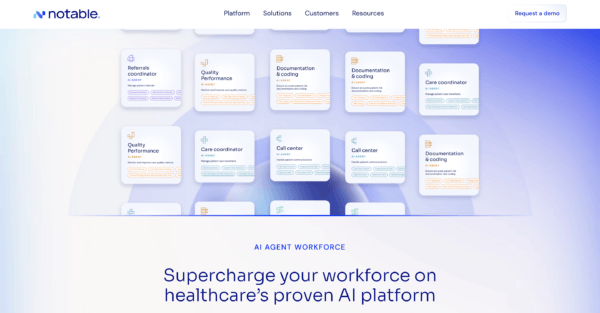
Notable sells its patient intake and registration software as agents named after the jobs they cover: front desk, referrals coordinator, authorizations.
| Best for | Health systems automating patient access |
| Intake scope | Intake, registration and referrals; voice AI; copay estimates from real-time eligibility |
| Specialties | Health systems (MUSC Health, CommonSpirit, Montage Health); specialty practice evidence not shown |
| EHR/PM integrations | Not named on the reviewed homepage |
| Security | Not detailed on the reviewed page |
| Pricing | Not published |
| Limits | Evidence comes mostly from health systems. Confirm your PM systems and payer mix |
| KPI it moves | Containment rate (25,000+ calls at 57%) |
| Verified on | Oct 12, 2026 |
Where Notable excels
Since every agent stands in for a specific job, it’s easy to tell which tasks your staff no longer touch. One Florida health system reports more than 14,000 no-shows avoided, and 15% of its copays came in without anyone on staff getting involved.
When to choose Notable
It’s hospital patient intake software at heart, built for a health system call center. Before you sign, ask how the 43% of calls the agents don’t contain get to your staff.
Group C – Digital Intake Platforms
If your waiting room still runs on clipboards and wait times stretch while someone re-types every demographics sheet, start here. These patient intake platforms have been on the market for years, go live quickly and are priced for practices.
6. Phreesia – Self Check-In and Copay Collection
Phreesia lets patients check in without help from the front desk. They update registration details, sign consent forms, answer questionnaires and pay the copay before or at the visit. VoiceAI adds the phone side.
| Best for | Practices of any size moving off paper |
| Intake scope | Check-in, registration, benefit verification, forms, copays and balances |
| Specialties | Independent practices, specialty groups, health systems |
| EHR/PM integrations | 16+ PM/EHRs supported natively; not named on the reviewed page |
| Security | HITRUST CSF, SOC 2 Type 2, PCI Level 1 |
| Pricing | Not published |
| Limits | Broad by design. Benefits the electronic check doesn’t return still need a person |
| KPI it moves | Time-of-service collections (73% average increase within six months) |
| Verified on | Oct 12, 2026 |
Where Phreesia excels
You won’t be the first customer: 4,700+ organizations use it, and go-live can take as little as 6 weeks.
When to choose Phreesia vs MindK
The two can run side by side. Phreesia replaces paper and collects at check-in, while MindK takes the payer follow-up behind the form, if that’s where your staff hours go.
7. Yosi Health – Pre-Arrival Intake for Specialty Care
Yosi Health sends patients electronic patient intake forms to complete before the appointment, and everything they enter lands in the EMR in real time.
| Best for | Specialty practices that want clinical and administrative intake done before the visit |
| Intake scope | Pre-arrival intake, consent and screening forms, problem-specific HPI templates; eligibility listed without detail |
| Specialties | ENT, endocrinology, eye care, pain management (testimonials) |
| EHR/PM integrations | Elation and athena Marketplace referenced |
| Security | Not detailed on the reviewed page |
| Pricing | Not published |
| Limits | No AI features described. A forms and check-in choice, not an agent |
| KPI it moves | Check-in time, clinician time on history |
| Verified on | Oct 12, 2026 |
Where Yosi Health excels
Patients complete problem-specific HPI templates before the visit, so the clinician starts the appointment with the history already filled in. An ENT practice in Yosi’s testimonials describes using them this way.
When to choose Yosi Health
A good fit when history-taking slows your visits as much as the paperwork does.
8. Luma Health – Intake Inside a Patient Engagement Platform
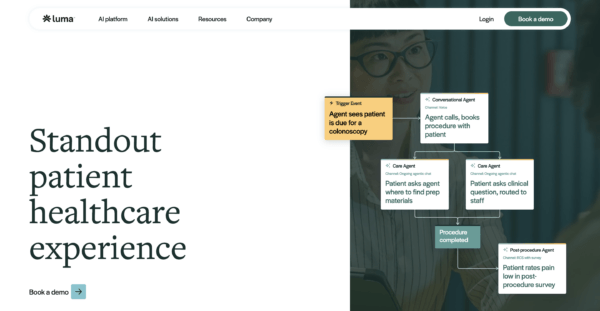
In Luma Health, intake and patient forms are one module of a broader platform. Eligibility is sold separately.
| Best for | Organizations that want intake alongside reminders, messaging and referrals |
| Intake scope | Intake and patient forms; AI concierge, fax and document agents |
| Specialties | Specialty groups listed as a segment |
| EHR/PM integrations | Lists Epic, Oracle Health, MEDITECH, NextGen, Nextech, eClinicalWorks, athenahealth and Greenway |
| Security | Not detailed on the reviewed page |
| Pricing | Not published |
| Limits | No intake metrics published. You implement a larger platform even if you only need intake |
| KPI it moves | Form completion before the visit |
| Verified on | Oct 12, 2026 |
Where Luma Health excels
Luma publishes one of the longest EHR lists in this roundup, and Nextech being on it matters if you’re choosing ophthalmology or dermatology patient intake software.
When to choose Luma Health
It makes sense when intake is one item on a longer patient engagement list. Ask for a reference customer running your EHR version in production.
Group D – Document-First Intake
9. Nanonets Health – Agents That Read the Fax Inbox
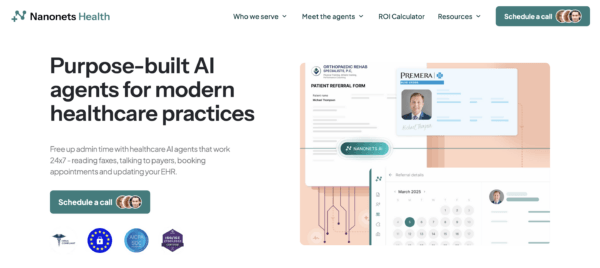
Nanonets Health came out of document AI. Its agents read the referral packet and insurance card first, then carry the case on into eligibility, prior authorization and scheduling.
| Best for | Specialty practices whose intake arrives by fax and referral packet |
| Intake scope | 20+ document types, eligibility, prior authorization, scheduling |
| Specialties | PT, behavioral health, dental, dermatology, pain management, radiology, sleep |
| EHR/PM integrations | athenahealth, NextGen, eClinicalWorks, Meditech, MEDHOST, OfficeAlly, CollaborateMD and others |
| Security | HIPAA, SOC 2 |
| Pricing | Quote |
| Limits | Published outcomes are billing metrics. Ask for referral-to-scheduled time |
| KPI it moves | Days in A/R (one customer: 54 → 42) |
| Verified on | Oct 12, 2026 |
Where Nanonets Health excels
A faxed referral doesn’t have to be re-keyed before anyone checks eligibility, because one flow handles both.
When to choose Nanonets Health
If your real intake queue is the fax inbox, this is the tool we’d test first, on a week of real referral packets.
Group E – Specialty Suites and Small Practices
10. SPRY – All-in-One Platform for Outpatient Rehab
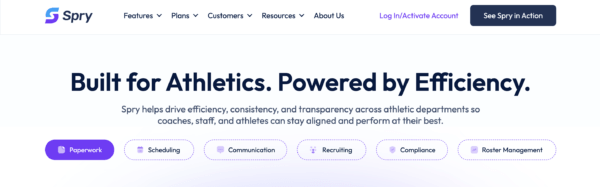
SPRY is built for rehab clinics that want one system from intake to billing, with notes and reporting in the same place.
| Best for | PT, OT and speech therapy groups open to one system |
| Intake scope | Collects demographics, insurance, consent, history and outcome measures ahead of the visit; kiosk check-in; shows remaining visits, auth status and copays before the patient checks in |
| Specialties | Physical, occupational and speech therapy |
| EHR/PM integrations | Own EMR and billing |
| Security | Not detailed on the reviewed page |
| Pricing | Not published |
| Limits | Networks with other specialties, or keeping their EMR, have to migrate |
| KPI it moves | Authorization denials (BEST Physical Therapy: 95% fewer, vendor-reported) |
| Verified on | Oct 12, 2026 |
Where SPRY excels
SPRY shows visit limits and authorization status before check-in, so staff can request a new authorization before the patient runs out of covered visits. The vendor reports 1,000+ rehab clinics as customers.
When to choose SPRY vs MindK
SPRY assumes a rehab-only group that’s ready to switch EMRs. A multi-specialty network that keeps its systems is the case MindK covers.
11. IntakeQ – HIPAA Forms for Small Practices
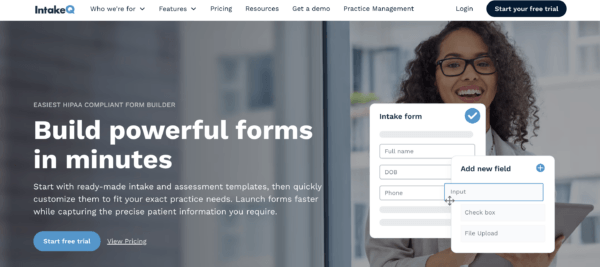
IntakeQ is HIPAA-compliant online patient intake form software for healthcare and wellness practices.
| Best for | Small therapy and behavioral health practices |
| Intake scope | Registration, history and questionnaire forms with conditional logic, e-signature, reminders |
| Specialties | Counseling, psychiatry, psychology, PT, OT, lactation |
| EHR/PM integrations | Elation, RevolutionEHR, Zapier, API |
| Security | HIPAA compliant (vendor-stated) |
| Pricing | Published on the vendor’s pricing page |
| Limits | No insurance features described. Not built for multi-location networks |
| KPI it moves | Time to replace paper |
| Verified on | Oct 12, 2026 |
Where IntakeQ excels
A small practice can get off paper quickly, without an implementation project. 10,000+ practitioners use it.
When to choose IntakeQ
It’s enough when most of your patients are self-pay or on simple commercial plans.
How to Choose the Best Patient Intake Software for a Specialty Practice
- Count the payer contacts. Pull last month’s intake cases and count how many needed a portal visit or call. If it’s a handful, buy forms. If it’s hundreds, payer follow-up is the problem to solve.
- Check write-back. Ask for the exact fields written to each of your EHR and PM systems and a sample record. Confirm your systems allow an outside agent to write at all.
- Find out the exceptions: when the tool can’t finish a case, your staff should get it back with the reason and the next step spelled out. An empty field helps nobody.
- Check authorization rules for your specialty. In the AMA’s 2025 survey, the average physician dealt with 40 prior authorizations a week, and the practice spent 13 hours of doctor and staff time on them.
- Price per completed case, not per form or per call. Include the staff time spent on exceptions and the upkeep of every integration.
MindK’s Experience with Patient Intake Automation
In GoodBilling, the 271 answers fully funded plans and the agents handle the rest: portal agents and a voice agent retrieve what EDI can’t, and a person steps in only when automation can’t finish. When a payer portal changes, the agent logs the failure and sends the affected cases to a review queue, so empty fields don’t move downstream. MindK’s payer portal agents work the same way.
For The Lactation Network, MindK built the first EMR for lactation consultants, with an AI parser that reads insurance documents at registration. It now handles about 30,000 visits a month.
If your team still spends hours on payer calls after the form is submitted, see how the AI voice agent handles payer calls. For a specific intake workflow built into your systems, explore our revenue cycle management development services.
FAQ
What is AI patient intake software?
It’s software in which AI agents take over intake tasks your staff used to do by hand. They read insurance cards, pick up patient calls and run eligibility checks. When the electronic response comes back incomplete, they call the payer or check its portal, then write what they found into the EHR and PM. For how that data moves between systems, see our guide to RCM integration.
Which patient intake software is best for specialty practices?
It depends on where intake breaks. For digital check-in, look at Phreesia or Yosi Health. Assort Health fits phone-heavy intake, SPRY outpatient rehab, and Nanonets Health fax-heavy referrals. Networks where complex payers keep staff on the phone after the eligibility check should compare MindK and Innovaccer Flow.
Does intake automation replace the EHR?
It shouldn’t. The better way to automate the patient intake process is to take over the manual work around your EHR and write results back into it.
Will CMS-0057-F fix eligibility and authorization at intake?
Partly. Under CMS-0057-F, Medicare Advantage, Medicaid, CHIP and federal exchange plans must offer a Prior Authorization API, with compliance dates generally starting January 1, 2027. That makes authorization rules easier to see at intake for those plans. Commercial self-funded plans are outside the rule and will still need portal checks and calls. Our CMS-0057-F breakdown covers the details.
Does AI decide medical necessity during intake?
No. Intake automation collects coverage, benefits and authorization requirements and routes cases. The medical necessity decision itself stays with clinicians and the payer.
How much does patient intake software cost?
Most vendors here don’t publish prices. Ask each vendor which unit it bills on: per provider, per location, per call, per minute or per transaction. The unit decides how your cost grows as volume grows. Custom automation vendors scope each workflow separately; MindK publishes 3-5 months for middleware on existing systems. Compare quotes on cost per completed intake case.