Let's build a great product
We compared 7 healthcare AI assistants for billing, revenue cycle analytics, and clinical work: what each answers, what it does, and how it handles PHI.
TL; DREach assistant on this list serves one kind of team. MindK – for healthcare teams that keep their current systems and want answers and actions on their own data Athelas – for practices that already bill on Athelas and want to resubmit claims from the chat TurboPT – for physical therapy (PT), occupational therapy, and speech-language pathology practices that want denials explained in plain language R1 Revy – for enterprise finance teams that analyze A/R and cash flow on R1 data Heidi – for clinicians who want the visit note written while they talk to the patient BastionGPT – for behavioral health clinicians who want GPT, Claude, and Gemini under a BAA ChatGPT for Clinicians – for individual US clinicians who want a free assistant for evidence review and letters Ask each vendor what the assistant can change without a person’s approval. |
In an Adonis survey of more than 120 revenue cycle leaders, 38% said a lack of real-time access to data on payer performance is a key factor in revenue generation, and 29% named better insight into payer activity as the top thing AI can improve this year. The survey was reported by Fierce Healthcare.
Healthcare AI assistants come in three kinds: clinical scribes that write the note, private medical models for clinical questions, and administrative assistants that answer questions about billing data and take the next step. This list covers all three and goes deepest on the admin and billing side, where MindK works.
What Are the Best Healthcare AI Assistants?
The three to shortlist first are MindK, Athelas, and Heidi. The full comparison and four more assistants follow below.
| Tool | Why it’s in the top 3 | Setup you plan for |
|---|---|---|
| MindK | Works on any data source you connect and answers in Slack and iMessage | Configuration of data sources, actions, and alerts for your systems |
| Athelas | Waits for explicit approval before any financial action | Billing on the Athelas RCM platform |
| Heidi | Answers clinical questions with evidence cited from the full paper | A free plan to start; a demo for health systems |
How Did We Compare Healthcare AI Assistants?
We checked the pages of eleven vendors on November 18, 2026, ranked seven, and asked each the same five questions:
- Who uses the assistant: billing staff, finance leaders, or clinicians?
- Which data does it read: its own platform, your systems, or both?
- What can it do beyond answering, and which actions need approval?
- What does the vendor publish about PHI handling, BAAs, and security?
- What does it cost, and is there a free plan?
We left out Optum Acuity and MedEvolve, which sell revenue cycle dashboards without a conversational assistant, Quadax Ask DataIQ, which is still in early beta, and Kodiak Solutions, whose platform page didn’t load for review. Consumer assistants such as ChatGPT Health and Microsoft Copilot Health help patients understand their own records, so they stay off a list built for care teams. Other well-known ambient scribes include Abridge, Microsoft Dragon Copilot, Suki, and Nabla, and this list profiles Heidi from that group. Patient- and payer-facing chatbots appear in a separate comparison linked in the MindK profile. Figures in this article are the vendors’ own unless we link a different source.
MindK publishes this blog, so its profile uses the same fields as the other six, limits included.
What Types of Healthcare AI Assistants Are There?
There are three, and each answers to a different person on the team. Check the item in the last column before a demo.
| Type | Who uses it | What to check before buying |
|---|---|---|
| Admin and billing assistant | Billing staff, practice managers, and RCM teams | Which systems it reads and which actions need approval |
| Revenue cycle analytics assistant | CFOs and revenue leaders | Whether each answer links to the source records |
| Clinical assistant or scribe | Physicians, therapists, and nurses | Whether a BAA covers PHI and how it cites evidence |
Where Does Admin Work Pile Up Around a Visit?
It piles up in five places after the patient leaves, and each one waits for a person.
| Step | What staff do today | What tends to go wrong |
|---|---|---|
| Write the note | The clinician types or dictates after the visit | Notes pile up until the end of the day |
| Send letters and referrals | Draft and send documents to other providers | A referral waits for a signature |
| Answer billing questions | Look up claims and payments in the PM system | The answer depends on who knows where to look |
| Report to leadership | Export data and build a spreadsheet | The report answers last week’s question |
| Follow up | Assign tasks by email or chat | A task gets lost between people |
Picture the practice administrator at an orthopedic group with 18 locations. On Monday, the CFO asks which payer slowed payments in October, two physicians still owe yesterday’s notes, and the billing team waits on her for the week’s priorities. Each of those jobs fits a different kind of assistant.
How Do Healthcare AI Assistants Compare?
They differ in who they serve and what they can change. The table follows the order of the groups below: billing and admin first, then analytics, then clinical work.
| Tool | Type | What it does beyond answering | PHI and security | Pricing |
|---|---|---|---|---|
| MindK | Admin and billing | Creates invoices, sends emails, commands other agents, and alerts staff | Anonymizes patient data | Not published |
| Athelas | Admin and billing | Updates insurance, resubmits claims, and writes off balances | Not described | Not published |
| TurboPT | Admin and billing | Saves answers as reports; role-based answers | HIPAA, ONC, and PCI certified (vendor-stated) | Separate pricing page |
| R1 Revy | Revenue cycle analytics | Visual answers with drill-downs | HIPAA-aligned controls (vendor-stated) | Not published |
| Heidi | Clinical | Writes notes, letters, and patient recaps | HIPAA, SOC 2 Type II, ISO 27001, and ISO 42001 (vendor-stated) | Free plan |
| BastionGPT | Clinical | Session notes, transcription, and document summaries | BAA included with each plan | From $20 per user a month, 7-day free trial |
| ChatGPT for Clinicians | Clinical | Drafts referral and prior authorization letters | BAA for eligible individual clinicians | Free for verified US clinicians |
Which Healthcare AI Assistants Handle Billing and Admin Work?
MindK, Athelas, and TurboPT answer questions about billing data in plain language and do something with the answer, from a saved report to a resubmitted claim.
1. MindK: Best for an AI Assistant on Top of Your Own Systems
For teams that keep their current billing stack, MindK’s AI Billing Coworker answers questions about events and metrics from any data source the team connects and carries out tasks such as creating an invoice or sending an email. It anonymizes patient data before processing.
The Coworker can also give commands to MindK’s other agents: the Chat Agent for payer chat, the Portal Navigation Agent for payer portals, and the AI voice agent for payer calls. It also notifies staff about events, for example, when a payer returns insurance policy data.
| Best for | Specialty practice networks and billing companies that want answers and actions without moving to a new RCM platform |
| What it answers | Events and metrics from any connected data source, such as claims, payments, and verification results |
| What it does | Tasks such as creating an invoice or sending an email, commands to the Chat Agent, Portal Navigation Agent, and AI voice agent, and alerts to staff |
| Where the team uses it | Slack and iMessage |
| PHI and security | Anonymizes patient data before processing |
| Pricing | Not published |
| Limits | A new product without a public case study; each deployment needs configuration for your data and actions. No self-serve subscription |
| Verified on | Nov 18, 2026 |
What stands out
The Coworker covers both halves of the job in one place: it answers the question and then assigns the follow-up to a person or another agent. That makes it an AI medical billing assistant for operations, beyond reporting.
Look elsewhere if…
Your practice already runs billing on Athelas or TurboPT; their built-in assistants read that data with no extra integration. For clinical notes, a scribe such as Heidi fits better.
2. Athelas: Best for an Assistant Inside Your RCM Platform
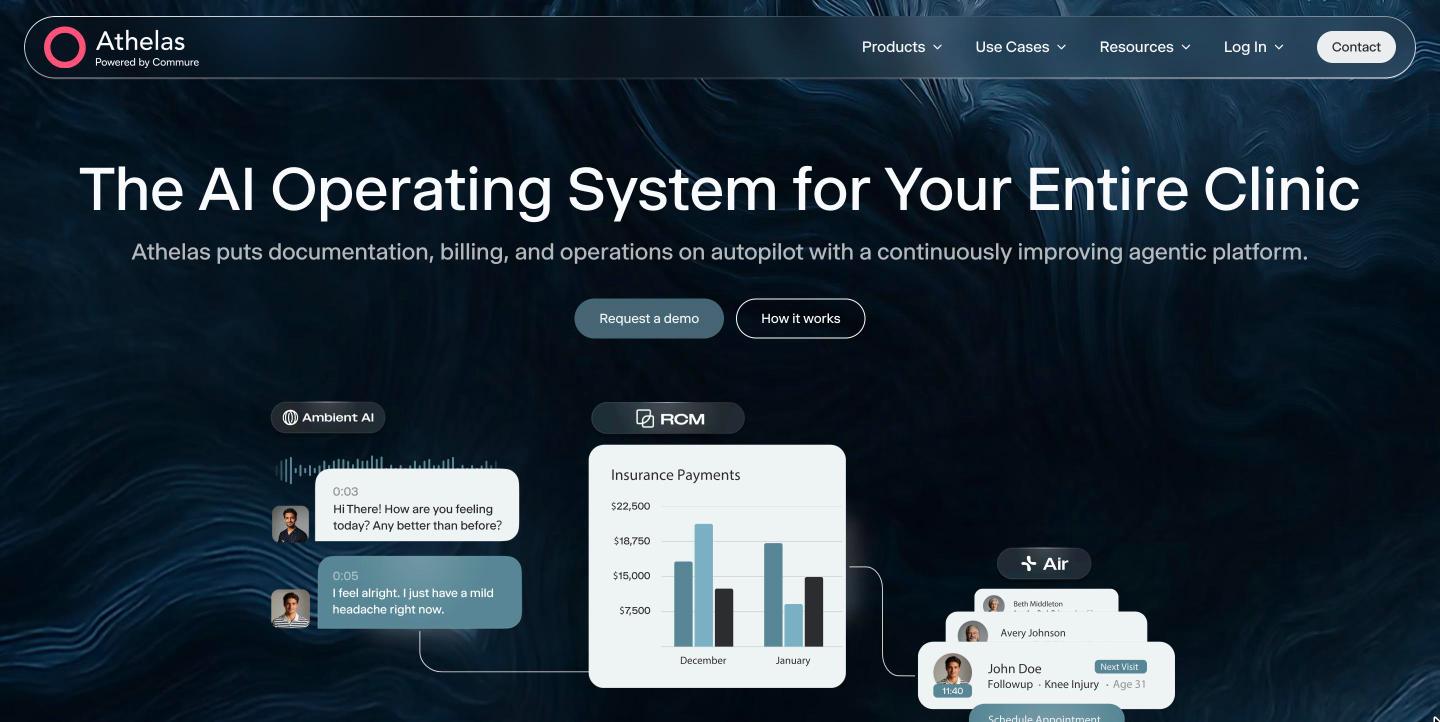
Practices that run billing on Athelas can ask its AI RCM Assistant about claims, balances, charges, payments, and encounters, and it explains denials and patient account details.
It also updates insurance, resubmits claims, and writes off balances from the same conversation.
| Best for | Practices and billing teams that already use Athelas for RCM |
| What it answers | Claims, balances, charges, payments, encounters, and denial explanations |
| What it does | Updates insurance, resubmits claims, and writes off balances |
| PHI and security | Not described on the reviewed page |
| Pricing | Not published |
| Limits | Works inside the Athelas platform only |
| Verified on | Nov 18, 2026 |
What stands out
Staff open the assistant from the page they’re already on in Athelas Insights, so a question about a claim starts from that claim.
Athelas or MindK?
Athelas fits when your billing already runs on its platform. MindK fits when your data sits in your own practice management (PM) system and billing tools and you don’t plan to switch.
3. TurboPT: Best for Therapy Practices
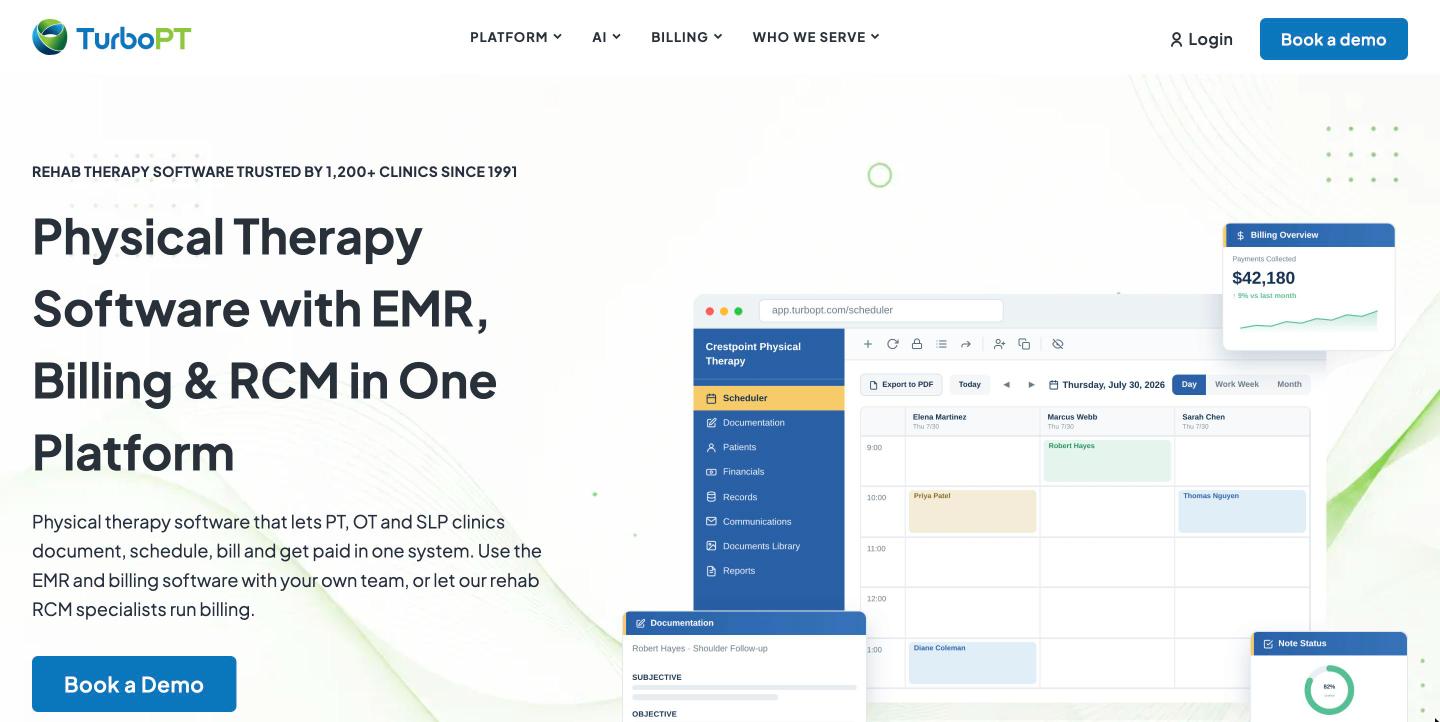
Physical therapy (PT), occupational therapy, and speech-language pathology practices on TurboPT can ask its Billing AI Assistant about claims, denials, electronic remittance advice (ERA), accounts receivable (A/R), payments, and payer performance, including why a payer denied a claim.
It shows the claims and remittances behind each figure and turns an answer into a saved, filterable report. Answers change by role, so the front desk, the office manager, and the owner each see what fits their job.
| Best for | PT, occupational therapy, and speech-language pathology practices |
| What it answers | Claims, denials, ERAs, A/R, payments, and payer performance |
| What it does | Saves answers as reports; role-based answers |
| PHI and security | HIPAA, Office of the National Coordinator for Health IT (ONC), and Payment Card Industry (PCI) certified (vendor-stated) |
| Pricing | On a separate pricing page |
| Limits | Doesn’t take actions in systems outside TurboPT |
| Verified on | Nov 18, 2026 |
What stands out
TurboPT keeps the full claim lifecycle in its own platform, so the assistant answers from claim data the vendor already holds.
TurboPT or MindK?
TurboPT fits a therapy practice that wants billing software and an assistant in one product. MindK fits a multi-location group that keeps its systems and wants the assistant to act across them.
Which AI Assistant Answers Revenue Cycle Analytics Questions?
R1 Revy answers finance questions in plain language on top of R1’s data. It explains the numbers; your team acts on them.
4. R1 Revy: Best for Enterprise Finance Teams
Finance teams on R1’s Phare platform can ask Revy natural-language questions about A/R, denials, cash flow, and more, such as which denials are growing the fastest. Revy answers with visuals and lets users drill down by payer, region, or facility.
It answers from governed R1 datasets, which gives revenue cycle analytics a single source that leaders can check.
| Best for | Enterprise finance and revenue teams, from CFOs to frontline staff |
| What it answers | A/R, denials, cash flow, A/R at risk, and work queue productivity |
| What it does | Surfaces insights for leaders to act on; takes no actions itself |
| PHI and security | Role-based access, PHI protection, and HIPAA-aligned controls (vendor-stated) |
| Pricing | Not published |
| Limits | Works on R1 data; the page doesn’t say whether non-R1 clients can use it |
| Verified on | Nov 18, 2026 |
What stands out
Revy logs each interaction and traces it to the data source behind it, which helps when a finance team has to defend a number.
R1 Revy or MindK?
Revy fits an organization that already works with R1. MindK fits a group that wants an assistant on its own data that can also hand work to other agents.
Which Healthcare AI Assistants Support Clinical Work?
Heidi, BastionGPT, and ChatGPT for Clinicians help clinicians write notes, review evidence, and draft documents. They sit next to the admin tools above and solve a different problem.
5. Heidi: Best for Ambient Notes and Visit Admin
Physicians, therapists, and health systems use Heidi as an ambient scribe: it listens to the visit, writes the note, and drafts the documents that follow, such as letters and patient recaps.
It also prepares morning briefs from patient history, keeps a digest of follow-ups promised in the room, and learns from the corrections a clinician makes to notes.
| Best for | Physicians, therapists, and health systems that want less charting time |
| What it answers | Clinical evidence questions |
| What it does | Writes visit notes, letters, patient recaps, and follow-up digests |
| PHI and security | HIPAA compliant, SOC 2 Type II attested, and ISO 27001 and ISO 42001 certified (vendor-stated) |
| Pricing | Free plan; demo for organizations |
| Limits | Clinical documentation; it doesn’t work billing or payer tasks |
| Verified on | Nov 18, 2026 |
What stands out
Heidi names Beth Israel Lahey Health and MaineGeneral Health among its users and features a physiotherapist in its customer stories, so therapy practices have a peer to ask.
Heidi or MindK?
They do different jobs. Heidi takes the note off the clinician’s plate; MindK takes billing questions and follow-ups off the admin team’s.
6. BastionGPT: Best for Behavioral Health Documentation
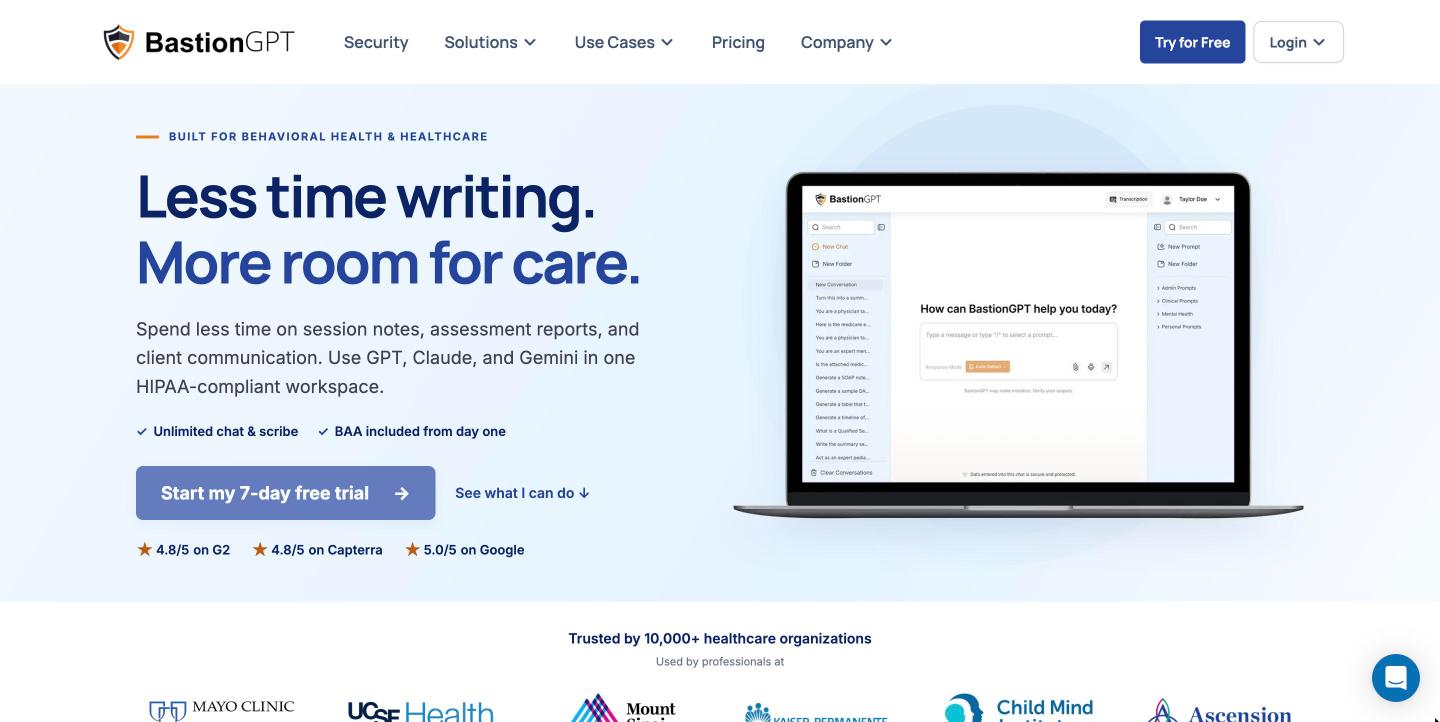
Behavioral health and other clinicians who want frontier models for PHI can work in BastionGPT, which picks among the latest GPT, Claude, and Gemini models for each clinical task. It drafts session notes, assessment reports, and client communication, and it summarizes long documents.
BastionGPT says customer data never trains AI models or gets sold, and the BAA covers the free trial too.
| Best for | Behavioral health clinicians and other providers who draft notes and reports |
| What it answers | Clinical questions |
| What it does | Session notes, transcription, and document summaries |
| PHI and security | Signed BAA included with each plan; AES-256 and TLS 1.3 encryption; third-party security testing |
| Pricing | From $20 per user a month, with a 7-day free trial |
| Limits | A clinical workspace; no billing system integration described |
| Verified on | Nov 18, 2026 |
What stands out
BastionGPT also covers PIPEDA in Canada and the Australian Privacy Principles, which helps groups with clinicians outside the US.
BastionGPT or MindK?
BastionGPT fits a clinician who wants a private model for notes. MindK fits the billing team that works the claims those notes lead to.
7. ChatGPT for Clinicians: Best Free Option for US Clinicians
Verified US physicians, nurse practitioners, physician assistants, and pharmacists can use ChatGPT for Clinicians free of charge for evidence review, documentation, and medical research. It drafts referral letters, prior authorization letters, and patient instructions.
Clinicians sign up with a valid National Provider Identifier (NPI) and a license that a third-party provider verifies, and an eligible individual can sign a BAA for the workspace.
| Best for | Individual US clinicians |
| What it answers | Evidence and research questions |
| What it does | Drafts documentation, referral and prior authorization letters, and patient instructions |
| PHI and security | BAA available to eligible individual clinicians; OpenAI advises against sharing PHI without one |
| Pricing | Free for verified US clinicians |
| Limits | Built for individual use; a team BAA requires ChatGPT for Healthcare |
| Verified on | Nov 18, 2026 |
What stands out
The price removes the trial barrier: a clinician can test it on a real week of documentation before the practice decides anything. Doximity GPT is the closest alternative: it’s also free for verified US clinicians and drafts prior authorization and appeal letters.
ChatGPT for Clinicians or MindK?
ChatGPT for Clinicians helps a physician write the prior authorization letter. The payer side of that request, from submission to follow-up, belongs to the tools in our prior authorization software comparison.
How Do You Choose a Healthcare AI Assistant?
Ask each vendor the same five questions, and bring a list of questions your team asked last month to the demo.
| Question for the vendor | Why it matters |
|---|---|
| Which data sources can the assistant read, and do we have to move onto your platform? | A platform switch turns an assistant purchase into a migration |
| Does each answer show the source records? | Your team has to trust a number before it acts on it |
| Which actions can it take, and which need approval? | Write-offs and resubmissions change revenue |
| What happens to patient identifiers before the AI model sees them? | Admin and clinical questions both touch PHI |
| Where does the team use it: inside your app or in Slack, email, or text? | An assistant in the tool people already open has a better chance of daily use |
Which Healthcare AI Assistant Should You Pick?
Pick MindK when you want an assistant on top of your own systems that can act and alert staff. Pick Athelas or TurboPT if your billing already runs on their platforms, R1 Revy for finance questions on R1 data, and Heidi, BastionGPT, or ChatGPT for Clinicians for clinical documentation.
MindK builds custom AI agents for healthcare billing teams. To scope an assistant for your own data, see MindK’s revenue cycle management development services.
FAQ: Healthcare AI Assistants
What is the best AI agent for healthcare teams?
The best AI agent software for healthcare organizations is the one built for your team’s daily work. Clinical teams save charting time with scribes such as Heidi, finance teams on R1 data ask Revy about cash flow, and billing teams need an agent that reads their own systems and acts on what it finds. MindK’s AI Billing Coworker covers that billing case: it answers questions on any data source the practice connects, creates invoices, and hands follow-ups to other agents.
What can healthcare AI agents automate?
Healthcare AI agents automate repeatable steps with clear rules, from visit notes and scheduling to eligibility checks, payer calls, and claim follow-up. MindK builds agents for the billing side of that work, including payer calls handled by its AI voice agent. Autonomous AI agents for RCM from vendors such as AKASA, Infinx, and Waystar appear in our AI RCM automation tools comparison.
Will AI replace medical billing and coding?
AI takes over repetitive lookups, reports, and routine tasks, while people keep judgment calls, appeals, and payer relationships. MindK designs its agents so a case goes to a person when automation can’t finish it.
Are healthcare AI assistants HIPAA compliant?
Only when the vendor signs a business associate agreement (BAA) for the plan you use and protects patient data on its side. Under HIPAA, a vendor that handles protected health information for a provider is a business associate, and the provider needs a written agreement with it. On this list, BastionGPT includes a BAA with each plan, and ChatGPT for Clinicians offers one to eligible individual clinicians. MindK’s Coworker anonymizes patient data before processing. Ask each vendor which plan the BAA covers and what happens to patient identifiers before the AI model sees them.
How much do healthcare AI assistants cost?
Clinical assistants publish prices more often than billing tools. ChatGPT for Clinicians and Doximity GPT are free for verified US clinicians, Heidi has a free plan with paid tiers per clinician, and BastionGPT lists plans from $20 to $75 per user a month. Billing and revenue cycle assistants such as MindK, Athelas, and R1 Revy price after a demo, because the cost depends on your data sources, actions, and volume.
How do healthcare AI agents integrate with EHRs?
Healthcare AI agents connect to an EHR in one of two ways: the EHR vendor builds them in, or they read the EHR and practice management (PM) system from outside through APIs and integrations. MindK takes the second route: its agents work on top of the systems a practice already runs and write results back into them.