We checked 11 healthcare software development companies against the questions that actually separate vendors: which healthcare software they have shipped and for which clients, which EHRs and standards they can back with a real project, who issued their certificates, whether they sign a BAA and what happens to PHI when their AI models run, and how many Clutch reviews stand behind their score.
TL; DRThe best healthcare software development company for you is one that has already delivered your type of project and can show the client behind it. Revenue cycle automation inside your current EHR – MindK, OSP Labs AI for clinical documentation and coding – Thinkitive Medical device software or SaMD – ScienceSoft, Itransition Extra developers under your own management – Chetu EHR integration and FHIR APIs – Mindbowser, Emorphis, Emids Patient-facing apps – Appinventiv, TATEEDA Specialty EHR/EMR, intake apps, and analytics platforms – MindK Before you sign, ask who issued each certificate and where the vendor’s AI models run. |
Open the service pages of most healthcare software development companies and you’ll see the same list: EHR, telehealth, HIPAA, AI. The list won’t tell you who fits your project, but delivery history does. So we sorted 11 firms, six of them headquartered in the US, by the projects they’ve shipped. All of them sell to US providers, payers, or healthtech companies.
For each one we went past the homepage: the healthcare pages, the Clutch profile, the name on each certificate, and any line about where patient data goes when AI is involved.
How We Evaluated Each Company
We checked every vendor against the same five questions and dated each check in its profile:
- What has it built for healthcare, and for whom? We looked for client names and numbers.
- Which EHRs and standards does it mention, and is there a client behind each one?
- Who issued its certificates? A badge with no issuer counts for less.
- Will it sign a business associate agreement (BAA), and what happens to protected health information (PHI) when its AI models run?
- How does it score on Clutch, how many reviews back that score, and how much of its work is medical?
MindK publishes this blog, so our own profile uses the same fields as the other ten, limits included.
Shortlist by Project Type
| Your project | Shortlist | Evidence we found |
|---|---|---|
| AI agents for payer calls and portals inside your current EHR | MindK, OSP Labs | Agents for eligibility, benefits, authorization, and claim status that write results back to your systems |
| Custom healthcare software on AI components already in production | MindK | Pre-built components adapted to your workflows and payers |
| AI for clinical documentation and coding | Thinkitive | Agents for SOAP notes, coding suggestions, and front-office work |
| Medical device software or SaMD under ISO 13485 | ScienceSoft, Itransition | Documented quality systems and FDA experience |
| Extra developers under your own management | Chetu | Dedicated teams and the lowest Clutch project minimum here |
| One product that connects to many EHRs | Mindbowser | Integration layer with 20+ EHR connections that runs in your cloud |
| FHIR APIs and CMS interoperability | Emorphis, Emids | Wide standards coverage and payer-side platform work |
| A patient app with a price range up front | Appinventiv | Published price tiers with timelines |
| A specialty EMR shaped around your workflows | MindK | Built the first EMR for lactation consultants (The Lactation Network) |
| A smaller US team for clinic or pharmacy apps | TATEEDA | San Diego office; clinic and pharmacy projects |
Common Challenges in Healthcare Software Projects and the Vendors That Address Them
| Project type | Common failure point | Read first |
|---|---|---|
| Revenue cycle automation | Agents handle simple payers and hand complex ones back to staff | Group A |
| Medical device software and SaMD | Design documentation that IEC 62304 and FDA submissions require | Group B |
| Multi-year modernization | Team capacity and continuity across product versions | Group B |
| EHR integration and FHIR APIs | Each EHR and payer API behaves differently in production | Group C |
| Patient apps and portals | Adoption drops when the app ignores clinic workflows | Group D |
| Specialty EHR/EMR | Generic EHRs miss specialty documentation and billing rules | Group A (MindK) and Group B |
Group A: Healthcare Software Development Companies for Revenue Cycle and Payer Automation
Choose from this group when your team spends its day on payer calls, portal checks, authorizations, and claim follow-up. These custom healthcare software development companies build AI agents that work inside your current systems and write results back to your EHR or practice management (PM) system. Our list of top RCM development companies compares RCM-focused firms in more depth.
A1. MindK: Custom Healthcare Software on Production-Tested AI Components
MindK builds custom healthcare software for US providers and healthtech companies, usually starting from AI components it has already built and tested. The team then fits each one to the client’s workflows, business rules, and security requirements. Past projects include specialty EHR/EMR systems, analytics platforms, revenue cycle automation solutions, and patient portals. MindK also runs its own RCM product and builds AI voice, chat, and provider portal navigation agents that work each case through to an answer.
| Best for | US specialty practice networks, regional hospital systems, and healthtech companies that need custom AI-native software or AI automation inside the systems they already run |
| What they build | Payer communication automation by voice, chat, and payer portal for eligibility, verification of benefits (VoB), prior authorization status, and claim status; specialty EHR/EMR; intake apps, and patient portals; software re-engineering projects |
| Healthcare focus | Medical is 70% of the Clutch focus; 4.9/5 from 20 reviews; 12+ years in healthcare |
| EHR and standards | Epic, Oracle Health, athenahealth, eClinicalWorks, MEDITECH, Veradigm, and NextGen; X12 270/271, 276/277, 278, 837, 835; FHIR, HL7 |
| Security | Signs a BAA; AWS-native builds |
| AI and PHI | An anonymizer depersonalizes PHI before minimum-necessary content reaches third-party models; re-linking happens in a secure environment. MindK can also deploy AI in isolation inside the client’s own environment |
| Pricing | Not published. Clutch minimum $25,000+, $50-99/hr. Middleware on existing systems: 3-5 months. Full RCM platform: 5-6 months to the first production release |
| Limits | No public SaMD or ISO 13485 portfolio. Clutch lists 50-249 employees, so large multi-year EHR programs fit Group B better. No public prior authorization case study. No self-serve subscription |
| Proof | The TLN EMR handles about 30,000 visits a month; MindK’s own RCM product has onboarded 300 practices |
| Verified on | Oct 15, 2026 |
What stands out
MindK builds next-generation healthcare software and middleware with AI at the core, instead of adding an LLM to a traditional SaaS product. Its work starts with AI agent development and also covers EHRs, interoperability, and patient-facing apps. Most projects share one aim: to take manual, error-prone work off staff, whether that’s a channel such as phone calls and chat or a full workflow such as verification of benefits.
Three things shape how MindK delivers. Its R&D lab keeps adding pre-built AI components, and the team proves them in its own products before using them for clients. Its AI SDLC speeds up prototyping and iteration 3-4x, while senior engineers own architecture, security, and releases. And as a product studio, MindK takes responsibility for product outcomes and quality. Consulting covers the full path, from data preparation to cost-effective scaling and responsible AI deployment.
The voice agent shows this approach in production: 12 agentic components and 69 capabilities, configured for 20 insurers. About 80% of it comes ready before a project starts, including handling for self-funded plans, long IVR menus, and portals that change without notice.
Look elsewhere if…
Your software diagnoses, treats, or monitors a condition. That usually brings FDA rules into play, and ScienceSoft (ISO 13485 certified) or Itransition (IEC 62304 experience) has the track record MindK doesn’t. If you need dozens of developers under your own management, Chetu and Appinventiv have larger benches. And if an off-the-shelf product already covers 90-95% of your process, custom automation won’t pay back.
A2. OSP Labs: AI Agents Across the Claims Cycle
OSP Labs aims its AI revenue cycle agents at RCM firms, billing companies, and providers with high claim volume. The agents check eligibility, put together prior authorization requests and follow them up, phone payers for claim status, and send denials to the right queue. OSP Labs says your current systems stay where they are.
| Best for | RCM firms, billing companies, and high-volume providers that want AI agents across the claims cycle |
| What they build | Agents for eligibility, prior authorization, claim scrubbing, claim status calls, denials and payment posting; payer calls, IVR navigation, and portal checks |
| Healthcare focus | Healthcare is the stated focus. The Clutch profile has no reviews yet and lists 20% medical |
| EHR and standards | Epic, Cerner, athenahealth, Change Healthcare, Availity, and Waystar via HL7 and FHIR APIs (vendor-stated) |
| Security | HIPAA-compliant workflows (vendor-stated); an ISO logo without details |
| AI and PHI | Describes PHI-safe data handling across agents; the reviewed page gives no detail on model providers or BAAs |
| Pricing | Not published |
| Limits | No Clutch reviews. Results on the reviewed page don’t name the client |
| Proof | 80% reduction in staff time on payer calls; 95%+ first-pass clean claim rate (vendor-stated) |
| Verified on | Oct 15, 2026 |
What stands out
One page covers the full claims cycle, from eligibility and prior authorization through denials and payment posting. OSP Labs also reports 70% faster denial resolution.
OSP Labs or MindK?
Both automate payer calls and portals around your existing systems. Ask each for a reference client with your payer mix and for the share of your workflow already built. With no Clutch reviews behind OSP Labs yet, that reference call carries extra weight.
A3. Thinkitive: Agents for Clinical Notes, Coding, and Scheduling
Thinkitive builds AI agents that draft SOAP notes and suggest ICD-10 and CPT codes. The same agents track prior authorizations, verify benefits, and run scheduling and call-center tasks.
| Best for | Practices and health systems that want AI agents for documentation, coding, and front-office work |
| What they build | SOAP note drafting, coding suggestions, prior authorization tracking, eligibility and benefits verification, scheduling and call-center agents |
| Healthcare focus | Medical is 80% of the Clutch focus; 4.8/5 from 3 reviews |
| EHR and standards | Epic, Oracle Health, athenahealth, and eClinicalWorks via HL7 and FHIR (vendor-stated) |
| Security | Signs BAAs; SOC 2 Type II and ISO 27001/42001 shown as badges |
| AI and PHI | Minimizes and encrypts PHI, limits access by role. and keeps audit logs; doesn’t say whether PHI reaches outside AI models |
| Pricing | Scoped after discovery; pilot, dedicated team, and staff augmentation models |
| Limits | Only 3 Clutch reviews. We couldn’t verify the client testimonials on the vendor’s page, so we left them out |
| Proof | 400+ healthcare experts and 250+ healthcare projects (vendor-stated) |
| Verified on | Oct 15, 2026 |
What stands out
Clinical documentation and front-office automation rarely come from one vendor on this list. Thinkitive does both.
Thinkitive or MindK?
If documentation and coding eat most of your clinicians’ time, Thinkitive is the closer match. When your staff still call complex payers after every eligibility check, MindK is the better fit.
Group B: Medical Device Software, SaMD, and Long Enterprise Programs
These medical software development companies suit projects where the software itself falls under FDA rules or where a program needs a large team for years. Their quality systems and regulatory experience come with more documentation than the rest of the list.
B1. ScienceSoft: A Verifiable ISO 13485 Quality System
ScienceSoft has worked in healthcare IT since 2005 and lists 750+ IT specialists. It plans FDA 510(k) submissions for software as a medical device (SaMD) and device software and signs a BAA with each client.
| Best for | Medical device companies, SaMD makers, and health systems that need regulated software and documentation |
| What they build | EHR, telemedicine, remote patient monitoring (RPM), digital therapeutics, SaMD |
| Healthcare focus | Medical is 45% of the Clutch focus; 4.8/5 from 43 reviews |
| EHR and standards | Describes EHR/EMR integration without naming specific systems |
| Security | ISO 13485:2016, ISO/IEC 27001:2022, ISO 9001:2015, and ISO/IEC 27701, issued by LL-C (Certification); signs a BAA |
| AI and PHI | No statement on the reviewed pages |
| Pricing | Published ranges: telemedicine $150,000-$400,000; EHR $120,000 to over $2,000,000; RPM or SaMD $200,000-$800,000+. Clutch $50-99/hr |
| Limits | The page gives two starting prices ($60,000 in the FAQ, $100,000 elsewhere). The page doesn’t name specific EHR integrations |
| Proof | AKLOS Health got a market-ready MVP in 6 months; an app for UNM Health Sciences Center aims to help 387,000+ older adults in New Mexico |
| Verified on | Oct 15, 2026 |
What stands out
ScienceSoft is the only company here that names the body behind its ISO certificates and points buyers to a portal where they can check them.
Best fit when…
Your software diagnoses, treats, or monitors a condition and will go through FDA review.
B2. Itransition: Medical Device and Lab Software Over Many Product Versions
Itransition reports 25+ years in healthcare IT. Its healthcare page lists expertise with FDA classes II and III and IEC 62304 classes A, B, and C.
| Best for | Medical device and lab companies that need a partner for multi-year product programs |
| What they build | EHR/EMR, medical device and lab software, pharma analytics, care management platforms |
| Healthcare focus | Medical is 15% of the Clutch focus; 4.9/5 from 42 reviews |
| EHR and standards | Specific EHRs not named on the reviewed page |
| Security | Expertise with IEC 62304 and OWASP principles; the healthcare page doesn’t list certificates held |
| AI and PHI | No statement on the reviewed page |
| Pricing | Not published. Clutch minimum $25,000+, $25-49/hr |
| Limits | Healthcare has the smallest share of Clutch focus on this list. Most case studies on the healthcare page don’t name the client |
| Proof | Medical equipment management software used by 400 blood centers, with 7 product versions over 10+ years (vendor-stated) |
| Verified on | Oct 15, 2026 |
What stands out
Seven product versions of the same blood center software over more than ten years show the continuity a device program needs.
Best fit when…
You run a device or lab product that will need new versions for a decade.
B3. Chetu: Dedicated Developers for Teams That Own the Scope
Chetu offers dedicated teams and on-demand medical software developers hired by language and framework. Its healthcare page covers EHR/EMR, RCM, telehealth, RPM, and pharmacy software and promises delivery in as little as 90 days.
| Best for | Organizations that want to extend an in-house engineering team and manage scope themselves |
| What they build | EHR/EMR, RCM, telehealth, hospital management, RPM, pharmacy |
| Healthcare focus | Clutch lists no medical share; 4.3/5 from 82 reviews |
| EHR and standards | EHR/EMR named generally; a Veradigm integration in portfolio titles |
| Security | Describes itself as HIPAA-aligned; no certifications named; no BAA statement |
| AI and PHI | General privacy safeguards; no detail on model providers |
| Pricing | Not published. Clutch minimum $10,000+ |
| Limits | The lowest Clutch average on this list. No certifications named |
| Proof | SASAdoctor telehealth app in Kenya reached 160,000 users |
| Verified on | Oct 15, 2026 |
What stands out
Chetu has the lowest Clutch minimum here ($10,000) and a developer pool of 1,000-9,999 employees.
Best fit when…
Your own architects and product managers will run the project, and you only need developers to fill the team.
Group C: Healthcare Interoperability Companies for EHR and Payer Data Exchange
Read this group if the hard part of your project is moving data between your product, EHRs, and payers. These healthcare interoperability companies also have payer-side deadlines to plan around: under CMS-0057-F, affected payers must offer FHIR-based APIs, with compliance dates generally starting January 1, 2027. MindK, profiled in Group A, also builds healthcare interoperability on HL7 and FHIR.
C1. Mindbowser: An EHR Connectivity Layer That Stays in Your Cloud
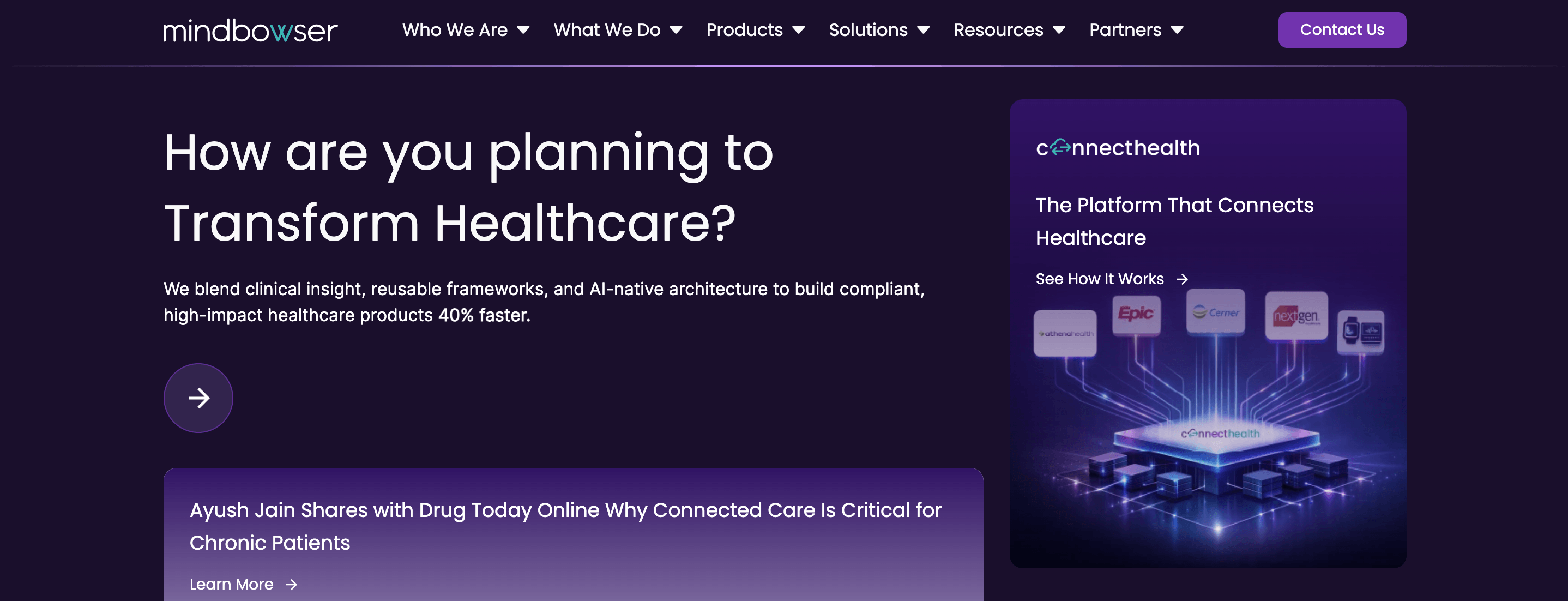
Mindbowser describes itself as a HealthTech consulting company. It sells ConnectHealth, an integration layer with connections to 20+ EHRs, builds SMART on FHIR apps, and partners with Medplum.
| Best for | Healthtech product companies that need to connect to many EHRs quickly |
| What they build | EHR integrations, SMART on FHIR apps, AI agents, digital health products |
| Healthcare focus | Presents itself as fully healthcare-focused; Clutch lists 20% medical; 4.9/5 from 6 reviews |
| EHR and standards | Epic, Oracle Cerner, athenahealth, eClinicalWorks, NextGen, OpenEMR, Open Dental |
| Security | Completed a SOC 2 Type II examination (auditor not named); the security page mentions DPAs, not BAAs |
| AI and PHI | ConnectHealth runs in the client’s cloud, so PHI stays in the client’s environment |
| Pricing | Not published; no licensing fees (vendor-stated) |
| Limits | Only 6 Clutch reviews. The case result we found doesn’t name the client |
| Proof | Dental eligibility verification automation cut admin work by 40% (vendor-stated) |
| Verified on | Oct 15, 2026 |
What stands out
Its answer on AI and PHI is concrete: the integration layer runs in your own cloud.
Best fit when…
You are building a product that has to work with many EHRs.
C2. Emorphis: Standards-Heavy Interoperability Work
Emorphis lists HL7 v2 and v3, FHIR R4 and R5, DICOM and CDA, and builds for USCDI data classes, SMART on FHIR launches, and bulk data export.
| Best for | Providers and healthtech companies building FHIR APIs, data exchange, and CMS or ONC compliance |
| What they build | Interoperability platforms, telemedicine, AI models for risk prediction and imaging |
| Healthcare focus | Medical is 50% of the Clutch focus; 4.9/5 from 13 reviews |
| EHR and standards | Epic, Cerner/Oracle Health, Allscripts, Athena |
| Security | Supports clients’ HITRUST, SOC 2 Type II, and ONC certification work without claiming to hold them; works to IEC 62304; uses BAA-covered cloud services |
| AI and PHI | The AI section doesn’t say how models handle PHI |
| Pricing | Not published. Clutch minimum $5,000+, $25-49/hr; first telemedicine release in 12-16 weeks |
| Limits | The only case study on the reviewed page doesn’t name the client |
| Proof | A multi-hospital system live across 14 facilities, with admin time down 38% (vendor-stated) |
| Verified on | Oct 15, 2026 |
What stands out
Emorphis lists the widest set of standards on this list, including bulk FHIR export for population health and payer data projects.
Best fit when…
Your project centers on FHIR APIs or data exchange.
C3. Emids: Payer and Provider Platforms Under CMS Mandates
Emids is based in Franklin, Tennessee, and reports 36+ years in healthcare. It implements payer core platforms and Epic, builds FHIR data exchange for CMS mandates and offers AI agents for prior authorization, claims, and clinical review.
| Best for | Payers and large health systems facing CMS interoperability deadlines |
| What they build | Payer core platforms, Epic implementation and managed services, FHIR interoperability, agentic AI |
| Healthcare focus | Clutch lists 100% medical; no reviews yet |
| EHR and standards | Epic |
| Security | Describes cloud services built for PHI security; no certifications listed on the homepage |
| AI and PHI | Describes governed agentic AI; no detail on model providers |
| Pricing | Not published |
| Limits | No Clutch reviews and no client-specific results on the homepage |
| Proof | 115+ million lives touched and 450+ platforms launched (vendor-stated) |
| Verified on | Oct 15, 2026 |
What stands out
It works on the payer platform and on the provider’s Epic system, so one team sees both ends of the data exchange.
Best fit when…
You are a payer, or a health system that needs Epic work and payer-facing APIs from one partner.
Group D: Healthcare App Development for Patients and Clinicians
Start here if patients or clinicians will use the product directly. This healthcare app development work centers on the screens people touch every day. For patient portals, also see MindK in Group A.
D1. Appinventiv: Patient Apps with Published Price Tiers
Appinventiv holds ISO 27001 and ISO 9001 certificates and reports 1,600+ developers and 500+ digital health builds. It is one of two vendors here that publish project prices.
| Best for | Organizations that want a patient-facing app with a price range before the first sales call |
| What they build | Patient apps, telemedicine, AI scribes and diagnostics, hospital communication tools |
| Healthcare focus | Medical is 25% of the Clutch focus; 4.6/5 from 90 reviews |
| EHR and standards | Epic and Cerner shown as logos; HL7, FHIR, ICD-10, LOINC, CPT |
| Security | ISO 27001 and ISO 9001; lists SOC 2 among standards it adheres to |
| AI and PHI | No BAA or AI and PHI statement on the reviewed page |
| Pricing | From $40,000-$80,000 (3-5 months) to $300,000-$500,000+ (10-18 months). Clutch minimum $50,000+, $25-49/hr |
| Limits | No BAA statement on the reviewed page. EHR logos appear without a description of the integrations |
| Proof | YouCOMM: 60% improvement in staff response time, deployed at 5+ major US hospital chains (vendor-stated) |
| Verified on | Oct 15, 2026 |
What stands out
You can estimate a budget from its six published tiers before the first sales call.
Best fit when…
You need a patient app and want price clarity early.
D2. TATEEDA: A US Team for Clinic, Pharmacy, and Data-Capture Apps
TATEEDA started in San Diego in 2013 and has made the Inc. 5000 list four times. It builds software for clinics, pharmacies, and clinical data capture.
| Best for | Mid-size providers and healthtech companies that want a smaller team with a California office |
| What they build | Clinic apps, pharmacy systems, e-data-capture forms, FHIR and HL7 integrations |
| Healthcare focus | Medical is 50% of the Clutch focus, plus 25% dental; 4.9/5 from 10 reviews |
| EHR and standards | Epic, Oracle Health, athenahealth, and NextGen shown as logos |
| Security | Cites HIPAA-compliant experience; no certifications or BAA statement |
| AI and PHI | Uses AI copilots for code under human supervision; no statement on PHI in models |
| Pricing | Not published. Clutch minimum $25,000+, $50-99/hr |
| Limits | No certifications claimed. Clutch lists the headquarters in Odesa, Ukraine, while the profile text says San Diego, so ask where your team will sit |
| Proof | For VisionTree, the team adjusts 40-50 e-data-capture forms every cycle |
| Verified on | Oct 15, 2026 |
What stands out
TATEEDA keeps up with apps that change every cycle, such as VisionTree’s clinical questionnaires.
Best fit when…
You need a mid-size clinic or pharmacy app with frequent changes.
Where MindK’s Healthcare Experience Comes From
MindK has 12+ years in healthcare. Medical work makes up 70% of its Clutch focus, where it holds 4.9/5 from 20 reviews. The four projects below show the range.
Specialty EMR. MindK built the EMR for The Lactation Network, the first one made for lactation consultants. It reads insurance documents with an AI parser at registration and handles about 30,000 visits a month.
Analytics platform re-engineering. For BIG Healthcare, a Canadian healthcare analytics firm, MindK rebuilt the platform as independent services with a new ETL pipeline, a Kimball data warehouse, per-tenant processing, MFA, and audit logging.
Candidate intake. The International Surrogacy Center screens surrogate candidates in an app MindK built. Candidates fill in 10+ surveys, rules flag medical history issues, and status changes sync with the CRM both ways.
Revenue cycle automation. MindK also runs its own RCM product for US medical practices, which has onboarded 300 practices. Ten specialists shipped the first production version in 5 months. That build showed where EDI stops: self-funded and complex plans go to portal agents and a voice agent, and an anonymizer depersonalizes PHI before minimum-necessary content reaches third-party models.
To scope a product or workflow inside your current systems, explore MindK’s healthcare software development services. If payer calls still fill your staff’s day, see how the AI voice agent handles payer calls.
FAQ: Choosing a Healthcare Software Development Partner
What is software development in healthcare?
It is the work of building and maintaining software for providers, payers, life sciences, and healthtech companies under HIPAA and, for some products, FDA rules. Most projects involve EHR integration, patient apps, revenue cycle automation, or device software. Many firms also automate the manual work around existing systems; our guide to RCM integration shows how that data moves.
What are the top healthcare app development companies?
On this list, Appinventiv and TATEEDA focus on patient-facing apps, and MindK builds intake apps and patient portals. Appinventiv publishes prices up front; TATEEDA fits mid-size clinic and pharmacy apps.
How do you choose a healthcare software development company?
Start with your project type and the matching group above. Then ask each vendor which client stands behind its EHR claims, who issued its certificates, where its AI models run, and how many of its reviews come from healthcare.
What does healthcare software development cost?
Published ranges vary widely. ScienceSoft publishes $150,000-$400,000 for telemedicine and $120,000 to over $2,000,000 for an EHR. Appinventiv’s tiers start at $40,000-$80,000 and reach $300,000-$500,000+. For automation on existing systems, MindK cites 3-5 months for middleware and 5-6 months to the first production release of a full RCM platform. Ask every vendor to quote the same scope in the same unit, so the numbers line up.
Will a healthcare software vendor sign a BAA?
Any vendor that handles PHI should. ScienceSoft, Thinkitive, and MindK say they sign one. Ask as well whether the vendor holds BAAs with its cloud and AI model providers. For HIPAA compliant software development, see MindK’s HIPAA compliance consulting.
How does CMS-0057-F affect what we build?
It changes the payer side first. CMS-0057-F requires Medicare Advantage, Medicaid, CHIP, and federal exchange plans to offer FHIR-based APIs, a Prior Authorization API among them. Most compliance dates start January 1, 2027. The rule doesn’t cover self-funded commercial plans, so staff will keep using their portals and phone lines. For deadlines and scope, read our CMS-0057-F breakdown.
Can AI software decide medical necessity?
No. Automation gathers coverage, benefits, and authorization requirements and routes cases. The medical necessity decision stays with clinicians and the payer.